

microteaching

Presentation
•
Science
•
12th Grade
•
Practice Problem
•
Easy

Phy Sics
Used 2+ times
FREE Resource
30 Slides • 20 Questions
1

2

3

4

5

6

7

8

9

10
Multiple Choice
It refers to the term used to describe a negative acceleration.
Acceleration
Deceleration
Reference Frame
Uniformly Accelerated Motion
11
Multiple Choice
It refers to the change in velocity with respect to time.
Acceleration
Deceleration
Reference Frame
Uniformly Accelerated Motion
12
Multiple Choice
It refers to the speed with direction.
Distance
Displacement
Speed
Velocity
13
Multiple Choice
It refers to the physical entity to which the position and motion of an object is relative.
Acceleration
Deceleration
Reference Frame
Uniformly Accelerated Motion
14
Multiple Choice
It is a scalar quantity which represents the total path length traversed by an object which is moving from one place to another.
Distance
Displacement
Speed
Velocity
15
Multiple Choice
It refers to the motion of a body if the acceleration is constant.
Acceleration
Deceleration
Reference Frame
Uniformly Accelerated Motion
16
Multiple Choice
It refers to the term used to indicate of how fast something is moving.
Distance
Displacement
Speed
Velocity
17
Multiple Choice
It is a vector quantity which represents the straight line distance between the starting and endpoints.
Distance
Displacement
Speed
Velocity
18
Multiple Choice
It is the friction or drag that acts on something moving through air.
Air resistance
Aristotle
Galileo Galilei
Gravity
19
Multiple Choice
It represents the symbol “g” and it is a constant. The standard value is
9.8 m/s^2
Air resistance
Aristotle
Galileo Galilei
Gravity
20
Multiple Choice
He mentioned that objects with different weights will fall at different rates with heavier objects falling faster than lighter objects.
Air resistance
Aristotle
Galileo Galilei
Gravity
21
Multiple Choice
He mentioned that in the absence of air resistance, all objects fall with the same constant acceleration, g = 9.8 m/s^2
Air resistance
Aristotle
Galileo Galilei
Gravity
22

23

24

25

26

27

28

29

30

31

32

33

34

35

36

37
Multiple Choice
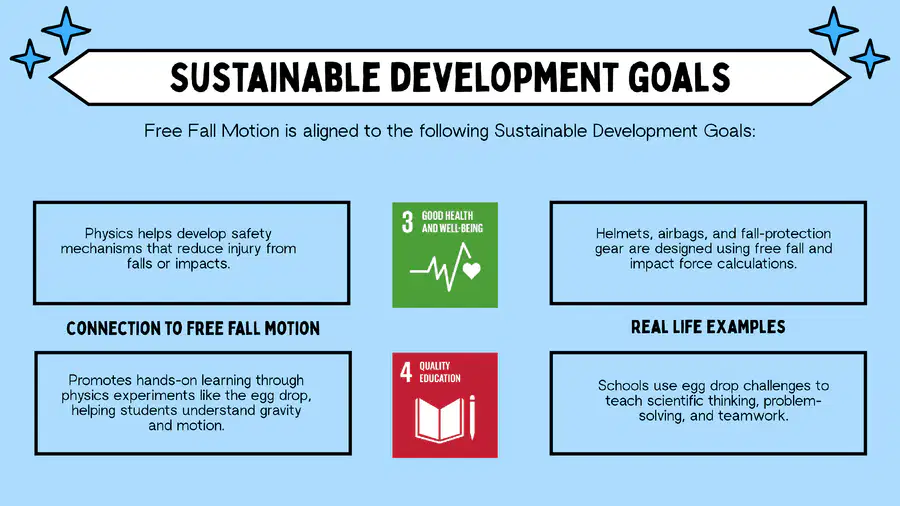
Promotes hands-on learning through physics experiments like the egg drop, helping students understand gravity and motion.
SDG 3: Good Health & Well-Being
SDG 4: Quality Education
SDG 9: Industry, Innovation, & Infrastructure
SDG 11: Sustainable Cities and Communities
38
Multiple Choice
Physics helps develop safety mechanisms that reduce injury from falls or impacts.
SDG 3: Good Health & Well-Being
SDG 4: Quality Education
SDG 9: Industry, Innovation, & Infrastructure
SDG 11: Sustainable Cities and Communities
39
Multiple Choice
Engineers use free fall calculations to design elevators, roller coasters, and crash safety systems
SDG 3: Good Health & Well-Being
SDG 4: Quality Education
SDG 9: Industry, Innovation, & Infrastructure
SDG 11: Sustainable Cities and Communities
40
Multiple Choice
Schools use egg drop challenges to teach scientific thinking, problem-solving, and teamwork.
SDG 3: Good Health & Well-Being
SDG 4: Quality Education
SDG 9: Industry, Innovation, & Infrastructure
SDG 11: Sustainable Cities and Communities
41
Multiple Choice
Understanding motion helps improve urban safety and resilience, especially in disaster-prone areas
SDG 3: Good Health & Well-Being
SDG 4: Quality Education
SDG 9: Industry, Innovation, & Infrastructure
SDG 11: Sustainable Cities and Communities
42
Multiple Choice
Helmets, airbags, and fall-protection gear are designed using free fall and impact force calculations
SDG 3: Good Health & Well-Being
SDG 4: Quality Education
SDG 9: Industry, Innovation, & Infrastructure
SDG 11: Sustainable Cities and Communities
43
Multiple Choice
In earthquake-prone zones, engineers apply gravity and motion principles to design buildings that withstand falling debris.
SDG 3: Good Health & Well-Being
SDG 4: Quality Education
SDG 9: Industry, Innovation, & Infrastructure
SDG 11: Sustainable Cities and Communities
44
Multiple Choice
Physics principles like free fall are essential in designing safe infrastructure and transportation systems.
SDG 3: Good Health & Well-Being
SDG 4: Quality Education
SDG 9: Industry, Innovation, & Infrastructure
SDG 11: Sustainable Cities and Communities
45
46

47
48
49
50

Show answer
Auto Play
Slide 1 / 50
SLIDE
Similar Resources on Wayground

40 questions
Class 12 EVS 2017 Paper
Presentation
•
12th Grade
47 questions
Commentary & Lines of Reasoning
Presentation
•
12th Grade
41 questions
Module 1 Reviewer
Presentation
•
11th Grade
49 questions
Momentum
Presentation
•
11th Grade
47 questions
CE 18 - Cryptography (EN)
Presentation
•
University
43 questions
AZ900
Presentation
•
12th Grade
42 questions
Media Convergence in the Digital Age
Presentation
•
12th Grade
44 questions
A level Animation 9626
Presentation
•
12th Grade
Popular Resources on Wayground
5 questions
A Home on the Shore

Quiz
•
3rd Grade
28 questions
US History Regents Review
Quiz
•
11th Grade
6 questions
A Horse Tale
Quiz
•
3rd Grade
20 questions
Math Review
Quiz
•
3rd Grade
10 questions
Juneteenth History and Significance

Interactive video
•
5th - 8th Grade
20 questions
Dividing Fractions
Quiz
•
5th Grade
55 questions
A Long Walk to Water Final Review
Quiz
•
6th - 8th Grade
10 questions
Equation Word Problems
Quiz
•
7th Grade
Discover more resources for Science
20 questions
Insurance
Quiz
•
9th - 12th Grade
10 questions
Juneteenth: History and Significance
Interactive video
•
7th - 12th Grade
6 questions
Mayan Mathematics part 1
Presentation
•
9th - 12th Grade
40 questions
Flags of the World
Quiz
•
KG - Professional Dev...
10 questions
Unit 9 Quiz
Quiz
•
9th - 12th Grade