

Electromagnetism

Presentation
•
Science
•
6th - 8th Grade
•
Practice Problem
•
Medium
+11
Standards-aligned

Barbara White
Used 24+ times
FREE Resource
16 Slides • 31 Questions
1

Middle School

2
Define open and closed circuits and identify their essential components.
Explain how electric and magnetic fields create forces that act at a distance.
Describe factors affecting the strength of electric and magnetic forces.
Model how an object's arrangement in a system affects its stored potential energy.
Identify applications of electromagnetism, such as in motors and generators.


3
Key Vocabulary

Circuit
A circuit is a complete and closed path through which electric current can flow continuously.

Conductor
A conductor is a material, like copper, that allows electric current to pass through it easily.

Insulator
An insulator is a material, such as wood, that prevents the flow of electric current.

Electric Current
Electric current is the rate of flow of electric charge, measured in units called amperes.

Electromagnet
An electromagnet is a temporary magnet created when an electric current flows through a wire coil.

Electric Field
An electric field is the area around a charged particle that exerts a force on others.
4
Key Vocabulary

Magnetic Field
A magnetic field is a region around a magnet that exerts a force on other magnets.

Potential Energy
Potential energy is the stored energy an object has due to its position or state.
5
What is an Electric Circuit?
A simple circuit needs three parts: an energy source, a path, and a device.
For electricity to flow, the circuit must be a complete or closed path.
Wires must have exposed metal at contact points to conduct the electricity.
An open circuit has a break, so electricity cannot flow and power devices.

6
Multiple Choice
What is the main requirement for an electric current to flow through a circuit?
A complete and unbroken path
At least two lightbulbs
A path made of a flexible material
A single point of contact
7
Multiple Choice
What is the relationship between a break in a circuit and a connected device like a lightbulb?
A break stops the flow of electricity, causing the device to not work
A break increases the flow of electricity, making the device brighter
A break reverses the flow of electricity, causing the device to work differently
A break has no effect on the flow of electricity or the device
8
Multiple Choice
A student assembles a circuit with a battery, metal wires, and a lightbulb, but the bulb does not light up. What is the most likely conclusion?
The circuit is open because of a break in the path
The battery is not a required component for the circuit
The metal wires are preventing the flow of electricity
The circuit needs a second energy source to work
9
How an Incandescent Lightbulb Works
An incandescent lightbulb makes light by heating a thin filament with electricity.
A complete circuit runs from the base, through the filament, to the casing.
Thomas Edison and Lewis Latimer used a durable, carbon-coated cotton filament.
They sealed the filament in a glass bulb with the air removed.


10
Multiple Choice
What is the main way an incandescent lightbulb produces light?
By heating a thin filament with electricity
By creating a chemical reaction in a gas
By using magnets to generate a field
By capturing and storing solar energy
11
Multiple Choice
What is the primary purpose of having a complete circuit in the lightbulb?
To allow electricity to flow and heat the filament until it glows
To hold the glass bulb in place
To make the filament more durable
To remove the air from inside the bulb
12
Multiple Choice
Based on the design of the lightbulb, what would most likely happen if the glass bulb were to crack and let air inside while it was on?
The hot filament would quickly burn out when it reacts with the air.
The light produced would become much brighter.
The electricity would stop flowing through the circuit.
The filament would become more durable.
13
Modern Lighting Technology

Incandescent Bulbs
These bulbs create light by heating a small wire called a filament.
The heated filament glows brightly to produce the light that we see.
A large amount of electrical energy is wasted, escaping as heat.

Fluorescent Lamps (CFLs)
An electric current passes through a gas inside the bulb to work.
The excited gas inside the lamp then starts to glow brightly.
They use 70% less energy than older incandescent bulbs.

LED Bulbs
This technology is very energy efficient, creating very little wasted heat.
They are very bright and can last for an extremely long time.
They contain no toxic chemicals, making them safer for the environment.
14
Multiple Choice
How do incandescent light bulbs produce light?
By passing electricity through a gas
By heating a wire filament until it glows
By using chemicals that are safe for the environment
By converting light directly into energy
15
Multiple Choice
What is a primary advantage of fluorescent lamps (CFLs) when compared to incandescent bulbs?
They work by heating a small wire filament.
They use less electrical energy to produce the same amount of light.
They last for a much shorter amount of time.
They are safer for the environment because they contain no gas.
16
Multiple Choice
A city plans to install new streetlights that must be very long-lasting and have the smallest negative impact on the environment. Which lighting technology is the best choice based on these requirements?
Incandescent bulbs, because they produce the brightest light by heating a filament.
Fluorescent lamps (CFLs), because they excite a gas to glow brightly.
LED bulbs, because they are highly energy-efficient and do not contain toxic chemicals.
Any bulb will work, as they all produce light in the same way.
17
Static Electricity
Static electricity is an electric charge that is not moving, but stays in one place.
Rubbing a balloon on your hair can create a static charge, making it stick to walls.
A very large and powerful discharge of static electricity is what causes lightning to occur.

Current Electricity

Electric current is an electric charge that is actively moving or flowing from one point to another.
An electric current requires a complete, unbroken path, called a circuit, in order to flow properly.
The electricity that powers all of the lights and devices in your home is electric current.
18
Multiple Choice
What is the primary difference between static electricity and current electricity?
Static electricity stays in one place, while current electricity moves.
Static electricity is used to power homes, while current electricity causes lightning.
Static electricity requires a circuit, while current electricity does not.
Static electricity is safe, while current electricity is dangerous.
19
Multiple Choice
What is a key requirement for current electricity to power a device like a light bulb?
It requires a complete and unbroken path to flow.
It can be created by rubbing two objects together.
It is a type of charge that stays in one place.
It is responsible for creating lightning strikes.
20
Multiple Choice
A string of holiday lights is designed so that if one bulb burns out, the entire string goes dark. Based on the principles of electricity, what is the best explanation for this?
The burned-out bulb creates a break in the circuit, stopping the flow of current.
The other bulbs are drained of their static electricity.
The burned-out bulb uses up all the electricity from the outlet.
The flow of electricity reverses direction and returns to the source.
21
Inside a Battery
Batteries convert stored chemical energy into electrical energy when connected to a complete circuit.
A battery contains a positive terminal, a negative terminal, and a chemical electrolyte inside.
A chemical reaction releases electrons that flow from the negative to the positive terminal.

Types of Batteries

Disposable batteries stop working when the chemicals inside the electrolyte are completely used up.
Rechargeable batteries, like lithium-ion batteries, can be recharged and used hundreds of times.
Their chemical reaction is reversible by connecting the battery to an external electrical source.
22
Multiple Choice
What is the primary function of a battery?
To convert chemical energy into electrical energy
To store electricity directly from an outlet
To create new chemicals using electricity
To generate power from heat or light
23
Multiple Choice
How does a battery create a flow of electrons in a circuit?
A chemical reaction releases them to flow from the negative to the positive terminal.
The electrolyte pushes them out of the positive terminal toward the negative one.
They are pulled from the complete circuit into the battery's positive terminal.
The battery gets hot, which causes the electrons inside to start moving.
24
Multiple Choice
What is the fundamental difference that allows a rechargeable battery to be used again while a disposable one cannot?
The chemical reaction in a rechargeable battery is reversible.
Rechargeable batteries have much larger positive and negative terminals.
Disposable batteries completely run out of electrons to release.
Rechargeable batteries are made with more powerful electrolytes.
25
What Is Electromagnetism?
In 1820, Hans Christian Ørsted found electric currents create magnetic fields.
This relationship between electricity and magnetism is called electromagnetism.
Coiling a wire with current flowing through it creates a stronger magnetic field.
Wrapping the coil around an iron core creates a simple, temporary electromagnet.


26
Multiple Choice
What is electromagnetism?
The relationship between electricity and magnetism
A type of permanent magnet found in nature
The flow of electricity through a wire
The force that pulls objects toward Earth
27
Multiple Choice
Based on Hans Christian Ørsted's discovery, how can the magnetic field created by an electric current be made stronger?
Using a much shorter wire
Coiling the wire carrying the current
Decreasing the electric current
Removing the iron core from the coil
28
Multiple Choice
A simple electromagnet is built by wrapping a wire coil around an iron core and passing a current through the wire. What is the most likely outcome if the electric current is turned off?
The iron core will become a permanent magnet.
The iron core will lose its magnetic field because the electric current is gone.
The wire coil will get hotter but remain magnetic.
The magnetic field will reverse its direction.
29
Electric Fields
An electric field is a region of space surrounding an electrically charged object.
This field exerts a force on other charged objects that come near it.
The field is invisible but can be mapped by its effect on a test charge.

Magnetic Fields

A magnetic field is an area around a magnet or an electric current.
This field exerts a force on other magnets or magnetic materials placed within it.
You can map a magnetic field by observing its effect on a compass needle.
30
Multiple Choice
What is the main characteristic of both electric and magnetic fields?
They are regions where a force is exerted on certain objects.
They are visible patterns created by electric currents.
They can only be created by permanent magnets.
They only affect objects that are also moving.
31
Multiple Choice
What is the key difference in how electric and magnetic fields exert a force?
An electric field acts on charged objects, while a magnetic field acts on magnetic materials.
An electric field is invisible, while a magnetic field can be seen.
An electric field is mapped with a compass, while a magnetic field is mapped with a test charge.
An electric field is created by a current, while a magnetic field is created by a stationary charge.
32
Multiple Choice
If you detect an invisible force in an area, what is the best method to determine if it is an electric or a magnetic field?
Use a compass to see if it moves, and then use a charged object to see if it is affected.
Measure the size of the field, as electric fields are always larger than magnetic fields.
Place a small light bulb in the area to see if it lights up.
Assume it is an electric field, as they are created by charged objects.
33
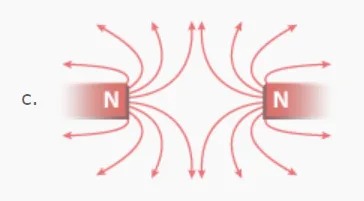
Potential Energy in Fields
A system of objects can have stored energy, called potential energy.
This energy changes when the position of the objects changes.
Pulling attracting magnets apart increases the potential energy in their field.
Pushing repelling magnets together also increases their potential energy.

34
Multiple Choice
What is potential energy?
Energy stored in a system of objects based on their position
Energy that an object has because of its motion
Energy that is created when magnets get hot
Energy that is lost when objects move
35
Multiple Choice
Under what condition does the potential energy in a system of objects change?
When the position of the objects in the system changes
When the objects start to glow
When the temperature of the objects increases
When the objects stop moving completely
36
Multiple Choice
Which of the following actions would cause the potential energy stored in a magnetic field to decrease?
Allowing two attracting magnets to move closer together
Pushing two repelling magnets closer together
Pulling two attracting magnets farther apart
Lifting a single magnet off a table
37
Applications
The telegraph used an electromagnet to transmit messages across long distances.
Speakers use electromagnets to make a cone vibrate, which creates sound waves.
Headphones also use an electromagnet to turn electric signals into the sounds we hear.

Force Factors

Increasing the electric current or the number of wire coils boosts the magnet's force.
The force is significantly stronger when the interacting objects are closer together.
Changing the orientation of a magnet can change the force from attractive to repulsive.
38
Multiple Choice
What determines the strength of an electromagnet's force?
By increasing the number of wire coils or the electric current.
By decreasing the distance between the magnet and an object.
By changing the orientation of the magnet from attractive to repulsive.
By using it in applications like speakers and telegraphs.
39
Multiple Choice
How does an electromagnet in a speaker help to create sound?
The electromagnet transmits messages across long distances.
The electromagnet changes its orientation to create sound.
The electromagnet vibrates a cone, which produces sound waves.
The electromagnet increases its electric current to get louder.
40
Multiple Choice
An engineer is building a telegraph to send messages over a very long distance, but the signal is too weak. What should the engineer do to increase the force of the electromagnet and make the signal stronger?
Increase the number of wire coils and the electric current.
Move the interacting objects farther apart.
Use the electromagnet in a headphone instead of a telegraph.
Change the orientation of the magnet to make it repulsive.
41
Superconducting Magnets
Superconducting magnets are powerful electromagnets cooled to extremely low temperatures (around –269°C).
At these temperatures, wires become superconducting, carrying current with no energy loss.
This allows them to generate incredibly intense magnetic fields.
They are used in MRI machines and high-speed maglev trains.


42
Multiple Choice
What is a defining characteristic of a superconducting magnet?
They are cooled to extremely low temperatures to function.
They are a type of permanent magnet found in nature.
They operate best at very high temperatures.
They generate weak, temporary magnetic fields.
43
Multiple Choice
Why is it significant that the wires in these magnets become 'superconducting'?
It causes the magnet to become very hot.
It allows electrical current to flow with no energy loss.
It makes the wires brittle and easy to break.
It stops the flow of electricity completely.
44
Multiple Choice
If the cooling system of a maglev train's superconducting magnet were to fail, what would be the most likely outcome?
The magnet's powerful magnetic field would collapse.
The magnet would become a permanent magnet.
The magnet would generate even more energy.
The maglev train or MRI machine would speed up.
45
Misconception | Correction |
|---|---|
Electricity gets 'used up' by a lightbulb. | Electrical energy is converted into light and heat, not used up. |
Any copper wire is magnetic. | A copper wire is only magnetic when an electric current flows through it. |
Magnetic fields are visible lines. | Magnetic fields are invisible forces that can be mapped to show their effects. |
A battery is full of electricity. | A battery stores chemical energy and converts it to electrical energy. |
46
A complete circuit needs a path and an energy source, like a battery.
Electric and magnetic forces act through fields, which store potential energy.
Electromagnet strength depends on current, coil number, and distance from the magnet.
Electromagnets are essential in speakers, MRI machines, and maglev trains.
47
Poll
On a scale of 1-4, how confident are you about the concepts covered in today's review?
1
2
3
4
Middle School
Show answer
Auto Play
Slide 1 / 47
SLIDE
Similar Resources on Wayground

40 questions
Phase Change @Home Lesson 4 Slides part 2
Presentation
•
6th - 8th Grade
39 questions
Review for Benchmark!
Presentation
•
6th - 8th Grade
43 questions
Newton's 3rd Law
Presentation
•
6th - 8th Grade
43 questions
Fossil Fuels
Presentation
•
5th - 9th Grade
43 questions
Earthquakes
Presentation
•
6th - 8th Grade
42 questions
Research Skills
Presentation
•
6th - 8th Grade
42 questions
Civil War Battles
Presentation
•
6th - 8th Grade
47 questions
Understanding Plate Tectonics
Presentation
•
6th - 8th Grade
Popular Resources on Wayground
10 questions
How much do you know about our Portrait of an Eagle?

Quiz
•
10th Grade
10 questions
Fast Food Slogans
Quiz
•
6th - 8th Grade
21 questions
Continents and Oceans
Quiz
•
6th Grade
20 questions
Parts of Speech
Quiz
•
5th Grade
16 questions
Subject & Predicate
Quiz
•
5th Grade
25 questions
Multiplication Facts
Quiz
•
5th Grade
12 questions
Map Skills
Quiz
•
3rd Grade
22 questions
Continents and Oceans
Quiz
•
5th Grade
Discover more resources for Science
17 questions
7.6D Aqueous Solutions
Quiz
•
7th Grade
20 questions
Scientific Method and Variables
Quiz
•
8th Grade
20 questions
Scientific method and variables
Quiz
•
8th Grade
27 questions
Counting Atoms - Subscripts
Quiz
•
8th Grade
10 questions
6.6D - Relative Density Review
Quiz
•
6th Grade
20 questions
Claim, Evidence and Reasoning (CER)
Quiz
•
6th - 8th Grade
18 questions
Counting Atoms
Quiz
•
7th - 8th Grade
20 questions
Density
Quiz
•
6th Grade