

Orbits and New Worlds

Presentation
•
Science
•
6th - 8th Grade
•
Practice Problem
•
Hard
+1
Standards-aligned

Barbara White
FREE Resource
11 Slides • 16 Questions
1

Orbits and New Worlds
Middle School

2
Learning Objectives
Define exoplanets and explain main challenges scientists face when detecting them.
Describe the Wobble Method and Transit Method used to locate distant exoplanets.
Explain that gravitational interactions are always attractive and depend on object masses.
Define the habitable zone and discuss why it matters when searching for life.


3
Key Vocabulary

Exoplanet
An exoplanet is a planet that orbits a star located outside of our solar system.

Barycenter
The barycenter is the shared center of mass around which a star and its planet orbit.

Doppler Shift
This is the change in light wavelength as a star moves closer or farther away from us.

Transit
A transit occurs when a planet passes directly in front of its star, blocking some light.

Habitable Zone
This is the specific region around a star where liquid water could potentially exist on a planet.

Wobble Method
The wobble method helps find exoplanets by observing a star's movement caused by a planet's gravity.
4
Key Vocabulary

Light-Year
A light-year is the very large distance that light can travel in one single year.

Gravitational Force
Gravitational force is the attractive force that exists between any two objects that have mass.

Mass
Mass is the scientific measure of the total amount of matter contained within an object.

System Model
A system model is a representation of a group of interacting parts, like a planet.
5
The Challenge of Finding Exoplanets
An exoplanet is a planet that orbits a star other than our Sun.
Thousands of these distant worlds have now been confirmed by scientists.
Their extreme distance makes them too small to be seen with telescopes.
The star's bright light also overpowers the faint light of the planet.

6
Multiple Choice
What is an exoplanet?
A planet that orbits a star other than our Sun.
A moon that orbits a planet in our solar system.
A small star found in a distant galaxy.
Any planet, including Earth and Mars.
7
Multiple Choice
Why is it so challenging to find exoplanets?
They are very far away and are hidden by the bright glare of their star.
They move too quickly to be tracked and are made of dark materials.
They do not reflect any light and are always smaller than moons.
They are only found in galaxies that are very different from our own.
8
Multiple Choice
Under which of the following conditions would an exoplanet be easiest to find?
A large planet orbiting a dim star that is relatively close to us.
A small planet orbiting a very bright star that is far away.
A planet that is the same size as Earth orbiting a distant star.
A gas giant planet hidden behind the glare of a massive, bright star.
9
Gravity: The Universal Force
All objects with mass pull on each other through gravity.
Greater mass means a stronger gravitational pull.
Earth's huge mass keeps you firmly on the ground.
10
Multiple Choice
Which statement best describes the force of gravity?
It is a pull that exists between any two objects that have mass.
It is a force that only exists on planet Earth.
It is a force that pushes objects away from each other.
It is a pull that only affects very large objects like planets.
11
Multiple Choice
What happens to the force of gravity when the mass of an object increases?
The gravitational pull becomes stronger.
The gravitational pull becomes weaker.
The gravitational pull disappears completely.
The gravitational pull does not change.
12
Multiple Choice
The Moon has significantly less mass than Earth. Based on this fact, what is the most likely outcome if an astronaut tries to jump on the Moon?
The astronaut would be able to jump much higher than on Earth.
The astronaut would be unable to float at all.
The astronaut would be pulled to the ground with more force than on Earth.
The astronaut's mass would be much greater on the Moon.
13
The Wobble Method: A Gravitational Dance
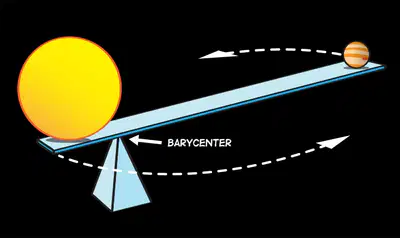
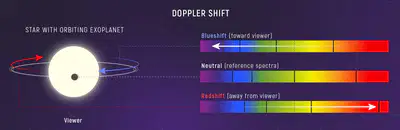
A planet's gravity causes its star to move in a small, circular "wobble".
The star and planet orbit a common center of mass called the barycenter.
This wobble creates a detectable Doppler shift in the star's light.
A more massive planet creates a larger, more easily detected wobble.
14
Multiple Choice
What causes a star to move in a small, circular 'wobble'?
The gravitational pull of an orbiting planet.
The star's own rotation on its axis.
Changes in the star's brightness over time.
The explosion of a nearby star.
15
Multiple Choice
What is the relationship between a star's wobble and the light astronomers observe?
The wobble makes the star appear to twinkle more.
The wobble causes the star to become hotter.
The wobble causes a predictable shift in the star's light.
The wobble makes the planet visible through a telescope.
16
Multiple Choice
If two planets are orbiting the same star, which one would be more easily discovered through the wobble method and why?
The more massive planet, because it will cause a larger and more noticeable wobble.
The less massive planet, because it will orbit the star at a much faster speed.
The more massive planet, because it will block more of the star's light.
The less massive planet, because its gravity will have less effect on the star.
17
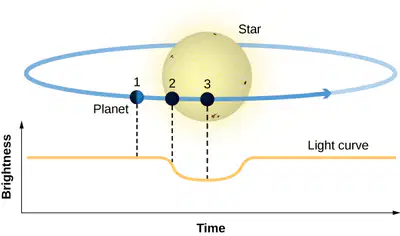
The Transit Method: A Cosmic Blink
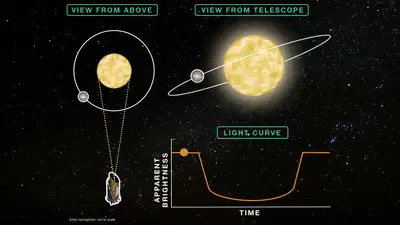
A transit occurs when an exoplanet passes in front of its star.
This pass blocks starlight, causing the star to briefly dim or “blink.”
A larger planet blocks more light, creating a bigger dip in brightness.
The time between transits reveals the planet’s orbital period, or year.
18
Multiple Choice
What happens during the transit of an exoplanet?
The planet passes in front of its star, causing the star to dim.
The star passes in front of its planet, making the planet brighter.
The planet absorbs all of the star's light permanently.
The star sends a bright flash of light toward the planet.
19
Multiple Choice
What is the relationship between the size of an exoplanet and the brightness of its star during a transit?
A larger planet blocks more light, causing a bigger dip in brightness.
A smaller planet blocks more light, causing a bigger dip in brightness.
The planet's size has no effect on the star's brightness.
A larger planet makes the star appear brighter during a transit.
20
Multiple Choice
Astronomers observe a star dimming in a repeating pattern every 400 Earth days. What can they conclude from this information?
The planet is very large.
The planet is very small.
The planet has an orbital period of 400 days.
The star is much hotter than the Sun.
21
The Search for Life: The Habitable Zone
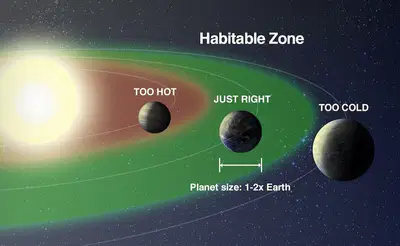
The search for life focuses on planets in their star's habitable zone.
This is the orbital range where a planet could have liquid water.
Transit data helps estimate a planet’s size, orbit, and probable surface temperature.
22
Multiple Choice
What defines a star's habitable zone?
It is the orbital range around a star where a planet could have liquid water.
It is a method for measuring the dimming of a star.
It is the area in space where stars are most commonly found.
It is a planet that has a confirmed atmosphere and clouds.
23
Multiple Choice
How is the transit method used to learn about a planet?
By measuring how a star's light dims, which helps determine a planet's size and orbit.
By sending a probe to land on the planet's surface.
By analyzing the color of the star to see what it is made of.
By directly photographing the planet's oceans and continents.
24
Multiple Choice
Scientists use the transit method to find a planet and calculate that its surface temperature could allow for liquid water. What is the most reasonable conclusion they can draw?
The planet is a good candidate for being in the habitable zone.
The planet is guaranteed to have life on it.
The planet must be a gas giant like Jupiter.
The star is about to run out of fuel.
25
Common Misconceptions
Misconception | Correction |
|---|---|
We can take direct pictures of exoplanets. | Exoplanets are too small and far to be seen directly with telescopes. |
Gravity is a force that only pushes things down. | Gravity is an attractive force between any two objects that have mass. |
Finding an exoplanet means we have found alien life. | Only some exoplanets are in the 'habitable zone' where liquid water can exist. |
Any dip in a star's brightness is a planet transit. | A planet's transit must be a consistent and periodic dip in the star's brightness. |
26
Summary
Exoplanets are planets outside our solar system, found using indirect methods.
The Wobble Method detects a star moving from a planet's gravitational pull.
The Transit Method detects a star dimming when a planet passes in front.
Data reveals a planet’s size, orbit, and if it is in the habitable zone.
27
Poll
On a scale of 1-4, how confident are you about the concepts covered in today's review?
1
2
3
4
Orbits and New Worlds
Middle School
Show answer
Auto Play
Slide 1 / 27
SLIDE
Similar Resources on Wayground

21 questions
Recognizing Newton's 3 Laws
Presentation
•
6th - 8th Grade
21 questions
Scientific theory vs Law
Presentation
•
6th - 8th Grade
22 questions
STEMScopedia - Heat and Matter
Presentation
•
6th - 8th Grade
22 questions
The Water Cycle
Presentation
•
6th - 8th Grade
22 questions
Waves
Presentation
•
6th - 8th Grade
20 questions
Plate Tectonics
Presentation
•
6th - 8th Grade
20 questions
Punnett Square Review
Presentation
•
6th - 8th Grade
20 questions
Solar System
Presentation
•
6th - 8th Grade
Popular Resources on Wayground
24 questions
PBIS-HGMS Day 10

Quiz
•
6th - 8th Grade
10 questions
HCS SCI 03 Summer School Review 3
Quiz
•
3rd Grade
11 questions
Home Scope
Quiz
•
7th - 8th Grade
15 questions
HCS SCI 05 Summer School Assessment 3 Review
Quiz
•
5th Grade
35 questions
Lufkin Road Middle School Student Handbook & Policies Assessment
Quiz
•
7th Grade
18 questions
Geo 11.3 Area of Circles and Sectors
Quiz
•
9th - 11th Grade