

Lymphatic and Immune Systems SM1

Presentation
•
Science
•
12th Grade
•
Practice Problem
•
Easy
Standards-aligned

Adam Lucas
Used 7+ times
FREE Resource
42 Slides • 27 Questions
1

2

3
Open Ended
Describe the main components of the lymphatic system and their roles in supporting the immune system.
4
Multiple Choice
Why is the lymphatic/immune system important for the human body?
It helps transport oxygen to tissues
It helps transport immune system structures and supports immunity
It produces digestive enzymes
It regulates body temperature
5

6
Multiple Choice
Which of the following is NOT a function of the lymphatic system?
Produce, maintain, and distribute lymphocytes
Maintain normal blood volume by returning excess tissue fluids
Transport hormones, nutrients, and waste products
Produce red blood cells
7

8
Multiple Select
Which of the following are components of the lymphatic system?
Interstitial fluid (lymph)
Lymphatic vessels
Lymph nodes
Red bone marrow
9

10
Fill in the Blanks
As soon as the interstitial fluid enters the lymph capillaries, it is called
11

12

13
Open Ended
Explain how the lymphatic system helps maintain normal blood volume and pressure. Use information from both the interstitial fluid and lymphatic vessel slides.
14
Multiple Choice
What prevents lymph from leaving the lymphatic vessel once it has entered?
Blood pressure
One-way valve formed by overlapping capillary wall cells
Smooth muscle contraction
Gravity
15

16
Multiple Choice
Which region is NOT a superficial region where lymph nodes are found on each side of the body?
Inguinal (groin)
Axillary (armpit)
Cervical (neck)
Popliteal (behind the knee)
17

18
Multiple Choice
Which of the following is NOT a function of the tonsils?
Filtering blood for pathogens
Providing protection against pathogens entering through the nose or mouth
Being clusters of lymphatic tissue under mucous membranes
Protecting against harmful substances
19

20
Multiple Choice
What is the main function of the spleen?
Filters blood for pathogens
Produces insulin
Regulates body temperature
Absorbs nutrients
21

22
Fill in the Blanks
The thymus is responsible for the maturation of
Type answer...
23

24
Multiple Select
Which of the following are organs of the immune system?
Tonsils and adenoids
Spleen
Liver
Thymus
25

26
Multiple Choice
Which type of immune system creates a long-lasting memory of pathogens for a quicker response in the future?
Adaptive immune system
Innate immune system
Digestive system
Endocrine system
27

28
29
Multiple Choice
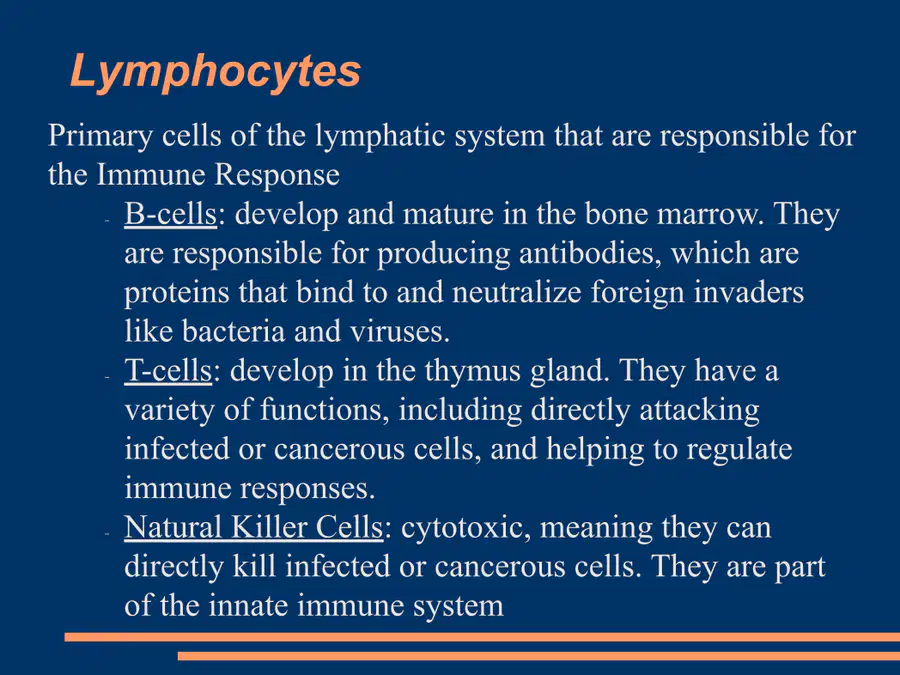
Which type of lymphocyte is responsible for producing antibodies?
B-cells
T-cells
Natural Killer Cells
Monocytes
30

31
Multiple Select
Which of the following are functions of dendritic cells?
Act as messengers between innate and adaptive immune systems
Engulf and digest foreign particles
Produce antibodies
Directly kill infected or cancerous cells
32

33
Multiple Choice
What is the main function of macrophages?
Destroy microorganisms via phagocytosis
Produce antibodies
Regulate immune responses
Cause inflammation
34

35
Fill in the Blanks
Invading pathogens are called
Type answer...
36

37
Multiple Select
Which of the following are common conditions associated with the lymphatic/immune system?
Infectious Mononucleosis
Spleen Rupture
Diabetes Mellitus
Hodgkin's Lymphoma
38

39
Open Ended
Explain why rest is recommended for a minimum of 3-4 weeks in patients diagnosed with infectious mononucleosis.
40

41
Multiple Choice
Which of the following is a classic symptom of spleen rupture?
Kehr’s Sign (radiating left shoulder pain)
Right lower quadrant pain
Coughing up blood
Blurred vision
42

43
Open Ended
Explain how the lymphatic system contributes to the spread of cancer throughout the body.
44

45
Multiple Select
Which of the following are symptoms of Non-Hodgkin's Lymphoma?
Nausea
Vomiting
Enlarged spleen or liver
Cough
46

47
Fill in the Blanks
A common symptom of lymphoma is swelling of the
Type answer...
48

49
Multiple Choice
What is the most common tick-borne illness in the United States?
Lyme's Disease
Malaria
Rocky Mountain spotted fever
West Nile Virus
50

51
Open Ended
Describe the progression of symptoms across the three stages of Lyme’s Disease.
52

53

54

55
56

57

58

59

60

61

62

63

64

65
Open Ended
What would happen if the inflammatory response and fibroblast phases are prolonged?
66
Open Ended
What do you think would happen to the scar?
67

68

69

Show answer
Auto Play
Slide 1 / 69
SLIDE
Similar Resources on Wayground

62 questions
Revision Class 5: Research Methods
Presentation
•
11th - 12th Grade
62 questions
Reproductive System
Presentation
•
11th - 12th Grade
60 questions
Polarity Molecules
Presentation
•
12th Grade
63 questions
Socioeconomic Factors
Presentation
•
University
63 questions
Elements, mixtures and compounds
Presentation
•
12th Grade
65 questions
Unit 6A: The Nervous System Review
Presentation
•
12th Grade
64 questions
PS 6.1 Notes: Ionic Bonding
Presentation
•
12th Grade
66 questions
Legislative Branch
Presentation
•
12th Grade
Popular Resources on Wayground
10 questions
Safety Day 2026 – Student Review

Quiz
•
9th Grade
21 questions
Continents and Oceans
Quiz
•
6th Grade
20 questions
Parts of Speech
Quiz
•
5th Grade
16 questions
Subject & Predicate
Quiz
•
5th Grade
25 questions
Multiplication Facts
Quiz
•
5th Grade
12 questions
Map Skills
Quiz
•
3rd Grade
22 questions
Continents and Oceans
Quiz
•
5th Grade
15 questions
Rounding Decimals
Quiz
•
5th Grade
Discover more resources for Science
7 questions
Newton's Laws Video Quiz

Interactive video
•
9th - 12th Grade
35 questions
Cell Transport/Enzyme/Cell/Macro Review
Quiz
•
9th - 12th Grade
13 questions
Explore Enzyme Functions and Interactions
Quiz
•
9th - 12th Grade
10 questions
Fact or Fiction: Microbes
Quiz
•
9th - 12th Grade
10 questions
Understand Cell Functions and Organelles
Quiz
•
9th - 12th Grade
19 questions
Explore Macromolecules in Living Organisms
Quiz
•
9th - 12th Grade
15 questions
Layers of Atmosphere passage

Passage
•
9th - 12th Grade
22 questions
Quiz Review Day 5 Water and Macromolecules
Quiz
•
9th - 12th Grade