Search Header Logo
GED Soc.Studies 2025 - 20th Century Global Conflict (Part 01)

GED Soc.Studies 2025 - 20th Century Global Conflict (Part 01)

Assessment

Presentation

Social Studies

University

Practice Problem

Medium

Created by

Adesti Komalasari

Used 2+ times

FREE Resource

13 Slides • 35 Questions

1

​Geography of the World | Twentieth Century

Global Conflict - Part One

By Adesti Komalasari

2

Word Cloud

Mention one word that comes to your mind when you read/hear about this word:

Imperialism

3

Word Cloud

Mention one word that comes to your mind when you read/hear about this word:

Fascism

4

​GUESSING THE CONFLICT:
WHICH WAR AM I?

5

Multiple Choice

I involved global powers like the United States, Nazi Germany, and Japan. I began in 1939 and included the Holocaust, the attack on Pearl Harbor, and ended with Germany’s surrender in 1945. Which war am I?

1

World War I

2

World War II

6

Multiple Choice

I involved secret agreements that redrew the map of the Middle East. My aftermath saw the collapse of empires and the beginning of Western mandates in former Ottoman territories. Though I ended in 1918, the borders I shaped still spark conflict today. Which war am I?

1

World War I

2

World War II

7

Multiple Choice

I involved trench warfare, the Schlieffen Plan, and a failed attempt to quickly defeat France. Millions died, and I ended with a treaty that severely punished Germany. Which war am I?

1

World War I

2

World War II

8

Multiple Choice

I was marked by the use of industrial-scale genocide, with entire populations targeted for annihilation. My aggressors used propaganda, secret police, and racial ideology to justify mass murder. When I ended in 1945, the world said ‘never again.’ Which war am I?

1

World War I

2

World War II

9

SAY IT OUT LOUD:
AGREE or DISAGREE?

10

Poll

The ideology of fascism gained traction in multiple regions due to widespread disillusionment with democratic institutions.

AGREE

DISAGREE

11

Poll

The Treaty of Versailles created a fair and balanced resolution to World War I that promoted long-term stability in Europe.

AGREE

DISAGREE

12

Poll

Stalin’s collectivization policies and Five-Year Plans modernized the Soviet Union, though at a devastating human cost.

AGREE

DISAGREE

13

Poll

World War II was an entirely European conflict that did not involve regions beyond the continent.

AGREE

DISAGREE

14

Let's have a glimpse of the reading text and answer the following questions

15

Multiple Choice

Which of the following best explains why Germany’s Schlieffen Plan failed?

1

Russia’s rapid mobilization disrupted Germany’s plan for a quick victory.

2

France’s navy was stronger than expected.

3

The Schlieffen Plan focused only on the Eastern Front and some parts of Asia.

4

Britain’s immediate entry into the war overwhelmed Germany.

16

Multiple Choice

What does the term mandate most likely mean in the context of the post-WWI Middle East?

1

 A legally binding contract made between European powers to formalize agreements on political or military matters.

2

A colonial administrative region temporarily overseen by another power.

3

A peace treaty signed by all parties involved.

4

A religious edict for territorial expansion.

17

Multiple Choice

What conclusion can be drawn about the effects of the Treaty of Versailles on Germany?

1

It stabilized Germany’s economy but limited its military.

2

It unified Europe under a new peace agreement.

3

It caused economic and political instability, leading to extremism.

4

It helped Germany rebuild quickly after the war.

18

Multiple Choice

How did Pan-Arabism and Islamism differ as responses to the post-Ottoman world?

1

Pan-Arabism was religious, while Islamism was political.

2

Pan-Arabism emphasized language and ethnicity; Islamism focused on religion as unity.

3

Both aimed to align only with Western ideals.

4

Islamism called for Arab unity across borders; Pan-Arabism rejected international involvement.

19

Multiple Choice

All of the following were contributing factors to the rise of Adolf Hitler EXCEPT:

1

The failure of the Weimar Republic.

2

Popular support for collectivized agriculture.

3

Hyperinflation and unemployment.

4

Anger over the Treaty of Versailles.

20

Multiple Choice

In the phrase “marching its young men into the hail of bullets, bombs, and artillery shells,” what does this imagery symbolize?

1

The beauty of military sacrifice.

2

The technological advancement of war.

3

The brutal nature of modern warfare.

4

The pride of national service.

21

Read this short text and try to answer the questions based on the text

22

Unseen Fronts of World War I


While the strategic failures and alliance entanglements of World War I are well documented, less attention is paid to the war’s technological and human dimensions beyond Europe. The conflict marked a turning point in military technology: it was the first major war to integrate mechanized warfare at scale. Machine guns, poison gas, tanks, and aerial reconnaissance fundamentally altered how battles were fought. The introduction of chemical weapons, such as chlorine and mustard gas, caused horrific injuries, challenging the limits of medical response and international law. Despite eventual restrictions under the Geneva Protocol, the psychological trauma left by these weapons endured long after the armistice.

Beyond the European trenches, the war was truly global in scope. Millions of soldiers from colonized regions, including India, Senegal, Egypt, and the Caribbean, were conscripted or recruited into imperial armies. These colonial troops often faced discriminatory treatment, inferior supplies, and limited recognition despite their sacrifices. Their participation, however, sowed the seeds of political consciousness and anti-colonial movements in the decades that followed.

On the home front, the war’s impact was equally transformative. Total war required the full mobilization of societies. Women entered the industrial workforce en masse, replacing men sent to the front lines. Civilians endured rationing, censorship, and air raids for the first time in modern history. Propaganda became a crucial tool for sustaining public morale and suppressing dissent.

Ultimately, World War I not only redrew borders but also disrupted global hierarchies, reshaped social roles, and accelerated technological change. Its legacy was not confined to the battlefield; it resonated through the homes, factories, and colonies of a rapidly changing world.

23

​Answer whether the statement is TRUE or FALSE

24

Multiple Choice

Question image

World War I was the first major conflict to use poison gas as a weapon.

1

TRUE

2

FALSE

25

Multiple Choice

Question image

World War I had little effect on civilians living away from the front lines.

1

TRUE

2

FALSE

26

Multiple Choice

Question image

The legacy of World War I was limited mostly to military and territorial changes.

1

TRUE

2

FALSE

27

Multiple Choice

Question image

Colonial troops who fought in World War I were treated equally to European soldiers.

1

TRUE

2

FALSE

28

Multiple Choice

Question image

One effect of World War I was the increased political awareness among colonized peoples.

1

TRUE

2

FALSE

29

​Answer the following multiple choice questions

30

Multiple Choice

Question image

All of the following were effects of World War I on civilian populations EXCEPT:

1

Civilians experienced bombing raids and government propaganda.

2

Most civilians were forcibly relocated from urban centers.

3

Women began working in industries to replace men at war.

4

Civil liberties were limited through censorship measures.

31

Multiple Choice

Question image

Which of the following best explains why the use of chemical weapons during World War I had consequences beyond the battlefield?

1

They shifted military alliances among European nations.

2

They prompted immediate technological innovation.

3

They caused psychological trauma and challenged legal norms.

4

They were widely supported by civilian populations.

32

Multiple Choice

Question image

Which hypothesis is best supported by the text?

1

Technological innovations in warfare can lead to rapid conflict resolution.

2

Equal treatment of soldiers strengthens global alliances.

3

Participation in war triggers broader social and political transformation.

4

Colonial troops were indifferent to the consequences of war.

33

Multiple Choice

Question image

What is the most accurate meaning of the term “total war” as used in the text?

1

A war involving only the military sectors of society.

2

A war fought on more than one continent.

3

A war that requires complete societal participation.

4

A war declared by totalitarian regimes.

34

Multiple Choice

Question image

What conclusion can be drawn about the legacy of World War I based on the reading?

1

Its aftermath was primarily limited to the redefinition of European borders.

2

It established long-term peace in colonial territories.

3

It triggered enduring changes in military, political, and social structures globally.

4

Its effects were reversed by the end of the 1920s.

35

​Let's understand a pie chart of How the U.S were spent taxes during World War I and answer the questions

36

media

37

Multiple Choice

Question image

What can be reasonably inferred from the fact that 75% of U.S. expenditures in FY1919 went to military-related costs?

1

Military spending was prioritized above all other sectors.

2

The U.S. maintained strict neutrality throughout the war.

3

Domestic programs were seen as equally important.

4

The U.S. relied entirely on volunteer soldiers.

38

Multiple Choice

Question image

In the infographic, the size of the pie chart represents what?

1

The level of civilian satisfaction with tax spending.

2

The relative size of total U.S. federal spending in 1919.

3

Public and the government’s support for the war and the antiwar.

4

The number of military personnel.

39

Multiple Choice

Question image

What does the category “Past Military” most likely include?

1

Only the salaries of retired generals.

2

Historical reenactments of Civil War battles.

3

Payments for military obligations predating WWI.

4

Grants for new military technology.

40

Multiple Choice

Question image

Which of the following was not included under the $7 billion “Human Resources” category?

1

Indian affairs

2

Postal services

3

Civil and miscellaneous expenses

4

Navy Department operations

41

Multiple Choice

Question image

How does “Current Military” spending compare to “Past Military” in FY1919?

1

Past military received significantly more than current military.

2

They received equal shares of the budget.

3

Current military spending was modest and temporary.

4

Current military had a slightly larger portion of the budget.

42

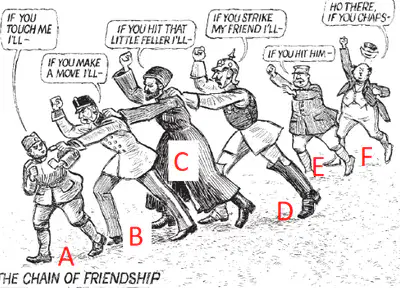
​Let 's see this picture and try to understand the picture by answering the questions

media

43

media

​This political cartoon, titled “The Chain of Friendship,” satirically captures the complex web of alliances that preceded World War I. Each figure represents a European power, linked by escalating threats of retaliation. Serbia (A) is confronted by Austria-Hungary (B), while Russia (C) steps in to defend its Slavic ally. Germany (D) supports Austria-Hungary, prompting France (E) to align against German aggression. Britain (F), observing from afar, is drawn in by treaty obligations. The image underscores how a localized conflict spiraled into a global war through a domino effect of entangled commitments.

44

Multiple Choice

Question image

What does the interlinked posture of the figures most likely symbolize?

1

A coordinated military parade

2

The fragility of diplomatic negotiations

3

The entangled system of alliances before World War I

4

An attempt to restrain nationalist ambitions

45

Multiple Choice

Question image

What rationale does the cartoon offer for the outbreak of a global war?

1

The pursuit of territorial expansion

2

An unchecked arms race

3

A cascade of mutual defense obligations

4

The failure of economic treaties

46

Multiple Choice

Question image

Based on Britain’s position (F) at the back of the line, what can be inferred about its stance before entering the war?

1

It was the first to declare war.

2

It had no alliances or responsibilities.

3

It was hesitant but bound by obligation.

4

It supported Serbia directly.

47

Multiple Choice

Question image

Which hypothesis does the cartoon most clearly support?

1

Strong alliances always deter war.

2

Interconnected military alliances can escalate local conflicts.

3

Empires are best defended through isolationism and feudalism

4

Public opinion dictated wartime decisions.

48

media

​Geography of the World | Twentieth Century

Global Conflict - Part One

By Adesti Komalasari

Show answer

Auto Play

Slide 1 / 48

SLIDE