

Copy of Copy of Unit 1 Chapter 1 Medical Science 2

Presentation
•
Health Sciences
•
12th Grade
•
Easy

Miranda Griffin
Used 4+ times
FREE Resource
30 Slides • 27 Questions
1

2

3
Multiple Choice
Which of the following best describes the difference between anatomy and physiology?
Anatomy studies the structure of body parts, while physiology studies their functions.
Anatomy focuses on diseases, while physiology focuses on treatments.
Anatomy is only about bones, while physiology is about muscles.
Anatomy and physiology are the same field.
4
Open Ended
Why is it important to understand the structural organization of the human body in medical science?
5

6

7
Multiple Choice
What is the difference between anatomy and physiology?
Anatomy studies the function of body parts, physiology studies their structure.
Anatomy studies the structure of body parts, physiology studies their function.
Anatomy and physiology both study only the structure of the body.
Anatomy and physiology both study only the function of the body.
8

9
Open Ended
List and briefly describe the levels of organization in the human body.
10

11
Multiple Choice
Which of the following are considered functional activities of metabolism?
Growth
Repair
Energy release
All of the above
12

13
Fill in the Blanks
Fill in the blank: The plane that divides the body into upper and lower parts is called the
14

15
Open Ended
Explain how the planes of the body (sagittal, midsagittal, coronal, transverse) help in describing anatomical positions and movements.
16
Multiple Choice
Based on the diagram and description, match each plane (midsagittal, transverse, coronal/frontal) to the body section it divides.
Midsagittal - right and left halves; Transverse - upper and lower portions; Coronal/Frontal - anterior and posterior portions
Midsagittal - upper and lower portions; Transverse - right and left halves; Coronal/Frontal - anterior and posterior portions
Midsagittal - anterior and posterior portions; Transverse - right and left halves; Coronal/Frontal - upper and lower portions
Midsagittal - anterior and posterior portions; Transverse - upper and lower portions; Coronal/Frontal - right and left halves
17

18

19
Multiple Select
Which of the following pairs are correctly matched with their definitions?
Anterior or ventral: Front or in front of
Posterior or dorsal: Back or in back of
Superior and inferior: Toward the midline
Cephalic and caudal: Toward the head end or tail end
20
Multiple Choice
Which directional term refers to 'toward the head end' in human anatomy?
Cephalic
Caudal
Posterior
Inferior
21

22

23
Fill in the Blanks
The plane that divides the body equally into left and right halves is called the
24

25

26
Multiple Select
Select all terms that refer to a position or direction relative to the surface of the body.
Superficial
Deep
Medial
Distal
27
Open Ended
Explain the difference between medial and lateral in anatomical terminology, and provide an example for each.
28
Multiple Choice
What term describes the direction 'away from the point of attachment or origin'?
Distal
Proximal
Medial
Superficial
29

30
Multiple Choice
Which organs are found in the dorsal (posterior) body cavity?
Brain and spinal cord
Heart and lungs
Liver and kidneys
Stomach and intestines
31

32
Open Ended
Compare the organs found in the thoracic cavity with those found in the abdominal cavity.
33

34
Fill in the Blanks
Fill in the blank: The
35
Multiple Choice
Which of the following cavities contains both the thoracic and abdominopelvic cavities?
Ventral body cavity
Dorsal body cavity
Cranial cavity
Pelvic cavity
36

37

38

39
Fill in the Blanks
Is the brain in the dorsal or the ventral cavity?
40

41
Multiple Choice
Which of the following best describes homeostasis?
The ability of the body to regulate its internal environment within narrow limits
The process of cell division
The ability to move from one place to another
The process of digestion
42

43
Multiple Select
Which of the following are examples of processes regulated by homeostasis?
Blood sugar levels
Body temperature
Heart rate
Digestion
44
45
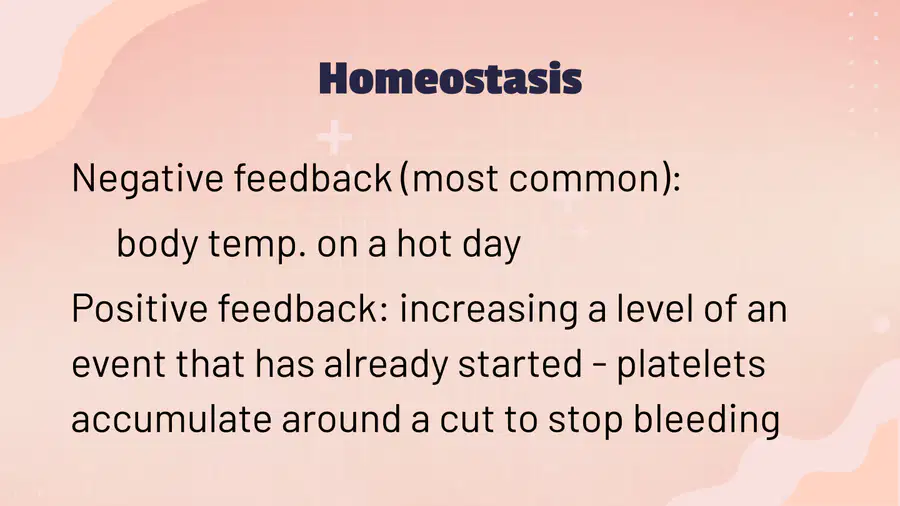
Open Ended
Explain the difference between negative feedback and positive feedback in the context of homeostasis, providing an example of each.
46
47
Multiple Choice
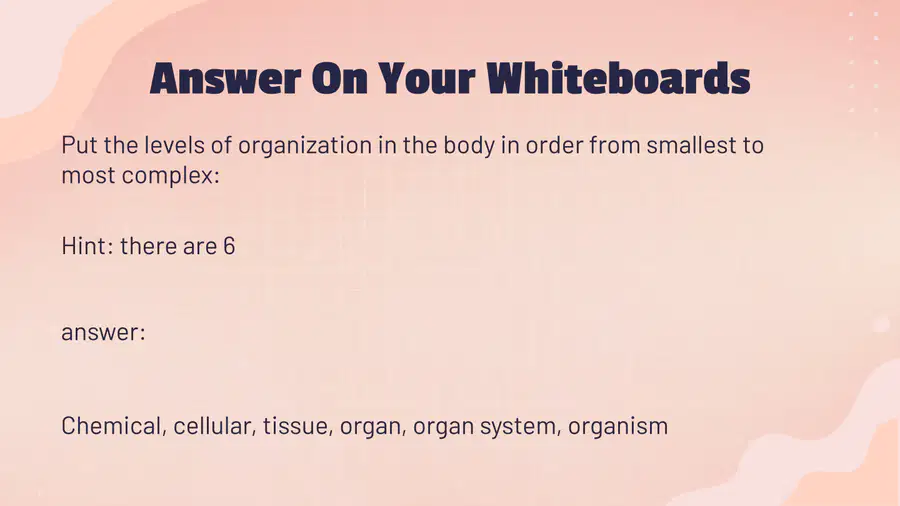
Put the levels of organization in the body in order from smallest to most complex: Chemical, tissue, cellular, organ, organism, organ system.
Chemical, cellular, tissue, organ, organ system, organism
Cellular, chemical, tissue, organ, organism, organ system
Tissue, chemical, cellular, organ, organ system, organism
Organism, organ system, organ, tissue, cellular, chemical
48
49
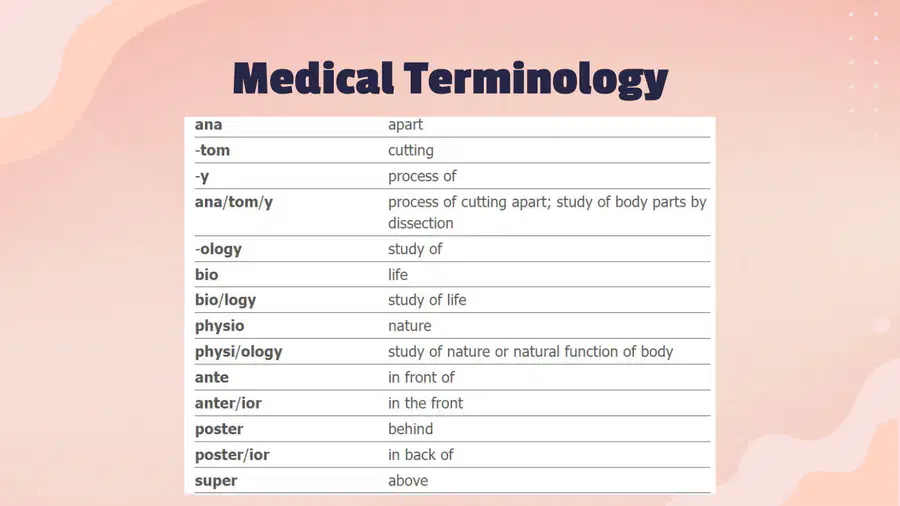
Fill in the Blanks
The prefix 'bio-' in medical terminology means
50
51
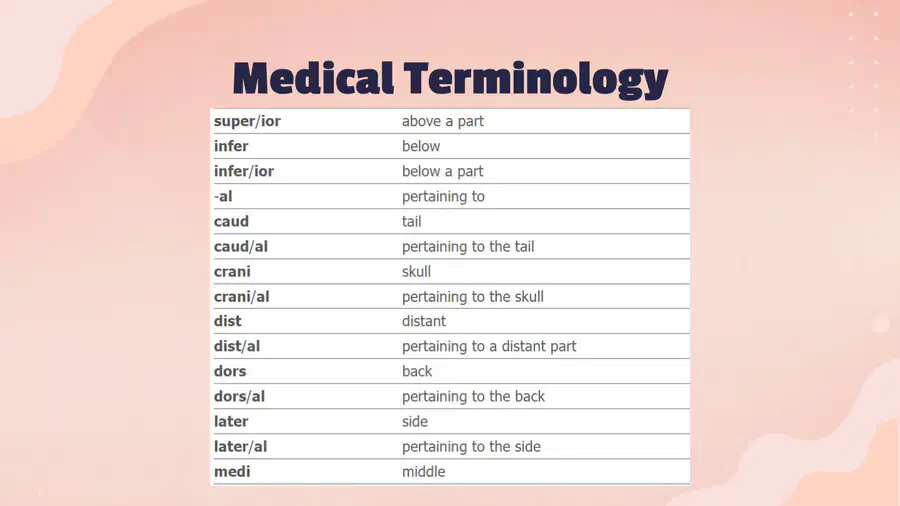
Multiple Choice
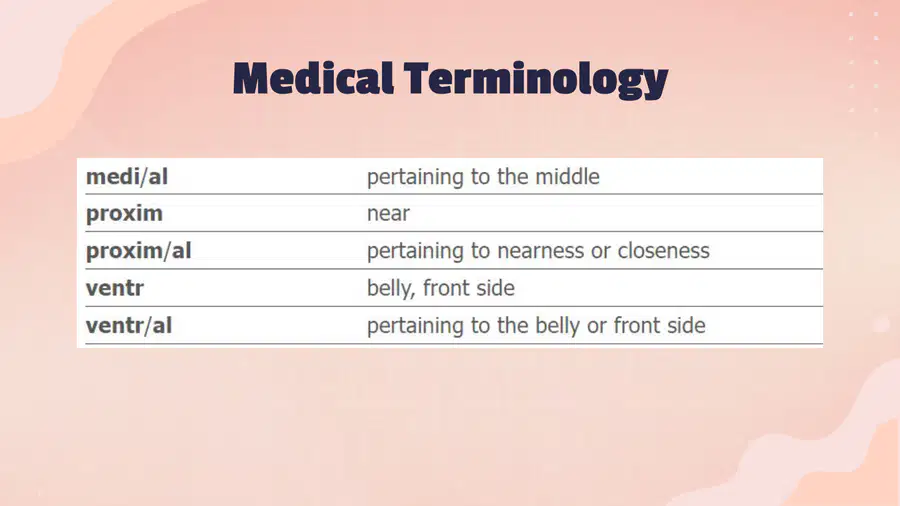
What does the term 'dorsal' refer to in medical terminology?
Back
Front
Side
Tail
52
53

54
55

56
Open Ended
Reflecting on today's lesson, which topic or concept about the structural organization of the human body would you like to learn more about or found most challenging?
57
Multiple Choice
Which of the following is NOT one of the objectives for this chapter on structural units of the human body?
Describe the 6 levels of structural organization of the human body and their interrelationship
Identify commonly used planes to divide the body based on their anatomical position
Explain the process of photosynthesis in plants
Differentiate between positive and negative feedback mechanisms to maintain homeostasis
Show answer
Auto Play
Slide 1 / 57
SLIDE
Similar Resources on Wayground

52 questions
Introduction to Corresponding Parts of Similar Triangles
Presentation
•
12th Grade
50 questions
Ocean Lecture
Presentation
•
12th Grade
51 questions
Characteristics of Rational Functions
Presentation
•
11th Grade
51 questions
PreCalculus Semester 1 Final Exam Study Guide
Presentation
•
11th - 12th Grade
55 questions
10 common idioms - 1 QUỲNH
Presentation
•
12th Grade
50 questions
Eng Z - Medieval English Literature
Presentation
•
11th - 12th Grade
52 questions
Topic 3: Establishment of Travel and Tour Business
Presentation
•
12th Grade
Popular Resources on Wayground
10 questions
Safety Day 2026 – Student Review

Quiz
•
9th Grade
21 questions
Continents and Oceans
Quiz
•
6th Grade
20 questions
Parts of Speech
Quiz
•
5th Grade
16 questions
Subject & Predicate
Quiz
•
5th Grade
25 questions
Multiplication Facts
Quiz
•
5th Grade
12 questions
Map Skills
Quiz
•
3rd Grade
22 questions
Continents and Oceans
Quiz
•
5th Grade
15 questions
Rounding Decimals
Quiz
•
5th Grade
Discover more resources for Health Sciences
26 questions
SLIME!!!!!
Quiz
•
KG - 12th Grade
21 questions
Los paises hispanohablantes y sus capitales
Quiz
•
12th Grade
20 questions
Cell Transport
Quiz
•
9th - 12th Grade
20 questions
Budgeting
Quiz
•
9th - 12th Grade
20 questions
Investing
Quiz
•
9th - 12th Grade
8 questions
DNA vs. RNA
Presentation
•
9th - 12th Grade
12 questions
Identify Rigid Transformations
Quiz
•
8th - 12th Grade
10 questions
Complementary, Supplementary, Vertical, and Linear Pairs
Quiz
•
9th - 12th Grade