

ENGLISH 8 - 1st Quarter Lessons Review

Presentation
•
English
•
8th Grade
•
Hard

Angelita Espanola
Used 4+ times
FREE Resource
54 Slides • 22 Questions
1
By Angelita Espanola
2
Afro-Asian Literature
3
Literature is written works like stories, poems, and plays that people create to express ideas, feelings, or tell stories. It can be fiction (made up) or non-fiction (real). Literature helps us understand different cultures, emotions, and human experiences.
4
It is a term fused to describe the spoken or written literary works, such as short stories and poems, by people from Africa and Asia.
5
Family and respect for elders
Traditions and customs
Struggles with colonization and freedom
Identity, culture, and change
Love, nature, and everyday life
6
Types of Conflicts
7
Conflict is an important part of the plot because it connects events and helps the story move forward. It’s not just about arguments—conflict can be any kind of struggle the main character faces.
8
Internal Conflict- Struggle within oneself
Character vs. Self - A character has a problem inside themselves. This can be fear, guilt, or a hard decision.
9
External Conflict- Struggle with a force outside oneself
Character vs. Character – A character has a problem with another character.
Character vs. Nature - A character fights against nature—like a storm, wild animal, or natural disaster.
Character vs. Society - A character disagrees with the rules or laws of their society. They want change.
10
Types of Characters
11
A character is a person, animal, being, creature, or thing in a story.
Writers use characters to:
Perform actions, Speak dialogue, Advance the plot
12
A round character is someone who feels real. They have a full personality and are affected by what happens in the story. They can learn new things, grow as a person, or even become worse by the end. These characters are more believable because they act like real people — they are consistent, have reasons for what they do, and feel alive.
A static character stays the same throughout the story. They do not change or grow, even when things happen around them.
13
A flat character, on the other hand, is simple and one-dimensional. We don’t learn much about them, and they usually show only one or two personality traits.
A dynamic character (also called a developing character) changes during the story. They grow or learn something important that affects who they are by the end.
14
Plot and its types
15
It is the sequence of events that shows what happens to the characters from the beginning to the end.
16

17
Exposition = The beginning of a story that gives important background information including the characters and setting.
Rising Action = These are the events that happen after the problem begins. They make the story more exciting and keep the reader interested.
18
Climax = The turning point of the action in the story. It is the most exciting part of the story.
Falling Action = The events that happen after the most exciting part (climax) and start to end the story.
Resolution = The end of the story when the problem is solved and everything is explained or finished.
19
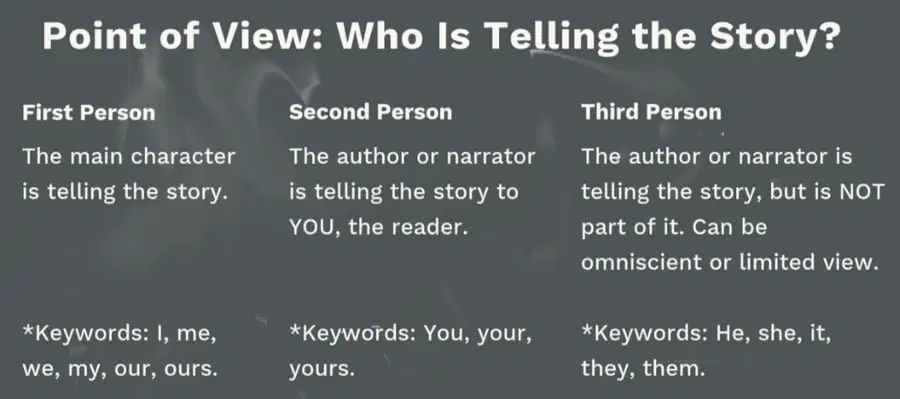
POV (Point-of-View)
20
This refers to the angle or perspective from which the story is told. Simply put, it refers to who is telling the story or through whose eyes the events are being described.
21
22
Features of Poetry
23
Poetry is a type of writing that uses special language.
Poetry uses feelings, imagination, and beautiful words.
Poetry uses sound and rhythm.
Poetry sometimes rhymes (but not always).
24
Line = It is one row of words. It goes from the left to the right.
Stanza = It is a group of lines in a poem. They are separated by a blank line

25
Rhyme = using words with identical or similar final sounds, like “cat” and “hat.”
Rhyme Scheme = the pattern of rhymes at the end of each line of a poem or song. This pattern is notated by labeling the lines that rhyme with each other with the same letter.
Tone = in poetry means the author's attitude towards the subject or the audience.
26
Mood = is the general atmosphere or emotional complexion in a piece of writing—in short, the array of feelings the work evokes in the reader.
Diction = the choice of words writers use to communicate their ideas. They base their choice of diction on the content, type or piece of writing, and audience.
Theme = are lessons or morals that an author wants the reader to learn from a story. This is not different in poetry. Poets often have messages they want to communicate to readers.
27
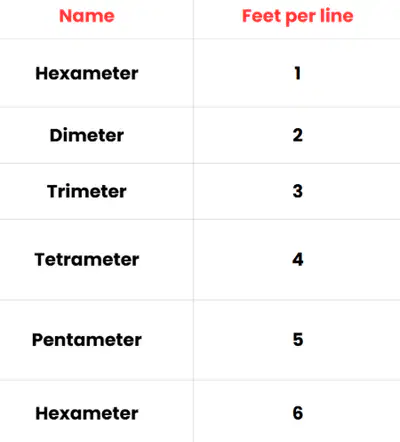
Meter = Meter is the rhythmic structure of a poem. It’s like the beat in music, but made with words instead of notes.
Just like music has a rhythm, so does poetry. This rhythm is created by patterns of stressed (ˊ) - with strong beats and are said louder and clearer and unstressed (˘) syllables - softer and are said more quietly and quickly.
28

29
Figures of Speech
30
words or phrases used in a special way to make language more interesting or expressive (not always with their literal meaning).
Tropes in Literature = These use words in a way that’s different from their normal meaning.
31
Simile = compares two different things using the words "like" or "as."
Her smile was as bright as the sun.
Metaphor = directly compares two different things by saying one is the other, without using "like" or "as."
The Lord is my shepherd.
Personification = where human characteristics are given to non-human objects, animals, or ideas.
The wind whispered through the trees.
32
Hyperbole = uses extreme exaggeration to make a point or show strong feeling. It is not meant to be taken literally.
"I'm so hungry I could eat a horse."
Irony = a figure of speech where the opposite of what is said or expected happens, often to be funny or show contrast.
A fire station burns down.
Oxymoron = two opposite or very different words are put together to create a special or interesting meaning.
Bittersweet , Seriously funny , Small crowd
33
are tools that writers use to create musical effects in their writing. These help the reader “hear” the poem. These devices help make language more interesting, emotional, or memorable, especially in poetry and songs.
34
Onomatopoeia = is a figure of speech where the word imitates the natural sound of a thing.
"The bees buzzed in the garden."
Alliteration is the repetition of the same consonant sounds at the beginning of words that are close together in a sentence or phrase.
"She sells seashells by the seashore."
35
CONTEXT /konteksto/ is the background (kalagayan) or situation (sitwasyon) in which something happens in a story.
It helps us understand what’s going on, why characters act a certain way, or what the author is trying to say.
36
Context in Literature
37
CONTEXT /konteksto/ is the background (kalagayan) or situation (sitwasyon) in which something happens in a story.
It helps us understand what’s going on, why characters act a certain way, or what the author is trying to say.
38
Biographical context = learning about the writer’s life to understand the story’s meaning more deeply.
Sociocultural context = the culture, society, and history around a story or event that help us understand it better.
Historical context = the background history that helps us understand a story better.
Linguistic context = the background information (who, when, where) and the surrounding words that help us understand meaning.
39
Symbolism is when a writer uses an object, action, or name to represent something bigger than itself — an idea, a feeling, or a quality. It’s like when a small thing in a story “stands for” something more important.
Allusion is when a writer talks about or hints at another story, event, or famous thing — but does not explain it directly. If you understand the reference, you get extra meaning from it.
40
Pre-writing Strategies for Poetry
41
Good poetry makes us feel something — maybe happiness, sadness, or surprise. It can use special language, like rhymes or pictures made with words, to make the poem interesting and alive.
Good poetry also makes us think. Sometimes it helps us see the world in a new way, whether it’s serious or funny.
42
Choose a Topic = Think about what you want to write about. It could be a feeling like love or sadness, or something you see or imagine.
Pick a poem style = There are many types of poems. For example:
Haiku (short poems from Japan with 3 lines)
Sonnets (poems with 14 lines)
Limericks (funny poems with 5 lines)
Free verse (no rules for rhyme or rhythm)
43
Write your poem = Poetry doesn’t need to follow normal sentence rules. Use your imagination and try tools like:
Similes (compare using “like” or “as”), Metaphors (say something is something else), Imagery (use words that create pictures in the mind)
Just start writing and don’t worry about mistakes. You can fix them later!
Edit your poem = After writing, read your poem again. Take out parts that don’t sound right and replace them with better words. Save your first draft so you don’t lose your ideas. If you get stuck, write down what you want that part to feel or mean, and try again later.
44
Get Feedback = Show your poem to friends, teachers, or join a writing group. Listen to their advice and think about how to improve your poem. Don’t be afraid to share your work!
45
Pre-writing Strategies for Prose (Short Stories)
46
A short story (Prose) is a small piece of fiction — meaning it’s made-up, not factual — that you can usually read in one sitting.
PROSE is a general classification of literature, either oral or written, that follows the natural flow of speech.
47
Anecdote = A brief story of something interesting and often humorous whose purpose is to support a point. They function much like parables: short narratives with a core moral lesson.
Drabble = A short story of about 100 words whose main purpose is to test the author’s skill, both in prose and in successfully getting a meaningful point across in so few words.
48
Sketch = A piece of writing that doesn’t typically contain a plot. Instead, the point of a sketch is to illuminate a particular character, setting, or location.
Vignette = A short scene which can be part of a larger body of work. The point of a vignette is to capture a single moment or detail about an element in the story, such as a character, idea, or object.
49
Feghoot = A funny short story that ends in a pun or wordplay.
Fable = A short story featuring anthropomorphic creatures, usually animals, whose narrative reveals some kind of a moral point at the end.
Flash Fiction = Refers to stories shorter than 1,000 words. One of the most famous examples of the form is the following short story, often attributed to Ernest Hemingway:
50
A good short story needs one strong mood or feeling.
The language should be clear and descriptive.
The story should have only a few characters.
The story must have a strong point of view or message.
Short stories can be creative and break some traditional rules.
51
Transitional signals, also known as transition words, are words or phrases that connect ideas and show relationships between sentences and paragraphs in writing.
52

53

54
55
Multiple Choice
A Japanese poem with 3 lines and a 5-7-5 syllable pattern is a—
free verse
56
Multiple Choice
Which is spelled correctly?
comunnity
coomunity
community
comunitty
57
Multiple Choice
_________ is a compilation of inter-woven series of tales in prose
and poetry, mostly animal fables.
Panhcatantra
Panchatantra
Panchatantar
Panchanatrat
58
Multiple Choice
__________ A short story featuring anthropomorphic creatures, usually animals, whose narrative reveals some kind of a moral point at the end.
Anecdote
Fable
Drabble
Feghoot
59
Multiple Choice
“One of us, the fourth, is a _______, having nothing but sense.
Which word below is spelled correctly?
dullard
dollard
dlulard
dulladr
60
Multiple Choice
A funny short story that ends in a pun.
Anecdote
Fable
Drabble
Feghoot
61
Multiple Choice
In North Africa, the people show their pride in their embroidery
that are individually hand sewn creating a culturally intricate design. ___________, Western fashion is predominantly the fad in
South African region.
immediately
likewise
thus
whereas
62
Multiple Choice
__________ refers to stories shorter than 1,000 words. One of the most famous examples of the form is the following short story, often attributed to Ernest Hemingway: “For sale: baby shoes, never worn.”
Anecdote
Fable
Flash Fiction
Feghoot
63
Multiple Choice
Which type of character undergoes change or development in the story?
Antagonist
Round
Flat
Dynamic
64
Multiple Choice
Which part of plot reveals the background of characters and setting?
Climax
Rising Action
Falling Action
Resolution
65
Multiple Choice
It is a humorous, often whimsical poem consisting of five lines. The rhyme scheme is AABBA, and the first, second, and fifth lines typically have three metrical feet, while the third and fourth lines have two.
Limerick
Haiku
Sonnet
Free Verse
66
Multiple Choice
A short scene which can be part of a larger body of work. The point of this is to capture a single moment or detail about an element in the story, such as a character, idea, or object.
Feghoot
Flash Fiction
Vignette
Drabble
67
Multiple Choice
A piece of writing that doesn’t typically contain a plot. Instead, the point of a sketch is to illuminate a particular character, setting, or location.
Feghoot
Flash Fiction
Vignette
Sketch
68
Multiple Choice
Africa was once a great continent ________ it was divided into five regions.
hence
before
similarly
therefore
69
Multiple Choice
The Lord is my shepherd, is an example of ___________ ?
simile
personification
metaphor
hyperbole
70
Multiple Choice
Which statement is TRUE?
Falling action is the ending of a story.
Internal conflict happens inside the mind.
A drabble is always a poem.
A vignette is longer than a novel.
71
Multiple Choice
The lesson or moral that a story conveys is its—
Tone
Mood
Diction
Theme
72
Multiple Choice
Which is the correct order of plot elements?
Climax → Exposition → Resolution → Falling action → Rising action
Exposition → Rising action → Climax → Falling action → Resolution
Resolution → Rising action → Climax → Exposition → Falling action
Exposition → Climax → Rising action → Falling action → Resolution
73
Multiple Choice
These changes in Africa brought massive confusion among people. ___________, there were prevalent conflicts organized by revolutionists in the areas of the northern and sub-Saharan colonies.
From then on
Likewise
Once again
Similarly
74
Multiple Choice
Which point of view uses “I” or “we” in narration?
Third person omniscient
Second person
First person
Third person limited
75
Multiple Choice
Which of the following is an example of external conflict?
A girl struggles to decide her future career.
A boy faces a storm at sea.
A student is guilty about lying.
A man struggleswhether to forgive his enemy.
76
Multiple Choice
Cuisine in Africa is a combination of fruits, milk and meat products. ___________, the five regions of the continent have the same recipes for African food which were handed down through the generations, long before it was divided.
From then on
Likewise
Once again
Similarly
By Angelita Espanola
Show answer
Auto Play
Slide 1 / 76
SLIDE
Similar Resources on Wayground

70 questions
5/12/2020 (F2)
Presentation
•
8th Grade
69 questions
Present Coninuous lesson
Presentation
•
7th Grade
70 questions
ENGLISH 9 - UNIT 2 - CITY LIFE - LESSON 2
Presentation
•
8th - 9th Grade
72 questions
Affix Unit 1 Review
Presentation
•
7th - 8th Grade
72 questions
Places We Call Home
Presentation
•
8th - 9th Grade
70 questions
Alat-alat Input Output dan Pemroses
Presentation
•
8th Grade
70 questions
Chemical Reactions
Presentation
•
8th Grade
71 questions
Unit 1 Catch Up Plan
Presentation
•
8th Grade
Popular Resources on Wayground
10 questions
Safety Day 2026 – Student Review

Quiz
•
9th Grade
21 questions
Continents and Oceans
Quiz
•
6th Grade
20 questions
Parts of Speech
Quiz
•
5th Grade
16 questions
Subject & Predicate
Quiz
•
5th Grade
25 questions
Multiplication Facts
Quiz
•
5th Grade
12 questions
Map Skills
Quiz
•
3rd Grade
22 questions
Continents and Oceans
Quiz
•
5th Grade
15 questions
Rounding Decimals
Quiz
•
5th Grade
Discover more resources for English
25 questions
Making Inferences
Quiz
•
6th - 8th Grade
20 questions
Figurative Language Review
Quiz
•
8th Grade
20 questions
Sentences, Fragments, and Run-ons
Quiz
•
8th Grade
30 questions
The Outsiders Day Activity
Quiz
•
8th Grade
27 questions
1st Nine Weeks: ELA Final Exam Study Guide
Quiz
•
6th - 8th Grade
20 questions
Action, Linking, and Helping Verbs
Quiz
•
3rd - 8th Grade
10 questions
Exploring the Role of Setting in Storytelling

Interactive video
•
6th - 10th Grade
10 questions
Differentiating the 3 Types of Irony
Interactive video
•
6th - 10th Grade