

AP Biology: Properties of Water

Presentation
•
Science
•
9th - 12th Grade
•
Medium
+5
Standards-aligned

Kimberly Mecir
Used 7+ times
FREE Resource
13 Slides • 12 Questions
1

By
2
Polarity

3

4
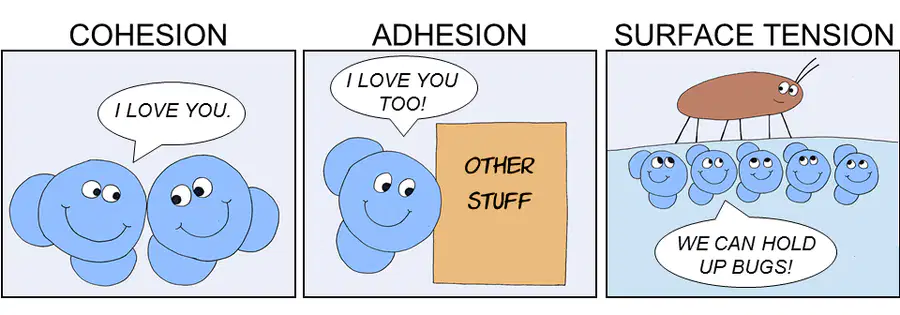
5
6

7

8

9


10

Temperature
Control
11

Low Density
Of A
Solid
12


Excellent Solvent
13

14
Multiple Choice
In a single molecule of water, two hydrogen atoms are bonded to a single oxygen atom by
hydrogen bonds.
nonpolar covalent bonds
polar covalent bonds.
ionic bonds.
van der Waals interactions
15
Multiple Choice
The slight negative charge at one end of one water molecule is attracted to the slight positive charge of another water molecule. What is this attraction called?
a covalent bond
a hydrogen bond
an ionic bond
a hydrophilic bond
a hydrophobic bond
16
Multiple Choice
Which of the following effects is produced by the high surface tension of water?
Lakes don't freeze solid in winter, despite low temperatures.
A water strider can walk across the surface of a small pond.
Organisms resist temperature changes, although they give off heat due to chemical reactions.
Water can act as a solvent.
The pH of water remains exactly neutral
17
Multiple Choice
The bonds that are broken when water vaporizes are
ionic bonds.
hydrogen bonds between water molecules.
covalent bonds between atoms within water molecules.
polar covalent bonds.
nonpolar covalent bonds
18
Multiple Choice
Many mammals control their body temperature by sweating. Which property of water is most directly responsible for the ability of sweat to lower body temperature?
water's change in density when it condenses
water's ability to dissolve molecules in the air
the release of heat by the formation of hydrogen bonds
the absorption of heat by the breaking of hydrogen bonds
water's high surface tension
19
Multiple Choice
Which of the following statements is true about buffer solutions?
They maintain a constant pH when bases are added to them but not when acids are added to them.
They maintain a constant pH when acids are added to them but not when bases are added to them.
They maintain a constant pH of exactly 7 in all living cells and biological fluids
They maintain a relatively constant pH when either acids or bases are added to them.
They are found only in living systems and biological fluids.
20
Multiple Choice
Hydrophobic substances such as vegetable oil are
nonpolar substances that repel water molecules.
nonpolar substances that have an attraction for water molecules
polar substances that repel water molecules
ar substances that have an affinity for water.
charged molecules that hydrogen-bond with water molecules.
21
Multiple Choice
Why does ice float in liquid water?
The liquid water molecules have more kinetic energy and thus support the ice.
The ionic bonds between the molecules in ice prevent the ice from sinking.
Ice always has air bubbles that keep it afloat.
Hydrogen bonds stabilize and keep the molecules of ice farther apart than the water molecules of liquid water
The crystalline lattice of ice causes it to be denser than liquid water
22
Multiple Choice
23
Multiple Choice
24
Multiple Choice
Water is an excellent solvent. Select the property that justifies this statement.
as a polar molecule, it can surround and dissolve ionic and polar molecules
it forms ionic bonds with ions, hydrogen bonds with polar molecules, and hydrophobic interactions with non polar molecules
it forms hydrogen bonds with itself so cohesion is possible
it is liquid and will adhere to many substances
25
Multiple Choice
By
Show answer
Auto Play
Slide 1 / 25
SLIDE
Similar Resources on Wayground

17 questions
Atmosphere and Climate Change
Presentation
•
9th - 12th Grade
20 questions
Photosynthesis
Presentation
•
9th - 11th Grade
20 questions
Periodic Trends
Presentation
•
10th - 12th Grade
19 questions
history of atom
Presentation
•
10th - 12th Grade
19 questions
Periodic Trends Lesson
Presentation
•
10th - 12th Grade
22 questions
Accuracy v. Precision, Sig Figs, and Scientific Notation
Presentation
•
9th - 12th Grade
21 questions
Introduction to the Integumentary System
Presentation
•
9th - 12th Grade
Popular Resources on Wayground
10 questions
How much do you know about our Portrait of an Eagle?

Quiz
•
10th Grade
10 questions
Fast Food Slogans
Quiz
•
6th - 8th Grade
21 questions
Continents and Oceans
Quiz
•
6th Grade
20 questions
Parts of Speech
Quiz
•
5th Grade
16 questions
Subject & Predicate
Quiz
•
5th Grade
25 questions
Multiplication Facts
Quiz
•
5th Grade
12 questions
Map Skills
Quiz
•
3rd Grade
22 questions
Continents and Oceans
Quiz
•
5th Grade
Discover more resources for Science
10 questions
Exploring Chemical and Physical Changes

Interactive video
•
6th - 10th Grade
20 questions
Atomic Structure
Quiz
•
9th Grade
10 questions
Decoding the Periodic Table of Elements
Interactive video
•
6th - 10th Grade
10 questions
Exploring the Periodic Table
Interactive video
•
6th - 10th Grade
14 questions
Physical and Chemical Changes
Quiz
•
10th Grade
22 questions
Periodic Table Review
Quiz
•
9th - 12th Grade
20 questions
Observation vs. Inference
Quiz
•
7th - 9th Grade
14 questions
Periodic Trends
Interactive video
•
11th Grade