

Early Europeans to North America

Presentation
•
Social Studies
•
8th Grade
•
Practice Problem
•
Easy

Micah Agas
Used 8+ times
FREE Resource
7 Slides • 10 Questions
1
Early Europeans to North America
By Micah Agas
2

The first Europeans to actually arrive in North America were Norse explorers led by Leif Erikson around the year 1000, landing in what is now Newfoundland, Canada. The Norse even built small settlements, such as the site known today as L’Anse aux Meadows, but these were temporary and did not develop into lasting colonies. It would be centuries before Europeans returned.
First Europeans
3
Multiple Choice
What is true about the Norse explorers led by Leif Erikson around the year 1000?
They built permanent colonies that lasted for centuries
They discovered the Caribbean islands before Columbus
They created small settlements like L’Anse aux Meadows, but these did not last
4

In 1492, Christopher Columbus sailed across the Atlantic under the Spanish flag and landed in islands of the Caribbean. Though he never set foot in what is today the United States, his voyages opened the door for further European exploration and colonization of the Americas. Columbus’s journeys marked the beginning of a new era of contact between Europe and the Western Hemisphere, leading to major cultural exchanges as well as conflict with Indigenous peoples.
Columbus
5
Multiple Choice
What was the main result of Christopher Columbus’s voyages in 1492?
He established the first English colony in North America
He landed in the Caribbean, opening the door to European exploration of the Americas
He reached Asia by sailing west across the Atlantic
6
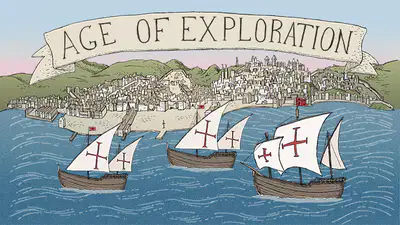
This period of time became known as the Age of Exploration, when European nations such as Spain, Portugal, France, and England sent explorers across the oceans. They were motivated by the “three G’s”: gold, glory, and God—seeking wealth, fame, and the spread of Christianity. Advances in navigation and shipbuilding made these journeys possible, and they forever changed the world by connecting Europe, Africa, and the Americas in new ways.
Age of Exploration
7
8
Labelling
The Age of Exploration connected these 3 continents for the first time.
Label these 3 continents:
Europe
North America
Africa
9
Multiple Select
Why did many European explorers begin sailing across the Atlantic in the late 1400s and 1500s?
To obtain more wealth and land for their country
To study Native American cultures
To have fun and vacation with family
to spread their religion
10
Multiple Select
When talking about the Age of Exploration, what are the three G's?
Gold
Glory
Gucci
God
11
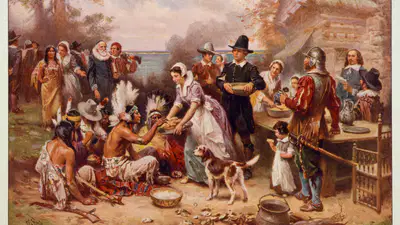
Among the most famous groups to follow were the Pilgrims, English separatists who sailed on the Mayflower in 1620. They established the Plymouth Colony in present-day Massachusetts, seeking religious freedom and a new start. Their survival depended heavily on the knowledge and help of Native Americans, including the Wampanoag people, who taught them vital skills such as planting corn and fishing. The Pilgrims’ story became a central part of early American history and tradition.
The Pilgrims
12
Multiple Choice
What was the main reason the Pilgrims traveled on the Mayflower in 1620?
To explore and make maps
To find gold and silver
To seek religious freedom and start a new life
13
Multiple Choice
What U.S. holiday celebrates the story of the Pilgrims and the Wampanoag (Native American) people?
Halloween
Thanksgiving
Easter
14
Multiple Choice
How did the Wampanoag people help the Pilgrims survive?
They built houses for them
They taught them how to plant corn and fish
They defended them from the Spanish
15
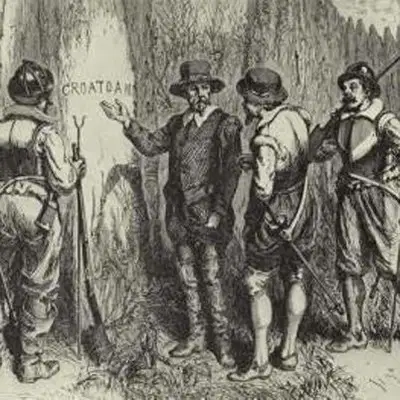
Before the Pilgrims, however, John White led expeditions to the coast of present-day North Carolina in the 1580s. As an artist and cartographer, White carefully documented the land and its Indigenous peoples through detailed drawings, providing some of the earliest visual records of Native American life. He later became governor of the ill-fated Roanoke Colony, known as the “Lost Colony,” after its settlers mysteriously disappeared. White’s work remains significant because it offers both a glimpse into early English attempts at colonization and the first artistic portrayals of Native Americans encountered by Europeans.
John White
16
Multiple Choice
What was John White known for during his expeditions in the 1580s?
Leading the first successful colony in Massachusetts
Establishing trade with the French
Creating detailed drawings and maps of the land and Indigenous peoples
17
Reorder
Reorder the following European explorers from earliest to latest to arrive in America from left to right.
Norse aka Vikings
Christopher Columbus
John White
The Pilgrims
Early Europeans to North America
By Micah Agas
Show answer
Auto Play
Slide 1 / 17
SLIDE
Similar Resources on Wayground

15 questions
War of 1812
Presentation
•
8th Grade
13 questions
The Underground Railroad
Presentation
•
7th - 8th Grade
10 questions
The Presidents of the United States of America
Presentation
•
8th Grade
14 questions
World War Two - Introduction to WWII
Presentation
•
7th - 8th Grade
10 questions
Federalist vs Anti-Federalist
Presentation
•
8th Grade
14 questions
Aztec Citizenship
Presentation
•
8th Grade
14 questions
September 11th
Presentation
•
8th Grade
15 questions
History of US Political Parties
Presentation
•
8th Grade
Popular Resources on Wayground
20 questions
Math Review

Quiz
•
3rd Grade
15 questions
Fast food
Quiz
•
7th Grade
20 questions
Context Clues
Quiz
•
6th Grade
20 questions
Inferences
Quiz
•
4th Grade
19 questions
Classifying Quadrilaterals
Quiz
•
3rd Grade
20 questions
Figurative Language Review
Quiz
•
6th Grade
20 questions
Equivalent Fractions
Quiz
•
3rd Grade
10 questions
Identify Fractions, Mixed Numbers & Improper Fractions
Quiz
•
3rd - 4th Grade
Discover more resources for Social Studies
56 questions
Civics & Econ Practice SOL #1
Quiz
•
6th - 8th Grade
154 questions
Civics & Economics SOL Review
Quiz
•
8th Grade
45 questions
Civil War/Reconstruction (TCI 23-25) Review
Quiz
•
8th Grade
56 questions
Civics & Econ Practice SOL #1
Quiz
•
6th - 8th Grade
20 questions
The United States 1800s-1900s
Quiz
•
6th - 8th Grade
30 questions
Women's Rights Movement
Quiz
•
8th Grade
8 questions
Bats
Quiz
•
8th Grade
53 questions
Q4 Review
Quiz
•
8th Grade