

0b-2. Sampling & Generalization

Presentation
•
Social Studies
•
9th - 12th Grade
•
Practice Problem
•
Hard

Christian Rettig
FREE Resource
22 Slides • 17 Questions
1

2
3
Multiple Choice
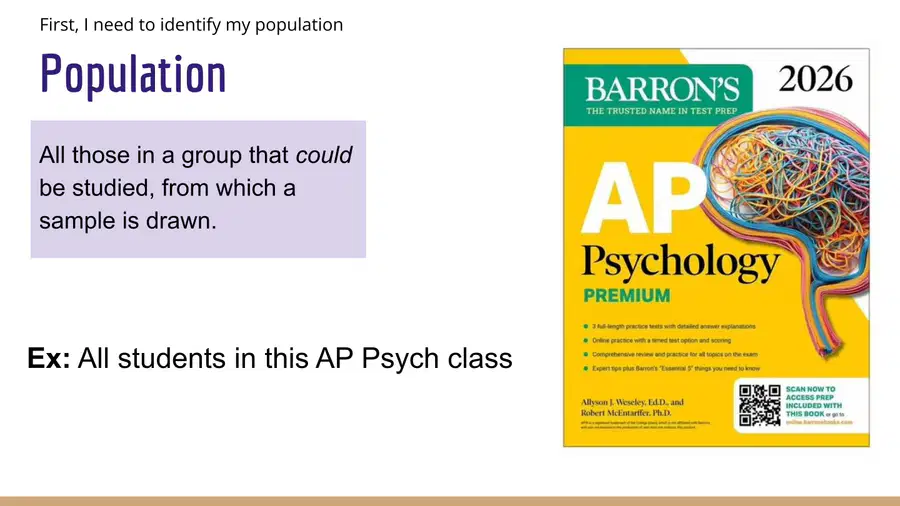
In this example, which group represents the POPULATION that I am interested in studying?
All teenagers
The students from my class that I select to ask about their favorite app
The students in my AP Psychology class
Everyone in this school
4
5
Multiple Choice
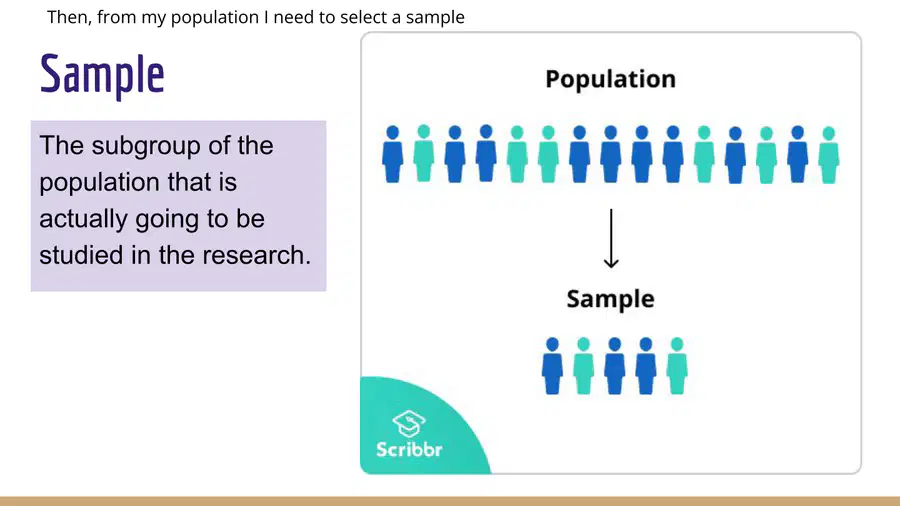
In the context of a research study, what is a sample?
The entire group the researchers want to learn more about
The subgroup of the population that is actually going to be studied in the research
The method used to collect data
The results of the research
6

7
Multiple Choice
Which of the following is the best explanation of what randomness means when it comes to selecting a sample from the larger population?
Every member of the population has an equal chance of being selected
The sample includes people from different subgroups in the population
Participants are selected in a casual manner
The sample contains only people who volunteered to participate
8
Multiple Select
Which of the following are methods to achieve random selection in sampling?
Drawing names out of a hat
Focusing on people who are physically near by
Using a random number generator
Asking people you know will agree to participate
9

10
Multiple Choice
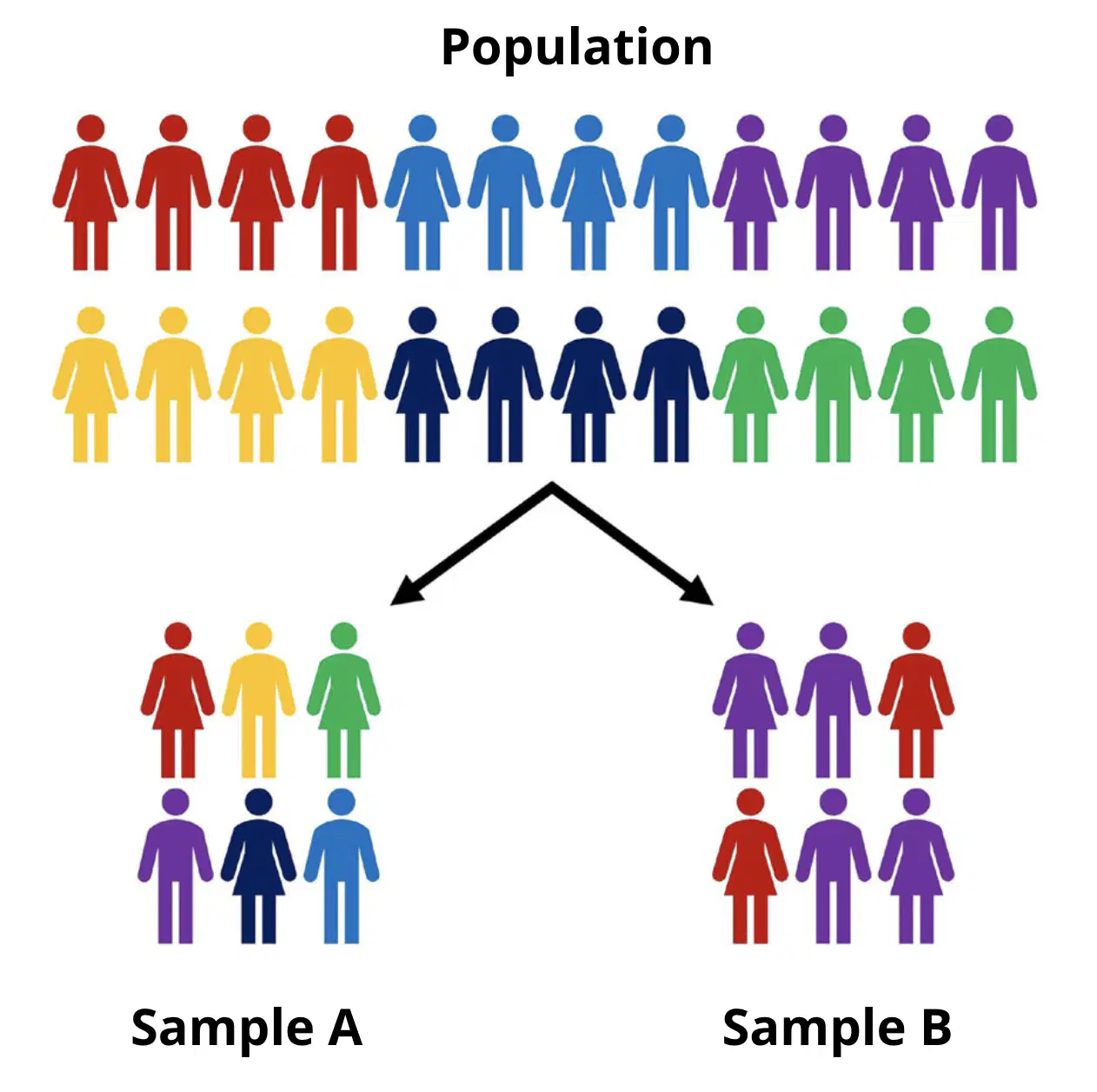
Which sample is representative of the population shown at the top of the image?
Sample A
Sample B
11
Multiple Choice
Why is it important for a sample to be representative of the population in research studies?
Because it guarantees that every individual in the population will eventually be studied
Because it makes the research process faster and easier to complete
Because it allows the researcher to avoid using random selection methods
Because it ensures the findings can accurately reflect the larger group
12

13
Fill in the Blanks
Type answer...
14
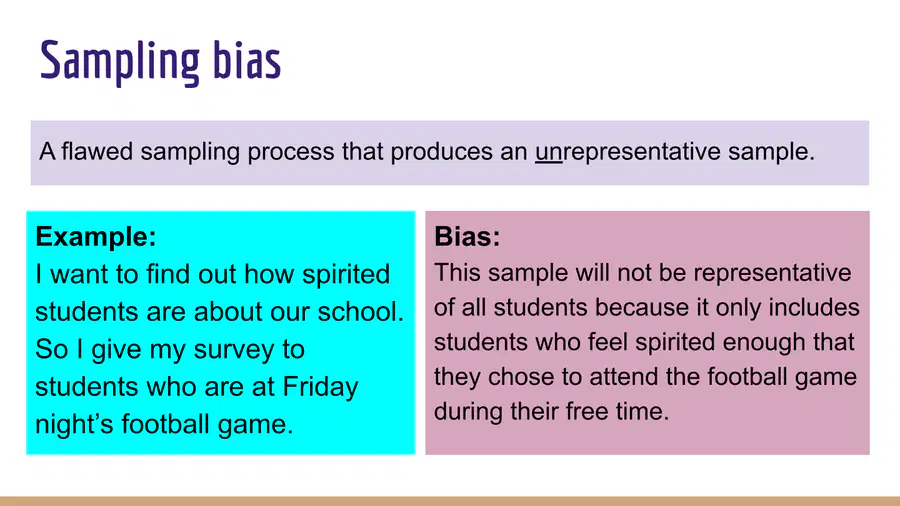
Sampling bias
Ideally, researchers are always able to do their research on a sample of people who accurately represent the larger population they are interested in learning about.
But sometimes that is too difficult or costly.
15
16
Multiple Choice
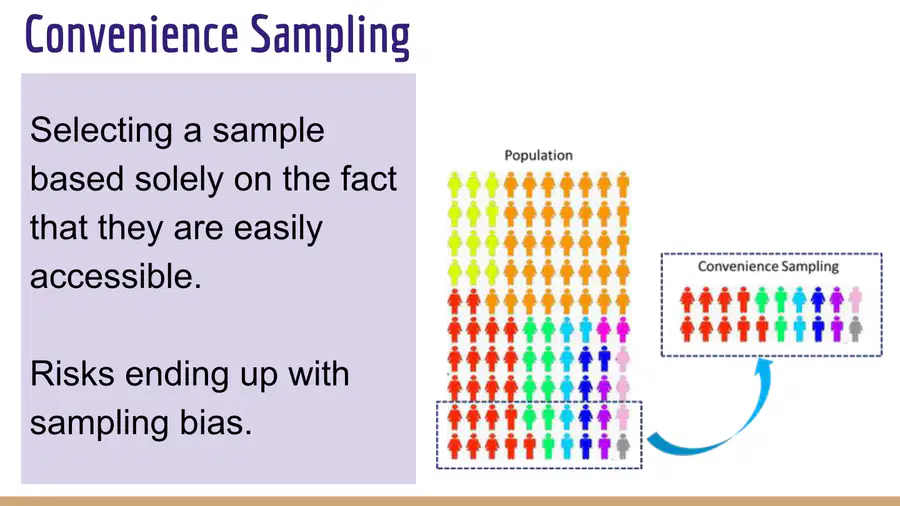
Which of the following is NOT an example of convenience sampling?
Giving surveys to whoever happens to be in the library after school
Giving surveys only to students who are in your AP Psych class
Giving surveys to students selected from the entire school roster using a random number generator
17
Multiple Choice
What is a major risk of using convenience sampling?
It is time-consuming
It is expensive
Ending up with sampling bias
It always produces a representative sample
18
19
Multiple Choice
Hank is writing an article for the school paper about how much time students in his school spend doing homework each night. So he asks the students in his AP Language class to fill out a chart each night for a week, adding up how much time they spend doing homework for all their classes.
What is the population that Hank is interested in learning about?
Students taking AP Language
Students who read the school newspaper
Students at his high school
Students who do their homework
20
Multiple Choice
Hank is writing an article for the school paper about how much time students in his school spend doing homework each night. So he asks the students in his AP Language class to fill out a chart each night for a week, adding up how much time they spend doing homework for all their classes.
Why is Hank's sampling strategy going to result in sampling bias?
Because Hank did not include every student in the school in his study
Because many students don't take AP classes, so this group of students is not representative of all students.
Because students might give dishonest answers to avoid looking lazy
Because students may not remember exactly how much time they spend on homework each night
21
22
Multiple Choice
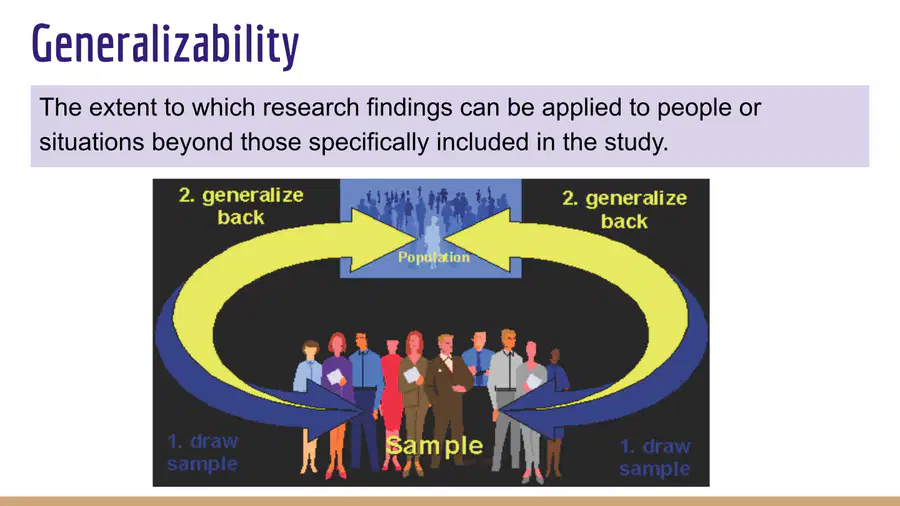
Which of the following best describes the concept of generalizability in research?
The process of making sure each subgroup in a population is proportionally represented in a sample.
The extent to which research findings can be applied to people or situations beyond those specifically studied.
The ability to measure variables in a way that produces consistent results over time.
The tendency for participants to change their behavior because they know they are being observed.
23

24
Analyzing "generalizability"
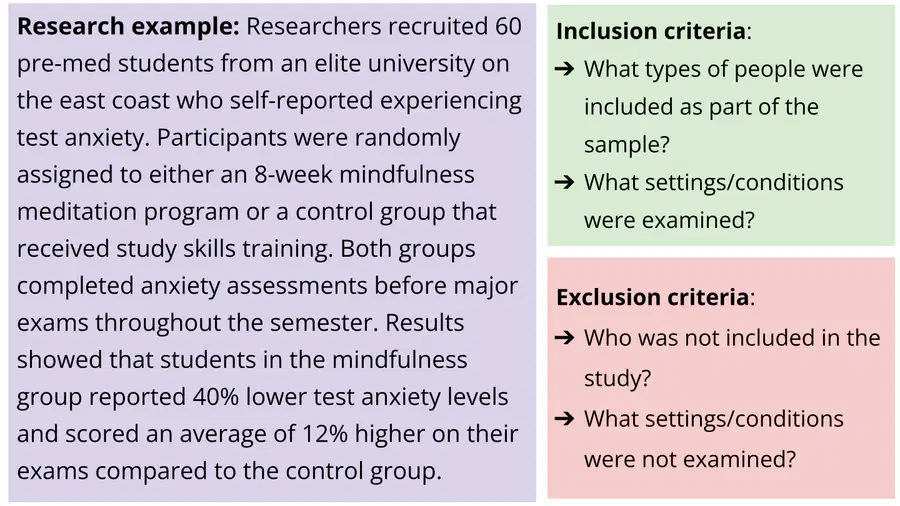
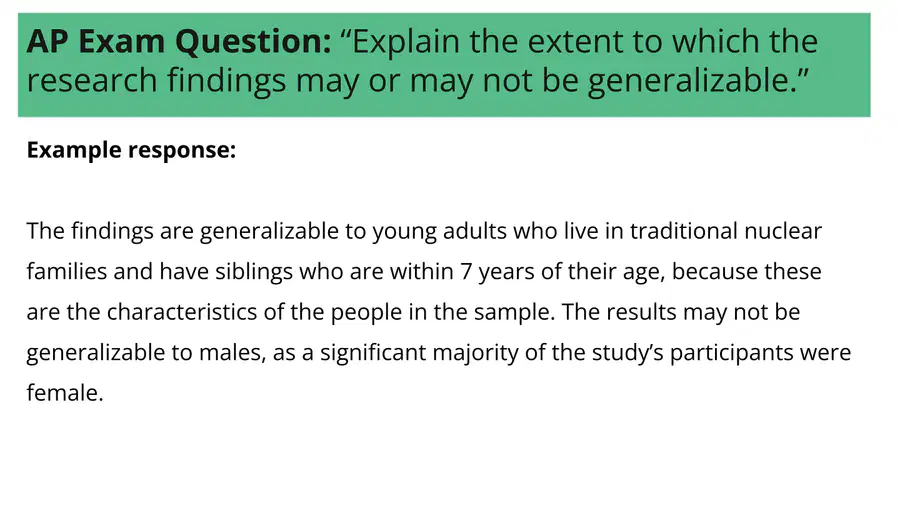
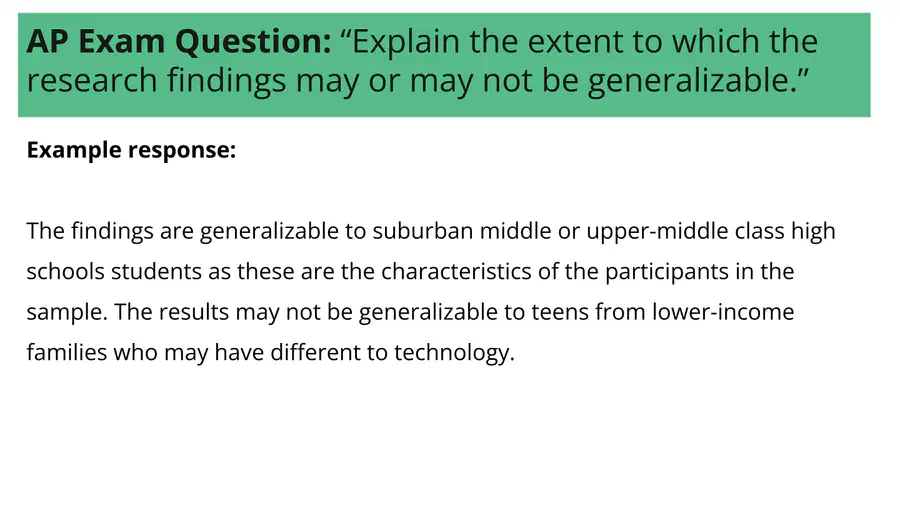
A part of the AP Psych exam will ask you to "explain the extent to which the research findings [of a particular study that you are reading about] may or may not be generalizable.
To answer this question, you need to identify who was included in the study's sample, and who was left out.
25
26
Multiple Select
Which of the following were included as part of the sample in the mindfulness meditation research example?
Pre-med students from an elite university
Students who self-reported test anxiety
Community college students
Young children
27
Multiple Select
Which of the following were not included as part of the sample in the mindfulness meditation research example?
English majors
Students who attend an elite university
Elderly people
Students who do not have test anxiety
28
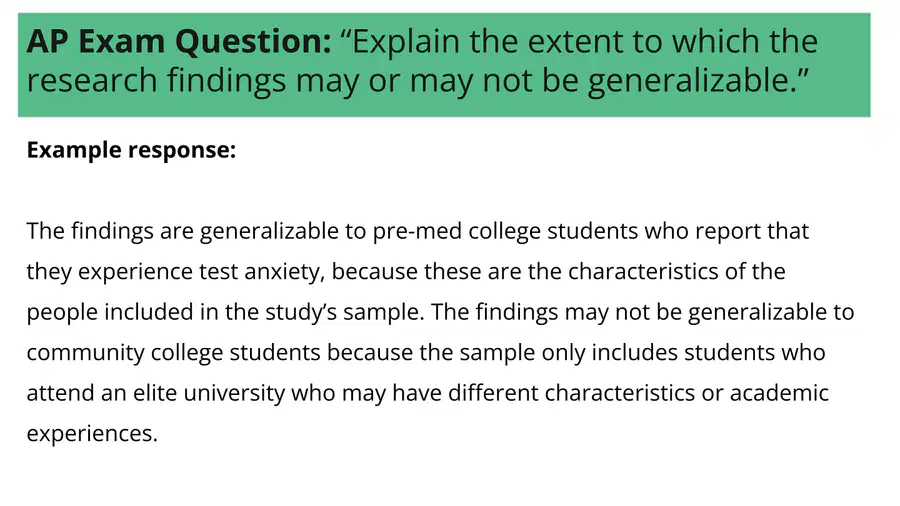
The next slide gives an example answer to the College Board's question: "Explain the extent to which the research findings may or may not be generalizable."
You will need to be able to write answers like this when given a description of the people who are part of the sample in a research study. As you read the next few slides, consider these answers to be models/examples for you.
29
30
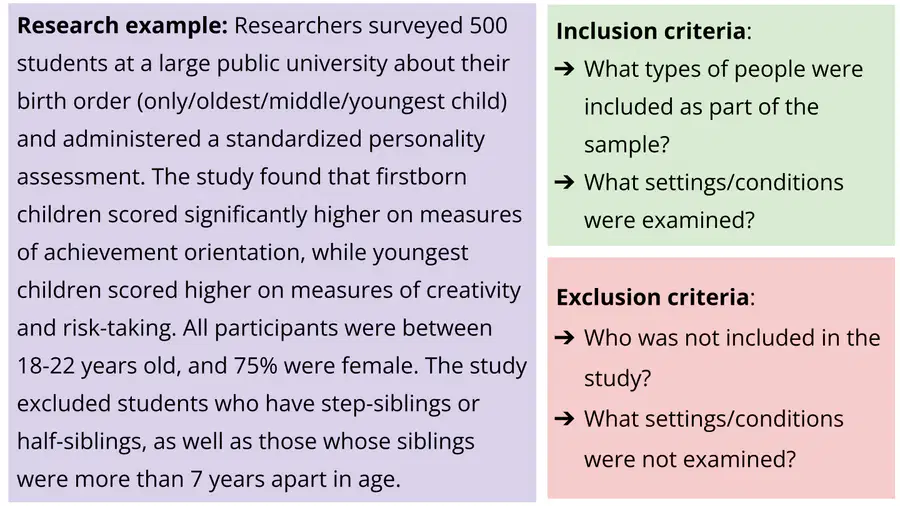
Here is another example
31
32
Multiple Choice
In the birth order research example, which group was excluded from the study?
Students with step-siblings or half-siblings
Firstborn children
Students aged 18-22
Female students
33
34
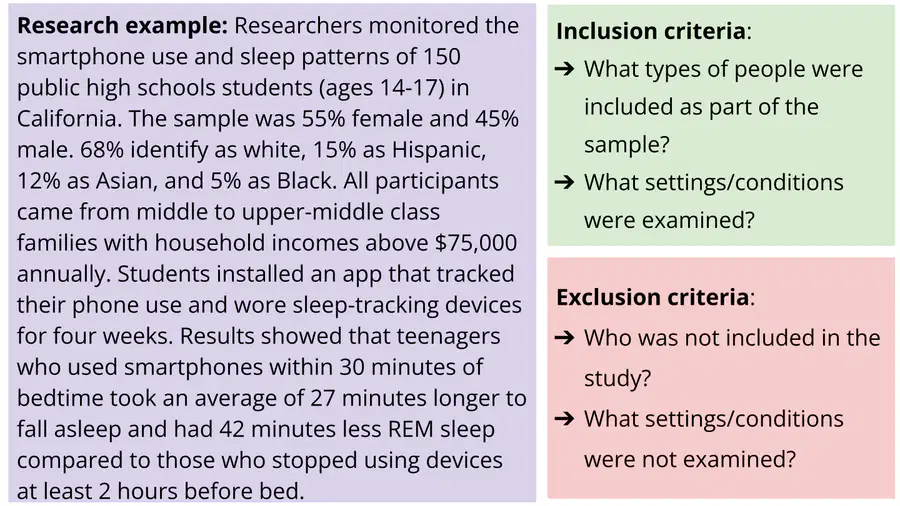
And another example
35
36
Multiple Choice
Based on the research example, which of the following groups was NOT included in the study sample?
Teens from lower-income families
High school students aged 14-17
Students from middle to upper-middle class families
Students who used smartphones within 30 minutes of bedtime
37
38

Now you try one
(do your best with what you just learned - we'll work on this many more times this year!)
39
Open Ended
Research example: Researchers surveyed 200 middle school students (ages 11–13) from suburban schools in Texas about their daily screen time and social skills. All students attended private schools where tuition exceeds $20,000 per year. Students completed self-report questionnaires on how many hours they spent on screens per day and participated in a peer-rating activity on cooperation and friendliness. Results showed that students who reported more than 4 hours of daily screen time received significantly lower peer ratings of cooperation than students who reported less than 2 hours of screen time.
Explain the extent to which the research findings may or may not be generalizable:
Show answer
Auto Play
Slide 1 / 39
SLIDE
Similar Resources on Wayground

35 questions
Charles Darwin and Evolution Lesson
Presentation
•
9th - 12th Grade
36 questions
Causes of the Stock Market Crash
Presentation
•
8th - 12th Grade
35 questions
Revolution of 1800 & Democratic Republicans
Presentation
•
9th - 12th Grade
34 questions
Solving Radical Equations
Presentation
•
9th - 12th Grade
34 questions
Macromolecules
Presentation
•
9th - 12th Grade
35 questions
Introduction to Bonding
Presentation
•
9th - 12th Grade
35 questions
Saber v Conocer
Presentation
•
9th - 12th Grade
35 questions
Telling time in Spanish
Presentation
•
9th - 12th Grade
Popular Resources on Wayground
10 questions
HCS SCI 03 Summer School Review 4

Quiz
•
3rd Grade
11 questions
HSMS - Standard Response Protocol
Quiz
•
6th - 8th Grade
16 questions
1.1-1.2 Quiz Review
Quiz
•
9th - 12th Grade
12 questions
Exponent Expressions
Quiz
•
6th Grade
20 questions
Adding and Subtracting Integers
Quiz
•
6th - 7th Grade
11 questions
Northeast States
Quiz
•
3rd - 4th Grade
10 questions
Characterization
Quiz
•
3rd - 7th Grade
10 questions
Common Denominators
Quiz
•
5th Grade