

1.2.1 College Pathways

Presentation
•
Other
•
9th Grade
•
Practice Problem
•
Easy

Brenda Brewer
Used 2+ times
FREE Resource
14 Slides • 7 Questions
1

Brenda Brewer bbrewer@ccaeducate.me 570.820.4210 x24589
In a minute I am going to roll a letter dice
Based on the letter rolled, you will think of something that starts with that letter for which you are thankful
Type your word in the chat BUT wait to hit send until I say GO!
2

3
1.2.1 College Pathways
Brenda Brewer bbrewer@ccaeducate.me Phone: 570.820.4210 x24589
Join the Quizzizz ~ Link in Chat
Answer questions in Zoom Polls
Use Guided Notes to Follow Along - Padlet Link Home Page
Open edio and Follow Along
Remember to hit Submit in edio when Guided Lesson is Complete!
Remember, you have choices for success in this course
4
Lesson Objectives:
list the various benefits of obtaining a traditional degree
identify the setbacks when choosing the college pathway
identify the various options of degrees
identify various types of post-secondary schools to choose from
Vocabulary:
associate's degree, bachelor's degree, college, community college, private university, state university, tuition, university
Intro to Trades 1.2.1 College Pathways

5
Poll
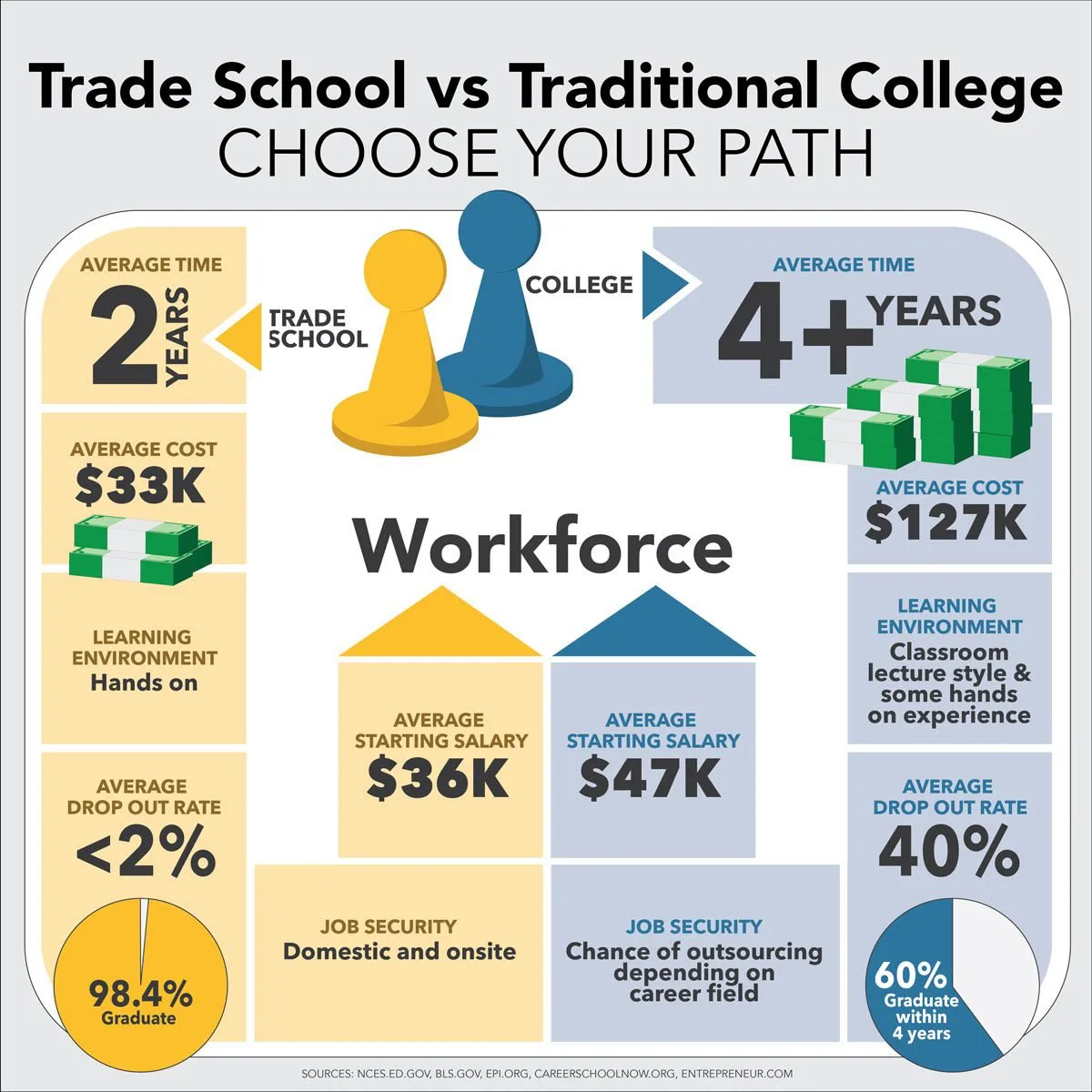
What do you think...getting a college degree will result in a higher paying job.
Always
Never
Depends
6
The millennial generation is the most-educated generation by far.
65% of millennials value higher education and plan to get a degree.
67% have already graduated or completed some college.
Millennials as a whole carry an average of $38,000 in student loan debt.
More than 50% of millennials say that their college debt was not worth it.
The Debate!

The answer is not so simple...
7



More Marketability When Job Hunting
When you have a degree listed on your résumé, it can give you the upper hand over another candidate for a position.
Ability to Enter Specialized Careers
You cannot work in some career fields unless you have a degree in a specific area. You would not want to have a surgical procedure done by someone who had not successfully graduated from medical school, would you?
Personal Development
By getting a degree, you are taking courses across multiple subjects, including humanities courses. This will help you become a well-rounded person

Increased Earning Potential
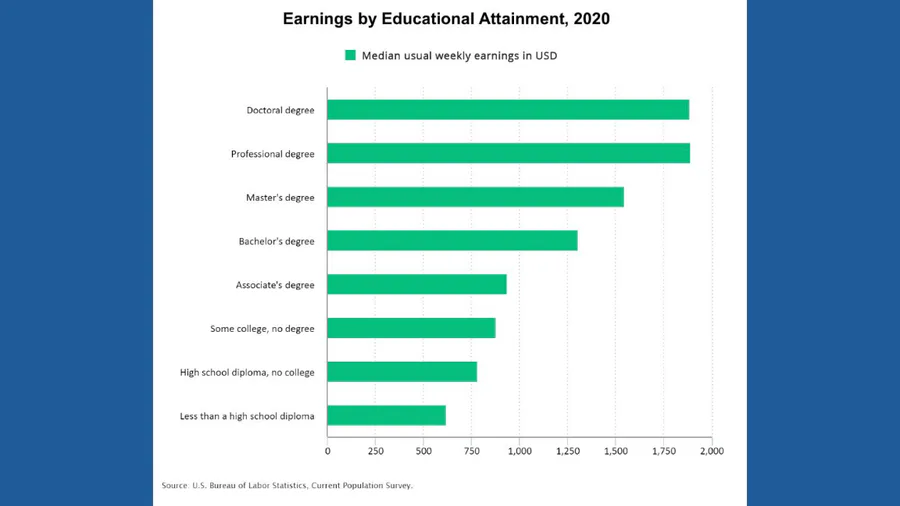
A degree could help you to land a higher-paying job than otherwise, and it could help you to advance faster in specific industries.
8
Match

Match the benefit topics to the definition
Personal Development
Increased Earning Potential
Enter Specialized Careers
Build more thinking and social skills
Ability to make more money
Some jobs require a college degree
Build more thinking and social skills
Ability to make more money
Some jobs require a college degree
9
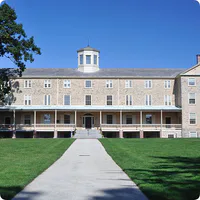

There are many options for attending college.
The word college is used here as a catchall phrase for all higher education institutions.
Tuition is the cost to attend school for one year full-time. The two major types of higher education institutions are colleges and universities.
Some famous colleges in Pennsylvania are Haverford College, Albright College, and Lafayette College.
Community colleges are more affordable, local schools that are publicly funded and offer associate's degrees, specific programs, and licensing certifications.

10

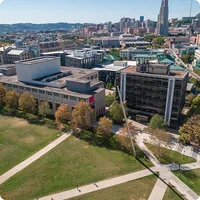
Universities are typically larger schools that consist of several colleges and offer a range of degrees.
Colleges within a university are often given a title based on their course of study, such as “College of Engineering.”
There are two main types of universities, state universities and private universities.
State universities are publicly funded institutions that are state-run.
Examples of state universities in Pennsylvania are Penn State University and the University of Pittsburgh.
Private universities are institutions that are not run by the state. These are often smaller than state universities and offer prestigious degrees that can come with higher tuition.
Examples of private universities in Pennsylvania are Bucknell University and Carnegie Mellon University.
11
Multiple Choice
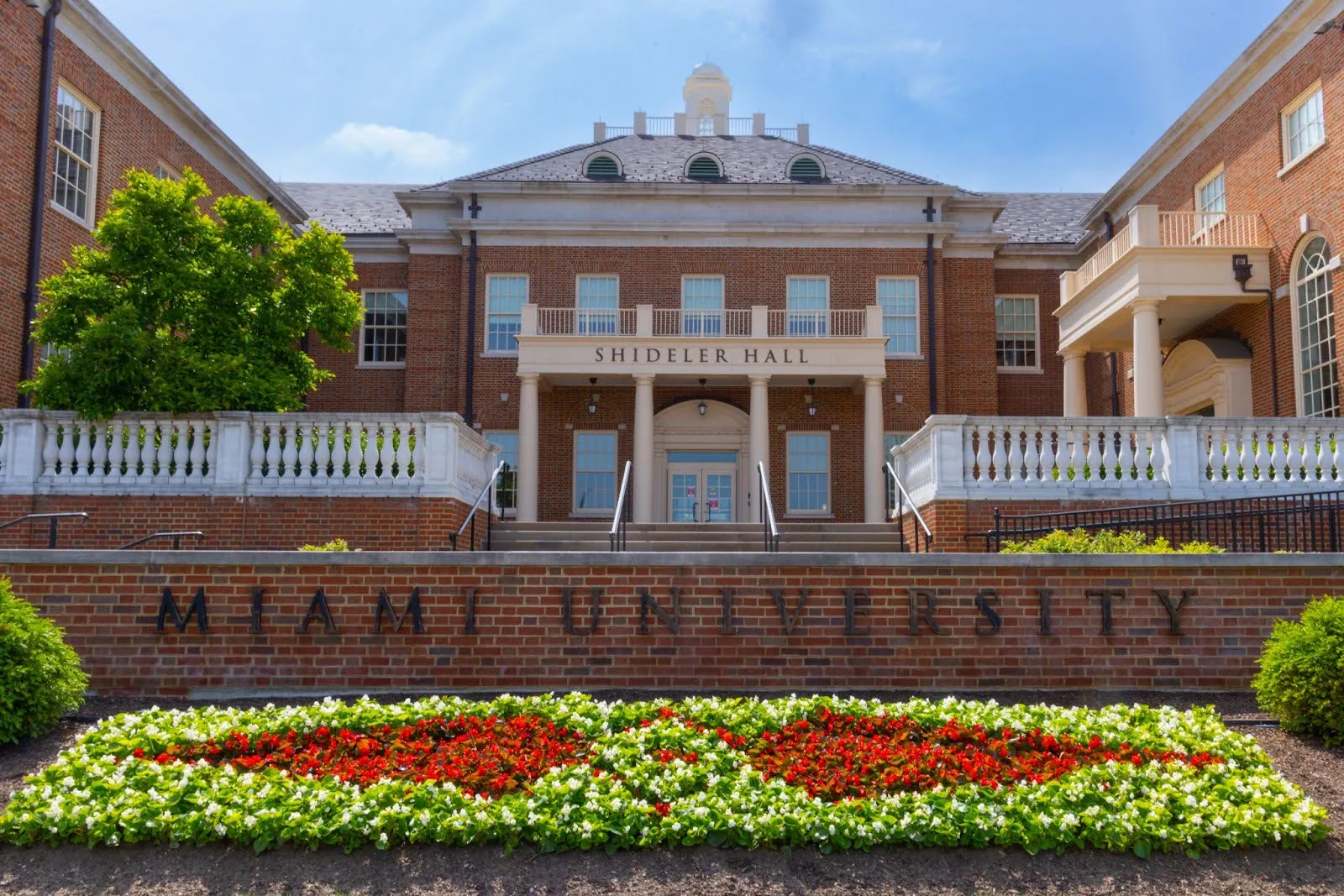
Miami University located in Oxford, Ohio, is a public school that receives some funding from the state of Ohio and includes six different colleges. What type of school is it?
Private University
Community College
State University
12
13
Match
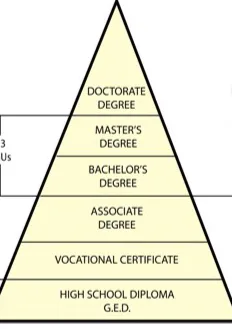
Match the college degree to the number of years to obtain
Associate's Degree
Bachelor's Degree
Master's Degree
Doctoral Degree
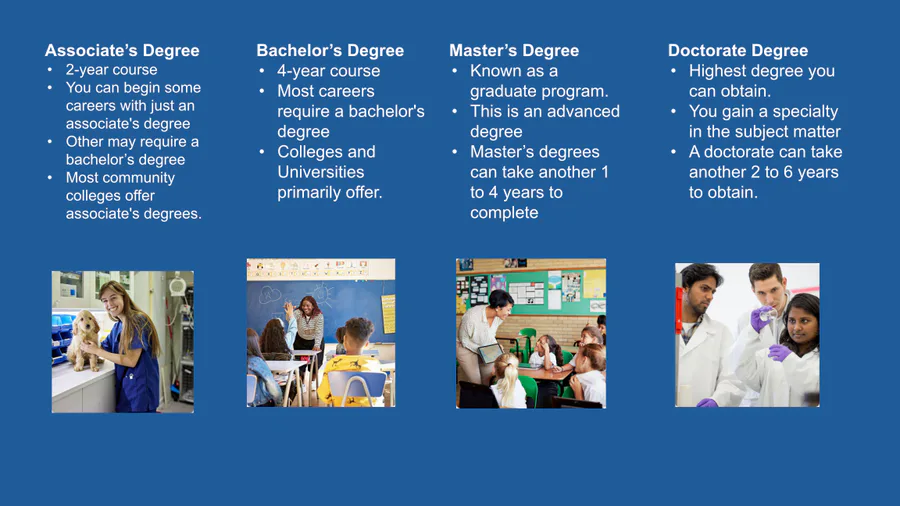
typically, 2 years
typically, 4 years
approximately 6 years
typically, 7-9 years
typically, 2 years
typically, 4 years
approximately 6 years
typically, 7-9 years
14
15
16
Multiple Choice

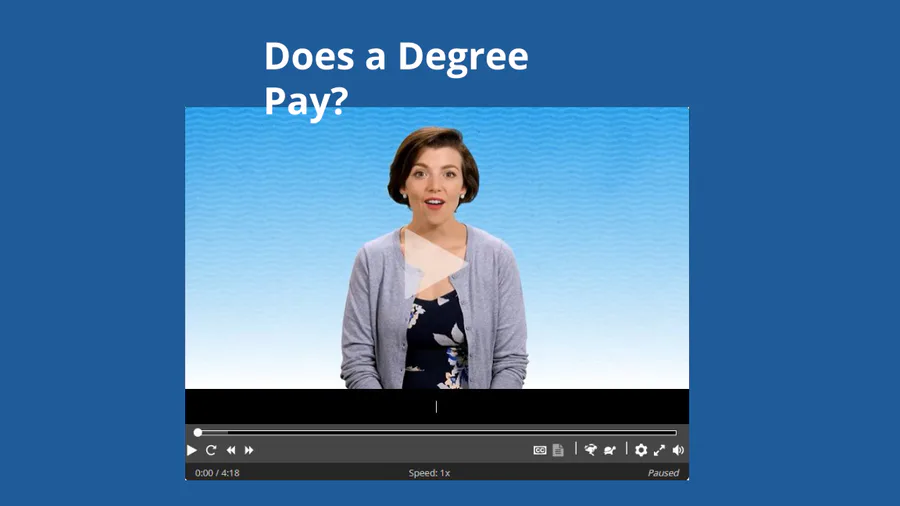
Yes or No: According to the video: Having a college degree does pay off in the long run?
Yes but it will take time to pay off student loans
No the pay increase is not enough
17
What if I got my degree only to find out that it is not the work I want to do?
What if there are not many jobs available in that degree field?
Does the degree I am getting allow me to transition easily to another career path later?
Do I need a degree in order to do the work I want to do?
What am I getting in exchange for the high tuition amount?
Is a Degree Worth It?!

18
Only 27% of college graduates have a job related to their degree.
That means that 73% of degrees are not even used for intended career paths.
On top of that, only 62% have a job that even requires a college degree.
Sadly, that means that 62% of degree-holders could have possibly avoided the college debt altogether.
Even worse off are those who start school, gain student loan debt, and do not finish. 40% of undergraduate students drop out of school.
Points to Ponder

19
Match

Match the definition to the correct terms
Small schools with a narrow focus of degrees
Typically a 4 year course of study
Local Colleges with Associate Programs
The cost to attend a college for one year
Typically a 2 year course of study
Colleges
bachelor's degree
Community Colleges
tuition
associate's degree
Colleges
bachelor's degree
Community Colleges
tuition
associate's degree
20
In this lesson, you learned:
the various benefits of obtaining a traditional degree
the positives and negatives of choosing the college pathway
the various options of degrees and schools from which to choose
In an upcoming lesson, you will learn about vocational education.
Summary
21
Multiple Choice

Which one of the following is the highest degree you can earn?
Associate's Degree
Bachelor's Degree
Master's Degree
Doctoral Degree
Brenda Brewer bbrewer@ccaeducate.me 570.820.4210 x24589
In a minute I am going to roll a letter dice
Based on the letter rolled, you will think of something that starts with that letter for which you are thankful
Type your word in the chat BUT wait to hit send until I say GO!
Show answer
Auto Play
Slide 1 / 21
SLIDE
Similar Resources on Wayground

17 questions
Simple past
Presentation
•
9th Grade
17 questions
Circumcenter and Incenter
Presentation
•
9th Grade
15 questions
Solving Equations Practice
Presentation
•
9th Grade
17 questions
Scientific Revolution
Presentation
•
9th Grade
16 questions
Quadratic Functions
Presentation
•
9th Grade
16 questions
Exponent Rules - Negative Exponents
Presentation
•
9th Grade
16 questions
Fragments and Runons
Presentation
•
9th Grade
16 questions
Python List Lesson
Presentation
•
9th Grade
Popular Resources on Wayground
10 questions
Safety Day 2026 – Student Review

Quiz
•
9th Grade
21 questions
Continents and Oceans
Quiz
•
6th Grade
20 questions
Parts of Speech
Quiz
•
5th Grade
16 questions
Subject & Predicate
Quiz
•
5th Grade
25 questions
Multiplication Facts
Quiz
•
5th Grade
12 questions
Map Skills
Quiz
•
3rd Grade
22 questions
Continents and Oceans
Quiz
•
5th Grade
15 questions
Rounding Decimals
Quiz
•
5th Grade
Discover more resources for Other
10 questions
Safety Day 2026 – Student Review
Quiz
•
9th Grade
20 questions
REGULAR Present tense verbs
Quiz
•
8th - 9th Grade
26 questions
SLIME!!!!!
Quiz
•
KG - 12th Grade
10 questions
Test Your Knowledge on Bullying
Quiz
•
9th Grade
12 questions
Absolute Value Equations
Quiz
•
9th Grade
20 questions
Position vs. Time Graphs
Quiz
•
9th Grade
20 questions
Function or Not a Function
Quiz
•
8th - 9th Grade
10 questions
Exploring Chemical and Physical Changes

Interactive video
•
6th - 10th Grade