

Writing an Essay Review: Dahl & The Narrative

Presentation
•
English
•
6th Grade
•
Practice Problem
•
Easy
+19
Standards-aligned

Kellece Branner
Used 13+ times
FREE Resource
8 Slides • 12 Questions
1
Multiple Choice
Why is it important to include a claim statement in the introduction of your essay?
It provides evidence for your argument.
It states your main idea or argument clearly.
It summarizes the entire essay.
It lists the sources you used.
2

3
Multiple Choice
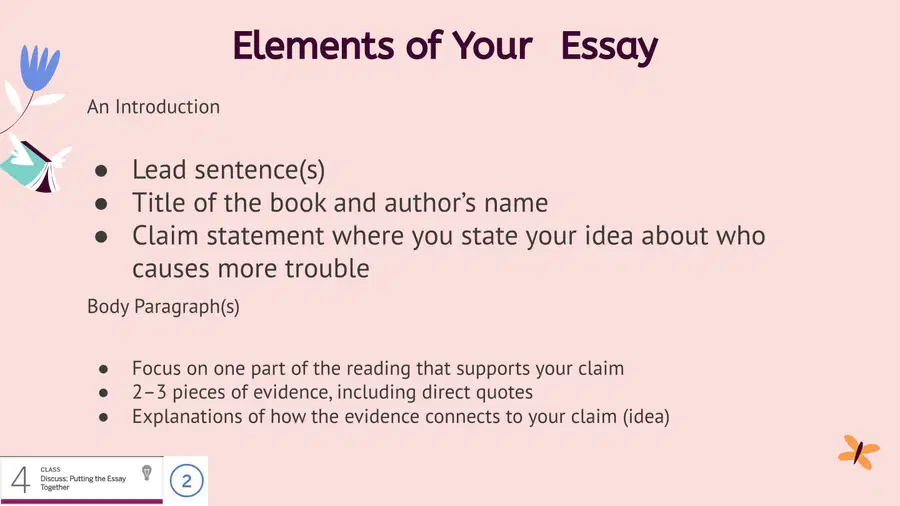
What are the three main elements that should be included in the introduction of your essay?
Lead sentence(s), title of the book and author’s name, claim statement
Conclusion, summary, references
Body paragraphs, citations, bibliography
Hook, statistics, counterclaim
4
Multiple Choice
Which of the following is NOT an element of a strong essay introduction, according to the slide?
Lead sentence(s)
Title of the book and author’s name
Claim statement about who causes more trouble
A summary of every chapter
5
6
7
Multiple Choice
What is the main claim of this essay?
Candy is dangerous for children's health
Thwaites's father is untrustworthy and enjoys causing trouble for boys
Children should avoid eating certain types of candy
Doctors know what's best for their children
8
9
10
11
Multiple Choice
Which evidence BEST supports the claim that the father is untrustworthy?
He is a medical doctor
He tells stories about candy ingredients
He makes up a fake disease called "ratitis"
He catches his son eating candy in bed
12
Multiple Choice
Which piece of evidence shows the father "enjoys causing trouble"?
He works as a doctor
He tells detailed, disgusting stories about rat's blood in candy
He finds Thwaites eating candy
He talks about different types of candy
13
Multiple Choice
The author's reasoning about the Liquorice Bootlaces story shows that the father is untrustworthy because:
He uses his authority as a doctor to make the lie more believable
He takes away Thwaites's allowance
He tells Thwaites to share the story with friends
He warns about the dangers of sugar
14
15
Multiple Choice
How does the chloroform story support the main claim?
It proves chloroform is dangerous
It shows the father creating another elaborate lie to deceive his son
It demonstrates the father's medical knowledge
It explains why children shouldn't eat candy
16
Multiple Choice
What effect do Mr. Thwaites’s stories have on Thwaites and his friends, according to Paragraph 3?
They make the boys trust adults more.
They make the boys want to eat more candy.
They make the boys suspicious of adults.
They make the boys want to become doctors.
17
Multiple Choice
What is the main reason Thwaites stops eating his favorite candy in Roald Dahl’s memoir Boy?
He is allergic to it.
His father convinces him it is dangerous.
His friends tell him to stop.
He runs out of money.
18
Multiple Choice
Which evidence-reasoning pair is strongest in supporting the main claim?
The father is a doctor - so he must be telling the truth
The ratitis story - shows he creates elaborate lies to trick his son
Thwaites eats candy in bed - proves he disobeys his father
The candy shop sells dangerous items - demonstrates adult negligence
19
Multiple Choice
Which statement best shows the author's reasoning about the father's behavior?
"Rather than helping his son learn about what really is healthy and unhealthy to eat, Mr. Thwaites deceived him into believing a lie"
"Most of us would do what Thwaites does"
"I ought to know. I'm a doctor"
"When you eat Bootlaces and catch this disease"
20
Sample Essay: The Trouble with Stories
Paragraph 1:
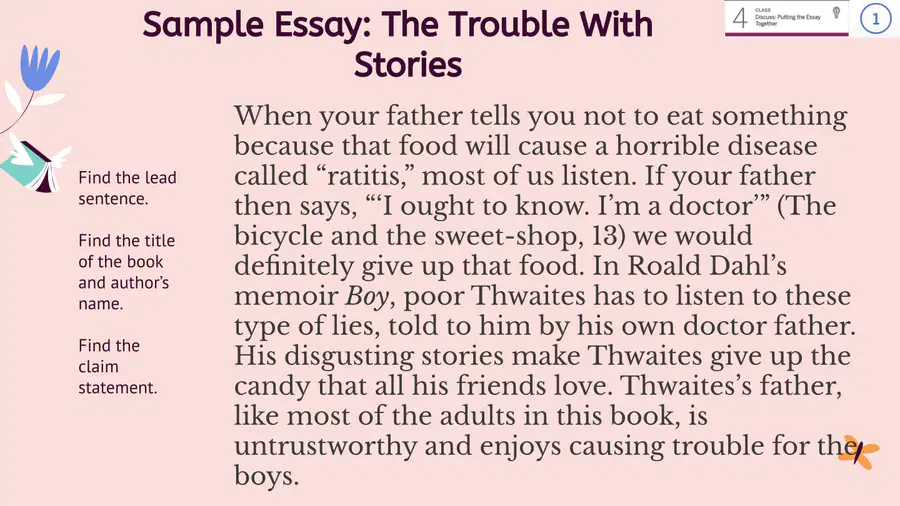
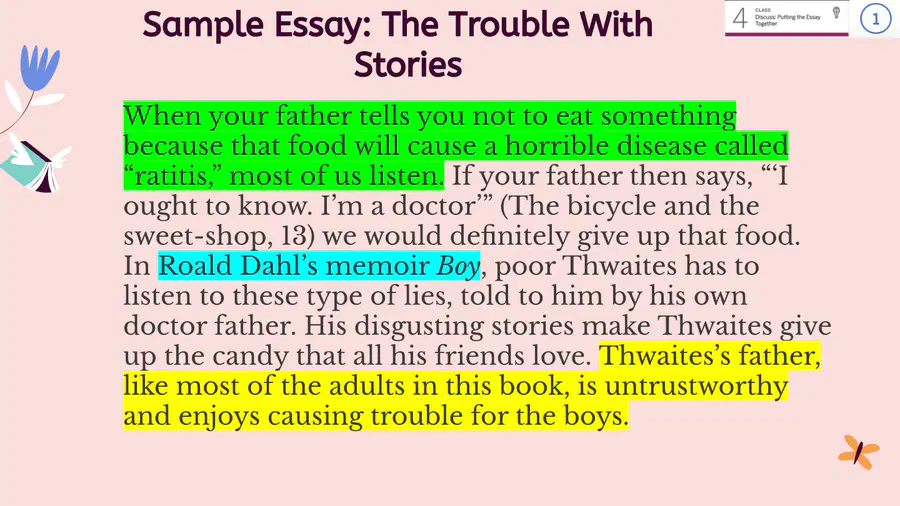
When your father tells you not to eat something because that food will cause a horrible disease called “ratitis,” most of us listen. If your father then says, “‘I ought to know. I’m a doctor’” (The bicycle and the sweet-shop, 13) we would definitely give up that food. In Roald Dahl’s memoir Boy, poor Thwaites has to listen to these types of lies, told to him by his own doctor father. His disgusting stories make Thwaites give up the candy that all his friends love. Thwaites’ father, like most of the adults in this book, is untrustworthy and enjoys causing trouble for the boys.
Paragraph 2:
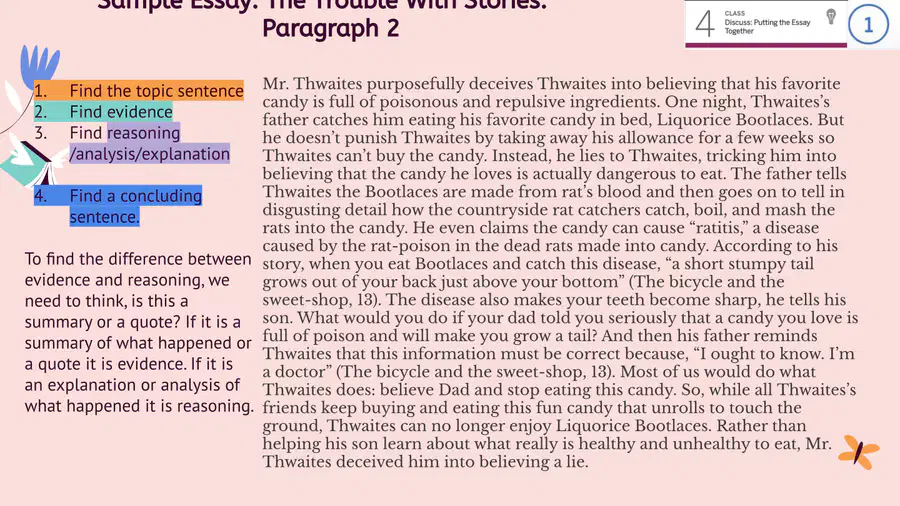
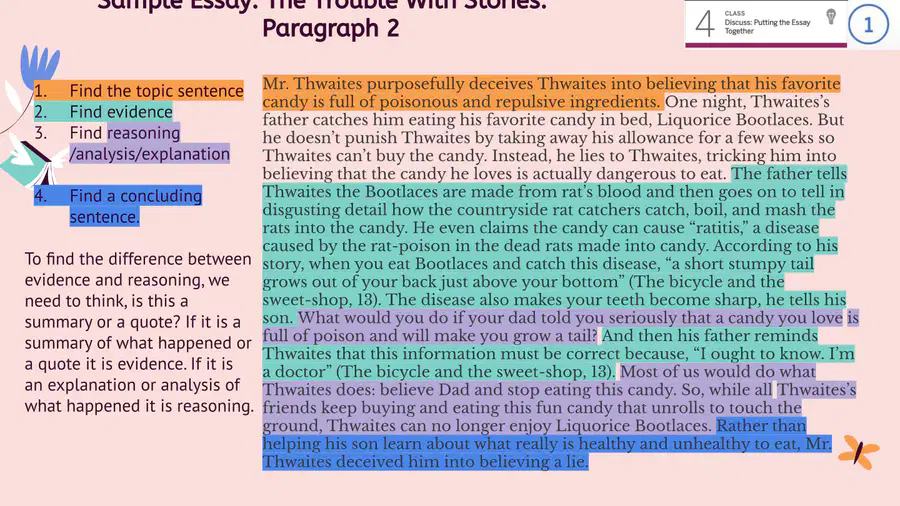
Mr. Thwaites purposefully deceives Thwaites into believing that his favorite candy is full of poisonous and repulsive ingredients. One night, Thwaites’ father catches him eating his favorite candy in bed, Liquorice Bootlaces. But he doesn’t punish Thwaites by taking away his allowance for a few weeks so Thwaites can’t buy the candy. Instead, he lies to Thwaites, tricking him into believing that the candy he loves is actually dangerous to eat. The father tells Thwaites the Bootlaces are made from rat’s blood and then goes on to tell in disgusting detail how the countryside rat catchers catch, boil, and mash the rats into the candy. He even claims the candy can cause “ratitis,” a disease caused by the rat-poison in the dead rats made into candy. According to his story, when you eat Bootlaces and catch this disease, “a short stumpy tail grows out of your back just above your bottom” (The bicycle and the sweet-shop, 13). The disease also makes your teeth become sharp, he tells his son. What would you do if your dad told you seriously that a candy you love is full of poison and will make you grow a tail? And then his father reminds Thwaites that this information must be correct because, “I ought to know. I’m a doctor” (The bicycle and the sweet-shop, 13). Most of us would do what Thwaites does: believe Dad and stop eating this candy. So, while all Thwaites’ friends keep buying and eating this fun candy that unrolls to touch the ground, Thwaites can no longer enjoy Liquorice Bootlaces. Rather than helping his son learn about what really is healthy and unhealthy to eat, Mr. Thwaites deceived him into believing a lie.
Paragraph 3:
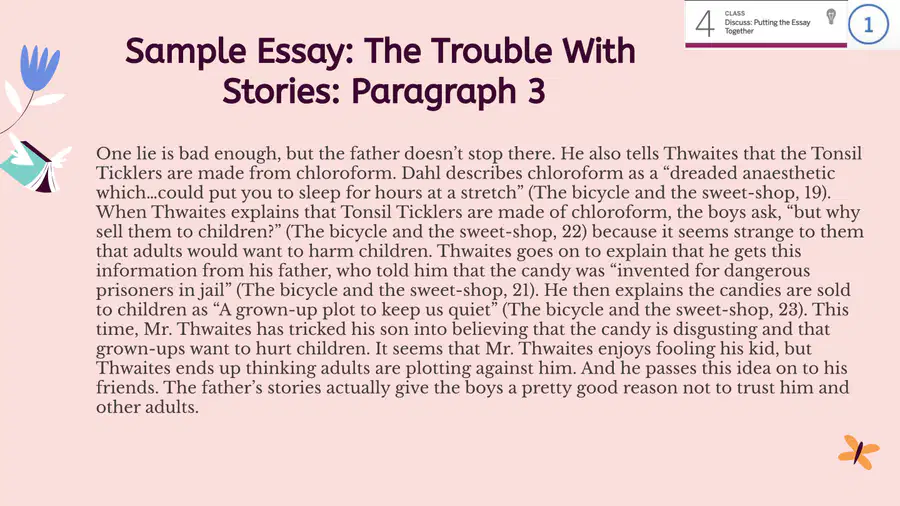
One lie is bad enough, but the father doesn’t stop there. He also tells Thwaites that the Tonsil Ticklers are made from chloroform. Dahl describes chloroform as a “dreaded anaesthetic which…could put you to sleep for hours at a stretch” (The bicycle and the sweet-shop, 19). When Thwaites explains that Tonsil Ticklers are made of chloroform, the boys ask, “‘but why sell them to children?’” (The bicycle and the sweet-shop, 22) because it seems strange to them that adults would want to harm children. Thwaites goes on to explain that he gets this information from his father, who told him that the candy was “invented for dangerous prisoners in jail” (The bicycle and the sweet-shop, 21). He then explains the candies are sold to children as “A grown-up plot to keep us quiet” (The bicycle and the sweet-shop, 23). This time, Mr. Thwaites has tricked his son into believing that the candy is disgusting and that grown-ups want to hurt children. It seems that Mr. Thwaites enjoys fooling his kid, but Thwaites ends up thinking adults are plotting against him. And he passes this idea onto his friends. The father’s stories actually give the boys a pretty good reason not to trust him and other adults.
Why is it important to include a claim statement in the introduction of your essay?
It provides evidence for your argument.
It states your main idea or argument clearly.
It summarizes the entire essay.
It lists the sources you used.
Show answer
Auto Play
Slide 1 / 20
MULTIPLE CHOICE
Similar Resources on Wayground

14 questions
Action or Linking?
Presentation
•
6th Grade
14 questions
Present Continuous Tense
Presentation
•
6th Grade
15 questions
Singular and Plural Nouns
Presentation
•
6th Grade
15 questions
What makes a poem, a poem?
Presentation
•
6th Grade
15 questions
Types of Conflict Review
Presentation
•
6th Grade
14 questions
Features of a Newspaper Report
Presentation
•
6th Grade
16 questions
Parentheses and Dashes
Presentation
•
6th Grade
14 questions
Connotation/Denotation
Presentation
•
6th Grade
Popular Resources on Wayground
10 questions
How much do you know about our Portrait of an Eagle?

Quiz
•
10th Grade
10 questions
Fast Food Slogans
Quiz
•
6th - 8th Grade
21 questions
Continents and Oceans
Quiz
•
6th Grade
20 questions
Parts of Speech
Quiz
•
5th Grade
16 questions
Subject & Predicate
Quiz
•
5th Grade
25 questions
Multiplication Facts
Quiz
•
5th Grade
12 questions
Map Skills
Quiz
•
3rd Grade
22 questions
Continents and Oceans
Quiz
•
5th Grade
Discover more resources for English
20 questions
Context Clues
Quiz
•
6th Grade
20 questions
Types of sentences
Quiz
•
6th Grade
25 questions
Making Inferences
Quiz
•
6th - 8th Grade
20 questions
Figurative Language Review
Quiz
•
6th Grade
15 questions
Plot Elements
Quiz
•
6th Grade
18 questions
Main Idea
Quiz
•
4th - 6th Grade
10 questions
Main Idea and Supporting Details
Quiz
•
3rd - 6th Grade
20 questions
Theme vs. Main Idea
Quiz
•
6th Grade