Search Header Logo
DNA Structure and Function Week 7

DNA Structure and Function Week 7

Assessment

Presentation

Science

University

Practice Problem

Hard

NGSS
HS-LS1-1, HS-LS3-2, HS-LS1-4

+2

Standards-aligned

Created by

Lee Ott

FREE Resource

28 Slides • 35 Questions

1

media

2

media

3

Open Ended

Why is understanding the structure of a cell important for studying DNA and RNA?

4

Multiple Choice

Question image
State Function
1
contains DNA
2
digests worn out cell parts
3
produces energy

5

media

6

media

7

Multiple Choice

Which of the following bases is found in RNA but not in DNA?

1

Uracil

2

Thymine

3

Adenine

4

Guanine

8

media

9

Multiple Select

Which of the following statements about pentose sugars in nucleic acids are correct?

1

Ribose is found in RNA.

2

Deoxyribose lacks an oxygen atom on carbon 2'.

3

Both DNA and RNA contain ribose.

4

Carbon atoms in sugars are numbered with primes.

10

media

11

Fill in the Blanks

Type answer...

12

media

13

media

14

Multiple Choice

Which carbon atom of the sugar in a nucleotide bonds to the phosphate group of the next nucleotide in a nucleic acid polymer?

1

3'-carbon

2

2'-carbon

3

4'-carbon

4

1'-carbon

15

Multiple Choice

What is the primary structure of a nucleic acid?

1

The unique sequence of bases

2

The double helix

3

The sugar-phosphate backbone

4

The hydrogen bonds between bases

16

media

17

Labelling

Label the following picture

Drag labels to their correct position on the image

Nitrogenous Base

Sugar base

Phosphate group

18

Multiple Choice

What type of bond links the sugars in adjacent nucleotides in a nucleic acid?

1

Phosphodiester bond

2

Hydrogen bond

3

Peptide bond

4

Glycosidic bond

19

media

20

Match

Question image

Match the following numbers in the diagram to what part of the DNA molecule they are pointing at.

4

5

3

6

2

hydrogen bonds

sugar phosphate backbone

nitrogenous bases

nucleotide

deoxyribose sugar

21

Dropdown

Question image
The two strands of DNA are held together by
.

22

media

23

Match

Question image

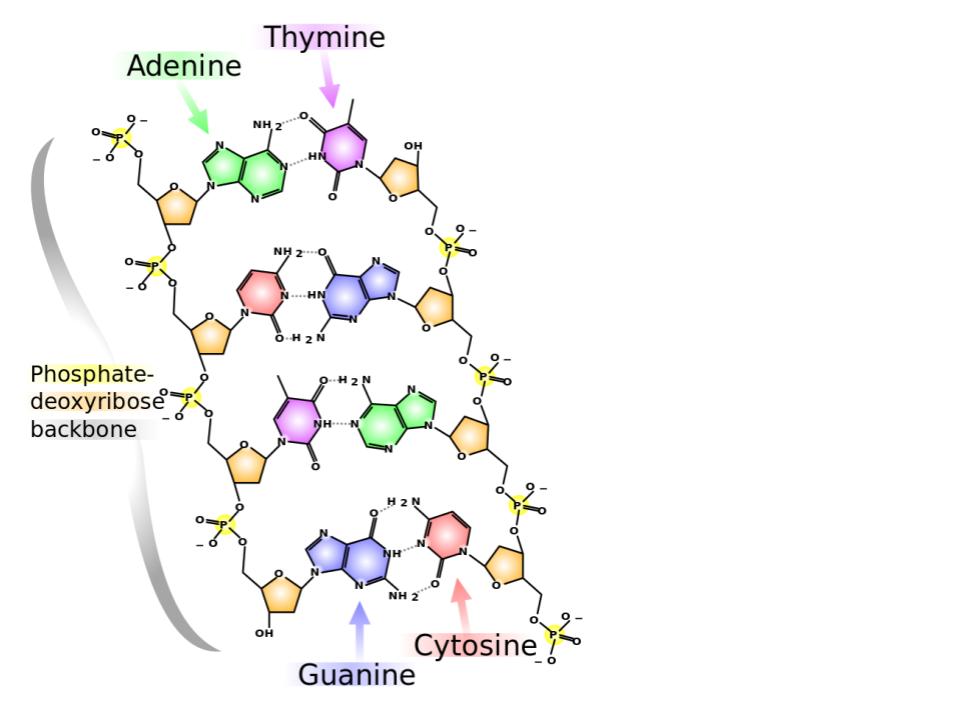
Match the following DNA complementary bases

Adenine

Cytosine

Guanine

Thymine

Thymine

Guanine

Cytosine

Adenine

24

Drag and Drop

Question image
In a molecule of double-stranded DNA, if you have 20% Adenine present then you would have ​
% Guanine,

% Cytosine, and ​
% Thymine present.
Drag these tiles and drop them in the correct blank above
20
30
60
40
10

25

Multiple Select

Which of the following statements about DNA base pairing are correct?

1

Adenine pairs with thymine

2

Guanine pairs with cytosine

3

Adenine pairs with cytosine

4

Guanine pairs with thymine

26

media

27

Multiple Choice

Who were the scientists that proposed the double helix structure of DNA in 1953?

1

James Watson and Francis Crick

2

Rosalind Franklin and Maurice Wilkins

3

Linus Pauling and Robert Corey

4

Erwin Chargaff and Oswald Avery

28

media

29

Fill in the Blanks

Type answer...

30

media

31

Multiple Choice

How many hydrogen bonds form between guanine and cytosine in DNA?

1

Three

2

One

3

Two

4

Four

32

media

33

Multiple Choice

Which base pairs are linked together by hydrogen bonds in the DNA double helix?

1

A and T, G and C

2

A and G, T and C

3

A and C, G and T

4

A and U, G and C

34

media

35

Open Ended

Explain the role of the replication fork and primer during DNA replication.

36

media

37

Multiple Select

Which of the following statements about the leading and lagging strands is/are correct?

1

The leading strand is synthesized continuously in a 5' to 3' direction.

2

The lagging strand is synthesized in short segments called Okazaki fragments.

3

Both strands are synthesized in the same direction as the replication fork movement.

4

The lagging strand is synthesized continuously.

38

media

39

Dropdown

After replication, each strand has ​
new strand(s) and ​
old strand(s).

40

media

41

Hotspot

Click where the replication fork(s) would be found at.

42

Labelling

Match the enzymes to the correct location.

Drag labels to their correct position on the image

Helicase

DNA Polymerase

Ligase

43

Labelling

Label the parts!

Drag labels to their correct position on the image

Single Stranded Binding Protein

Primer

DNA Polymerase

Topoisomerase

Replication fork

DNA Helicase

44

media

45

Match

Match the following molecules to their function:

Helicase

DNA Polymerase

RNA Polymerase

Primase

Single Stranded Binding Proteins

an enzyme that breaks the H bonds that hold the double helix together

an enzyme that adds new nucleotides to the exposed strands, creating new DNA

an enzyme that adds new nucleotides to the exposed strands, creating an RNA copy

an enzyme that lays down a primer for DNA polymerase

A structure that holds the double helix open, creating the replication bubble

46

Multiple Choice

Which enzyme is responsible for unzipping the DNA helix during replication?

1

Helicase

2

Ligase

3

Primase

4

DNA polymerase III

47

Multiple Choice

Which of the following statements about DNA polymerase III is correct?

1

It can synthesize a new DNA strand without a template.

2

It can only add nucleotides to an existing chain.

3

It can add nucleotides in any direction.

4

It can unwind the DNA molecule by itself.

48

media

49

media

50

Multiple Choice

Question image

What biotechnology is best illustrated by this diagram?

1

restriction enzymes

2

cloning

3

gel electrophoresis

4

gene therapy

51

Multiple Select

Which of the following are steps involved in the formation of recombinant DNA?

1

Mixing DNA fragments with plasmids in E. coli

2

Using restriction enzymes to cleave genes

3

Joining DNA ends with ligase

4

Heating DNA to separate strands

52

media

53

Fill in the Blanks

Type answer...

54

media

55

Multiple Choice

What is the first step in the Polymerase Chain Reaction (PCR) process?

1

Annealing

2

Extension

3

Denaturation

4

Final hold

56

Multiple Choice

At what temperature range does DNA denaturation typically occur in PCR?

1

50-60°C

2

70-80°C

3

90-95°C

4

100-105°C

57

media

58

Open Ended

Explain how PCR can be used to identify individuals at higher risk for breast cancer.

59

media

60

Multiple Choice

Question image
Which suspect is likely guilty?
1
Suspect #1
2
Suspect #2
3
Suspect #3

61

media

62

media

63

Open Ended

How does understanding cell structure help you make sense of DNA, RNA, and DNA replication?

media

Show answer

Auto Play

Slide 1 / 63

SLIDE

Discover more resources for Science