Search Header Logo
Enzyme Notes P.2

Enzyme Notes P.2

Assessment

Presentation

Science

9th Grade

Medium

NGSS
MS-PS1-5, HS-LS2-5

Standards-aligned

Created by

Alexa Solis

Used 6+ times

FREE Resource

11 Slides • 24 Questions

1

media

2

Multiple Choice

Question image
Enzymes are...
1
Nucleic Acids
2
Proteins
3
Lipids
4
Carbohydrates

3

media

4

Multiple Choice

Which of the following best describes the specificity of enzymes for their substrates?

1

Enzymes can bind to any molecule.

2

Enzymes are substrate specific and only bind to certain molecules.

3

Enzymes only bind to proteins.

4

Enzymes can bind to all types of substrates at the same time.

5

media

6

Multiple Choice

What is a cataylst?

1
A substance that speeds up a rate of chemical reaction.
2
Molecules that make enzymes work harder and faster 
3
reaction of an enzyme
4
A substance that slows down a rate of chemical reaction.

7

media

8

Multiple Choice

Question image

In the diagram, what is letter A?

1

product

2

enzyme-substrate complex

3

substrate

4

active site

9

Multiple Choice

Question image

Letter D...

1

enzyme

2

active site

3

substrate

4

products

10

Multiple Choice

Question image

Letter B...

1

substrate

2

active site

3

enzyme

4

products

11

Multiple Choice

Question image

Letter C...

1

products

2

substrate

3

enzymes

4

active site

12

Multiple Choice

Question image

Letter E...

1

active site

2

products

3

substrate

4

enzyme

13

Multiple Select

Which of the following statements about enzymes are correct? (select 2)

1

Enzymes are reusable.

2

Each enzyme works best at a certain pH and temperature.

3

Enzymes are always destroyed after a reaction.

4

Enzymes can only work with one specific substrate.

14

Multiple Choice

Question image
With what 3 letters do enzymes typically end?
1
-ose
2
-ase
3
-ese
4
-tic

15

Multiple Choice

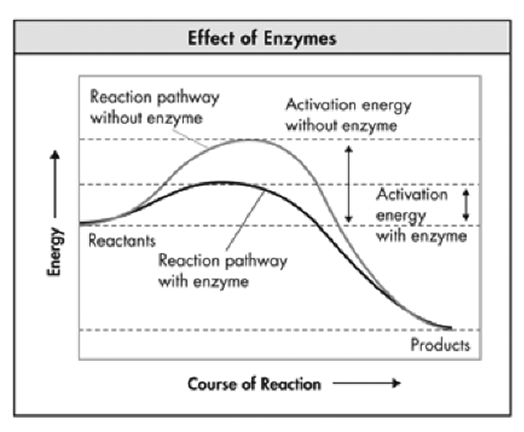
Question image
The graph shows how enzymes affect reactions in cells. Which statement best summarizes the information shown in the graph?
1
Enzymes increase the energy of the reactants.
2
Enzymes decrease the energy level of the products.
3
Enzyme decrease the activation energy of the reaction.
4
Enzymes reverse the direction of the reaction.

16

media

17

media

18

media

19

Multiple Choice

Which factors can impact enzyme function?

1

Temperature, pH, and inhibitors

2

Light, sound, and pressure

3

Water, salt, and sugar

4

Oxygen, carbon dioxide, and nitrogen

20

media

21

media

22

Dropdown

When an enzyme is denatured, its shape is ​​
changed.

23

Multiple Choice

Question image

Which image shows the enzyme being denatured?

1
2

24

media

25

Multiple Choice

Question image

Which line shows that an enzyme works best at a pH pf 9?

1

A

2

B

3

C

26

Multiple Choice

Question image

Which Enzyme works best at a temperature of 37?

1

Enzyme A

2

Enzyme B

27

Multiple Choice

Question image

Which Enzyme works best at a pH of 7.5?

1

Enzyme A

2

Enzyme B

28

Multiple Choice

Question image

Which Enzyme works best at a pH of 7?

1

Enzyme A

2

Enzyme B

29

Multiple Select

Question image

Which line shows that an enzyme that has been denatured at a pH of 9?

1

A

2

B

3

C

30

Multiple Choice

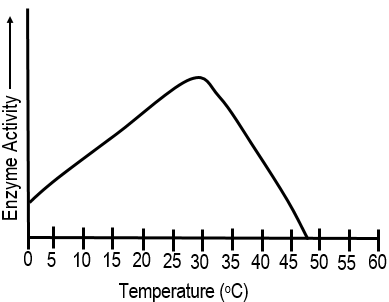
Question image
Based on the graph, what is the optimal temperature for this enzyme? 
1
15oC
2
40oC
3
30oC
4
35oC

31

Multiple Choice

Question image

What can we conclude from the graph? At a temperature of 62 ...

1

Enzyme activity is highest

2

Enzyme activity is low but working

3

Enzyme is denatured

32

Multiple Choice

Which graph shows that an enzyme works best at 100 degrees?

1
2
3
4

33

Multiple Choice

Question image

9C The graphs show the reaction rate for an enzyme across a range of temperatures and pH.


Based on these data, this enzyme functions best at what temperature and pH?

1

Temperature of 27°C and a pH of 4

2

Temperature of 37°C and a pH of 6

3

Temperature of 40°C and a pH of 8

4

Temperature of 50°C and a pH of 10

34

Multiple Choice

Question image
At high temperatures enzyme activity declines because of:
1
Denaturation
2
Decreased Kinetic Motion
3
Increased H-Bonding
4
Dissociation of Ionic Compounds

35

Glue notes in notebook

media

Show answer

Auto Play

Slide 1 / 35

SLIDE