Search Header Logo
Layers of the Earth Guided Notes

Layers of the Earth Guided Notes

Assessment

Presentation

English

8th Grade

Medium

CCSS
RI.7.3, RI.7.5, RI.8.3

+2

Standards-aligned

Created by

Tracy Merica

Used 5+ times

FREE Resource

29 Slides • 26 Questions

1

media

2

media

3

media

4

Multiple Choice

According to planetary differentiation, earth's layer are sorted by:

1

mass

2

volume

3

age

4

density

5

Multiple Choice

The temperature of the earth _________ as you go deeper

1

gets cooler

2

stays the same

3

gets warmer

4

decreases

6

media

7

Multiple Choice

What is one of the primary sources of heat in the earth's interior?

1

heat from the sun

2

microwave radiation

3

radioactive decay

4

kinetic energy as we move in orbit around the sun

8

Multiple Choice

Violent collisions of planetesimals during the formation of the planet generated a significant amount of earth's internal heat.

1

true

2

false

9

media

10

Multiple Choice

What causes convection current in the Earth?

1

The uneven heating on each layer inside the Earth.

2

The crusts outer layer.

3

The temperatures we feel outside.

11

Multiple Choice

Question image
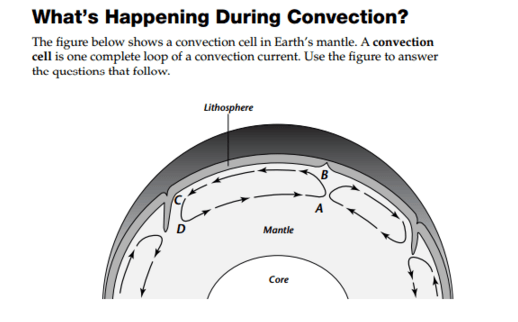
Where does the heat come from that drives this convection current in the mantle?
1
the sun
2
the core
3
the ocean
4
the mantle

12

media

13

media

14

media

15

media

16

media

17

Multiple Choice

Which of the following represents physical layers of Earth?

1

core, mantle, crust

2

core, mantle, oceanic crust, continental crust

3

inner core, outer core, mesosphere, asthenosphere, lithosphere

4

inner core, outer core, mantle, oceanic crust, continental crust

18

Multiple Choice

Which of the following represents chemical layers of Earth?

1

core, mantle, crust

2

core, mantle, lithosphere

3

inner core, outer core, mesosphere, asthenosphere, lithosphere

4

inner core, outer core, mantle, oceanic crust, continental crust

19

media

20

Multiple Choice

Question image

The crust and the uppermost mantle make up the solid layer of hard rock called the

1

inner core

2

asthenosphere

3

lithosphere

4

outer core

21

Multiple Choice

Question image

How does temperature change as you move from the crust to the core?

1

it gets cooler

2

it gets hotter

3

it stays the same

4

the core is frozen

22

media

23

media

24

Multiple Choice

What characteristic describes the asthenosphere?
1
Solid and rigid (stiff)
2
Liquid and flowing like water
3
Weak, semi-solid, and putty-like
4
Gas and vapor

25

media

26

Multiple Choice

What is the core made of?
1
steel
2
iron 
3
aluminum
4
iron and nickel

27

Multiple Choice

What describes the outer core?
1
solid
2
liquid
3
viscous
4
gas

28

Multiple Select

Which things increase as depth increases into the Earth?

1

time

2

Pressure

3

temperature

4

density

29

media

30

media

31

media

32

media

33

Multiple Choice

The epicenter of an earthquake is
1

The point below the surface where rock begins to break and the first motion occurs

2

The seismic station closest to the earthquake

3

The place where the greatest damage occurs

4

The point on the surface directly above the focus

34

Multiple Choice

Where is the point at which the first movement occurs during an earthquake?
1
Epicenter
2
Focus
3
Fault
4
Plate

35

media

36

Multiple Choice

Question image
The illustration shows a light ray striking an object.
In the illustration, the light ray striking the object is-
1
absorbed
2
stopped
3
reflected
4
refracted

37

Multiple Choice

Refraction occurs when _____________
1

the wave's speed changes by entering a new layer

2
a wave bounces off of a boundary
3
waves parts meet each other
4
waves bend around a barrier

38

media

39

Multiple Choice

Which type of wave arrives to a point first?
1
Primary Waves (P-Waves)
2
Secondary Waves (S-Waves)
3
Rayleigh Waves
4
Love Waves

40

Multiple Choice

Which classification of wave does the most damage?
1
Body Waves
2
Mega Waves
3
Surface Waves
4
Love Waves

41

Multiple Choice

Which travels fastest, always being the first detected by seismic stations?
1
P waves
2
S waves

42

Multiple Choice

Which kind of waves canNOT travel through a liquid?
1
P waves
2
S waves

43

media

44

media

45

media

46

Multiple Choice

Question image
What type of wave are the PINK waves? (orange circle is the core)
1
P-waves
2
S-waves
3
Love waves
4
Raleigh waves

47

Multiple Choice

Question image
What type of wave are the BLUE waves? (orange circle is the core)
1
P-waves
2
S-waves
3
Love waves
4
Raleigh waves

48

Multiple Choice

Question image
Which body wave is pictured?
1
P-Wave
2
S-Wave
3
Rayleigh Wave
4
Love Wave

49

Multiple Choice

Question image

The diagram shows a

1

S wave

2

P wave

50

media

51

media

52

media

53

media

54

media

55

media
media

Show answer

Auto Play

Slide 1 / 55

SLIDE