

Fisiologia do Sistema Somático e Visceral

Presentation
•
Health Sciences
•
University
•
Practice Problem
•
Hard

Jessica Sobrinho
FREE Resource
47 Slides • 27 Questions
1

2

3
Open Ended
Why is it important for health professionals to understand the differences between the somatic and visceral nervous systems?
4
Multiple Choice
What is the main function of the somatic nervous system?
To regulate internal organs automatically
To send sensory information to the central nervous system and control voluntary muscles
To control the digestive system
To produce hormones
5
6
Multiple Choice
Which of the following best describes the main function of the somatic nervous system?
It controls voluntary movements by innervating skeletal muscles.
It regulates involuntary functions such as heartbeat and digestion.
It processes sensory information from the environment.
It produces hormones for the endocrine system.
7

8
Multiple Choice
What is the primary difference between cardiac muscle and skeletal muscle as described in the lesson?
Cardiac muscle contracts rhythmically without direct innervation from the visceral nervous system, while skeletal muscle requires direct innervation to contract.
Cardiac muscle is voluntary, while skeletal muscle is involuntary.
Skeletal muscle is found only in the heart, while cardiac muscle is found throughout the body.
Cardiac muscle receives signals from the central nervous system, while skeletal muscle does not.
9
Multiple Select
Which of the following are characteristics of smooth muscle?
It lines the digestive tract and blood vessels.
It is under voluntary control.
It receives input from the visceral nervous system.
It is striated like skeletal muscle.
10

11
Fill in the Blanks
Type answer...
12

13
Open Ended
Explain how the distribution of lower motor neurons in the spinal cord relates to the control of distal and proximal muscles.
14

15
Multiple Choice
According to Henneman's size principle, which motor neurons are recruited first during muscle contraction?
Small alpha motor neurons
Large alpha motor neurons
Gamma motor neurons
Sensory neurons
16

17

18
Multiple Choice
Which of the following options correctly describes the role of alpha motor neurons in muscle control?
Alpha motor neurons are responsible for the release of neurotransmitters in the central nervous system.
Alpha motor neurons directly control heart rate.
Alpha motor neurons are responsible for regulating peristalsis in the digestive tract.
Alpha motor neurons are responsible for activating skeletal muscles.
Alpha motor neurons are responsible for regulating blood pressure.
19

20
Open Ended
Explain the main differences between red (slow-twitch) and white (fast-twitch) muscle fibers and how these differences affect muscle performance.
21

22

23
Multiple Choice
Which of the following statements correctly describes excitation-contraction coupling in the process of muscle contraction?
Muscle contraction is initiated by the release of adrenaline from the ends of motor neuron axons.
Acetylcholine produces an inhibitory postsynaptic potential in the postsynaptic membrane, resulting in muscle fiber contraction.
Muscle contraction is triggered by the release of K+ ions from organelles located in muscle fibers.
The excitatory postsynaptic potential is sufficient to cause action potentials in muscle fibers, triggering the release of Ca2+ ions.
Muscle relaxation occurs due to the continuous release of acetylcholine from the ends of motor neuron axons.
24
Fill in the Blanks
Type answer...
25

26
Multiple Select
Which of the following structures are found within a skeletal muscle fiber?
Myofibril
Nucleus
Sarcolemma
Tendon
27

28

29
Multiple Choice
Which of the following steps is essential for the initiation of muscle contraction?
Release of acetylcholine at the neuromuscular junction
Closure of sodium channels in the muscle membrane
Binding of ATP to troponin
Inhibition of calcium release from the sarcoplasmic reticulum
30

31
Open Ended
Describe the sequence of events that leads from excitation to relaxation in skeletal muscle fibers.
32
33
Multiple Choice
What is the primary function of muscle spindles in proprioception?
Detecting changes in muscle length
Generating voluntary muscle contractions
Producing ATP for muscle contraction
Transmitting pain signals
34

35
Multiple Choice
Which of the following statements about the stretch reflex (reflexo miotático) is correct?
It inhibits the contraction of the agonist muscle.
It is triggered by the stimulation of Golgi tendon organs.
It involves direct synaptic connection between sensory and motor neurons in the spinal cord.
It requires input from the brain to occur.
36

37

38
Open Ended
Explain how inhibitory interneurons contribute to the regulation of muscle contraction during proprioceptive reflexes.
39
Fill in the Blanks
Type answer...
40

41
Open Ended
Explain the role of interneurons in the spinal cord in coordinating motor responses, especially in relation to the Golgi tendon organs and muscle spindles.
42
43
Multiple Choice
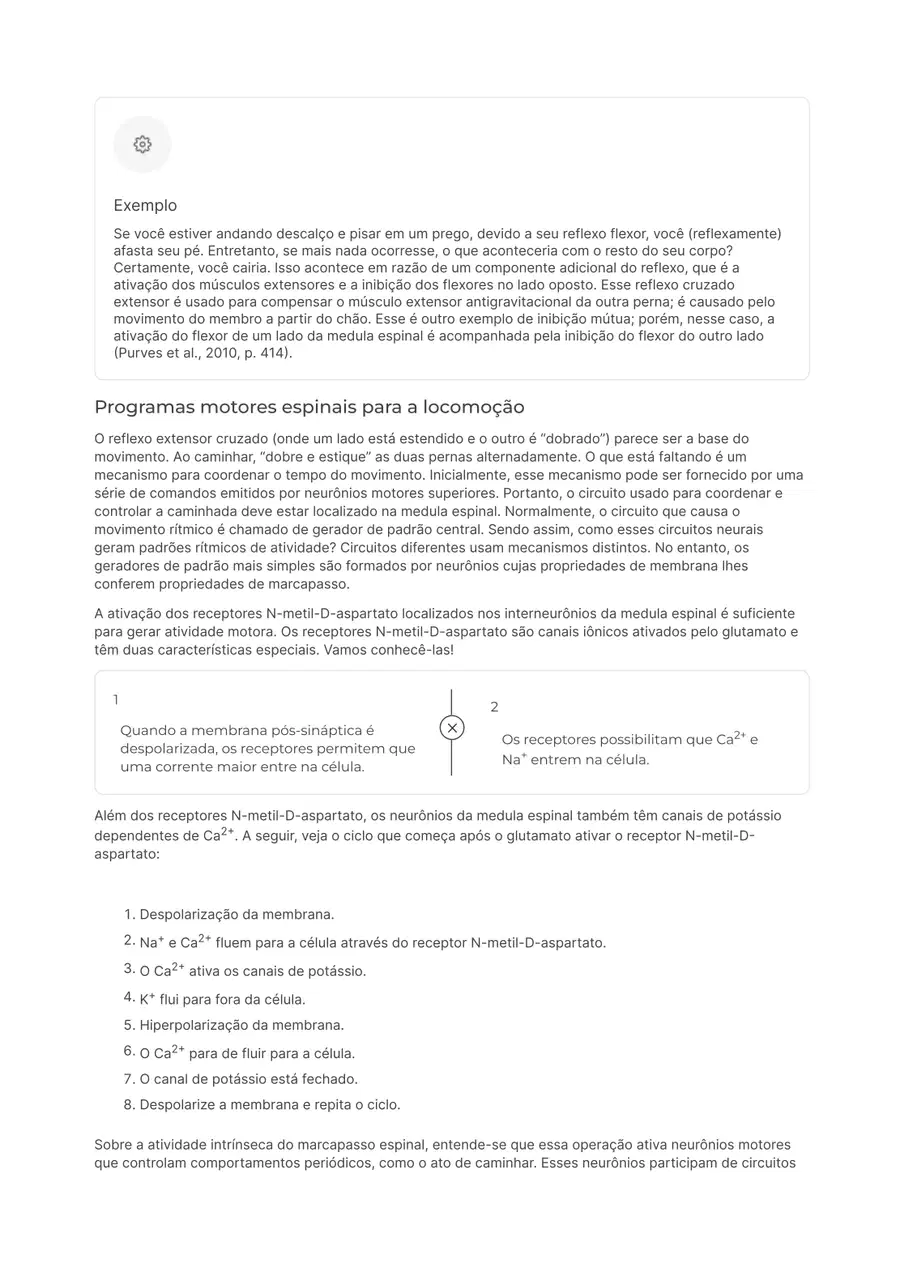
Which of the following statements best describes the function of the N-methyl-D-aspartate (NMDA) receptors in spinal interneurons during locomotion?
They inhibit the entry of Ca2+ and Na+ into the cell.
They allow a greater current to enter the cell when the postsynaptic membrane is depolarized.
They block the activation of potassium channels.
They prevent the depolarization of the membrane.
44
45

46

47
Multiple Select
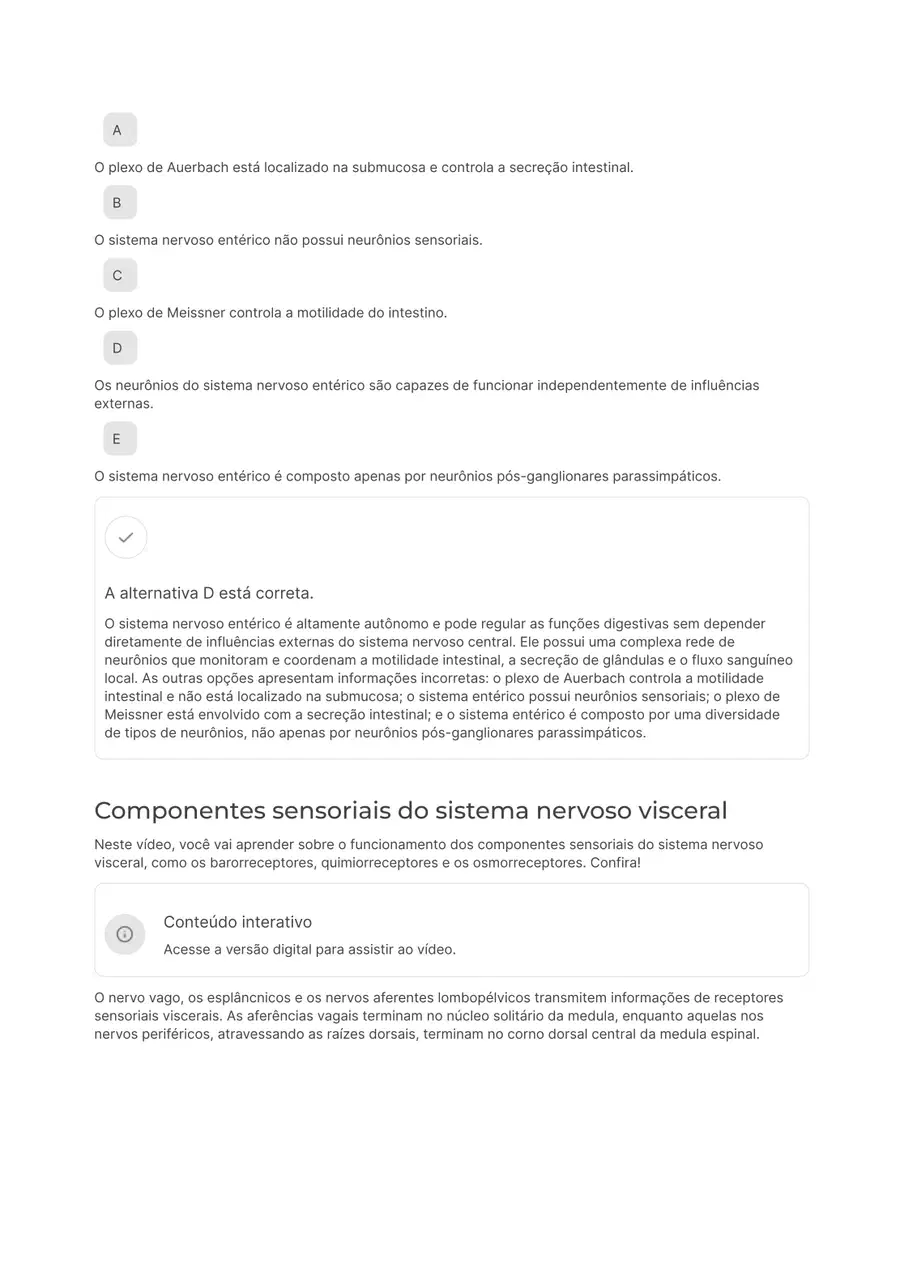
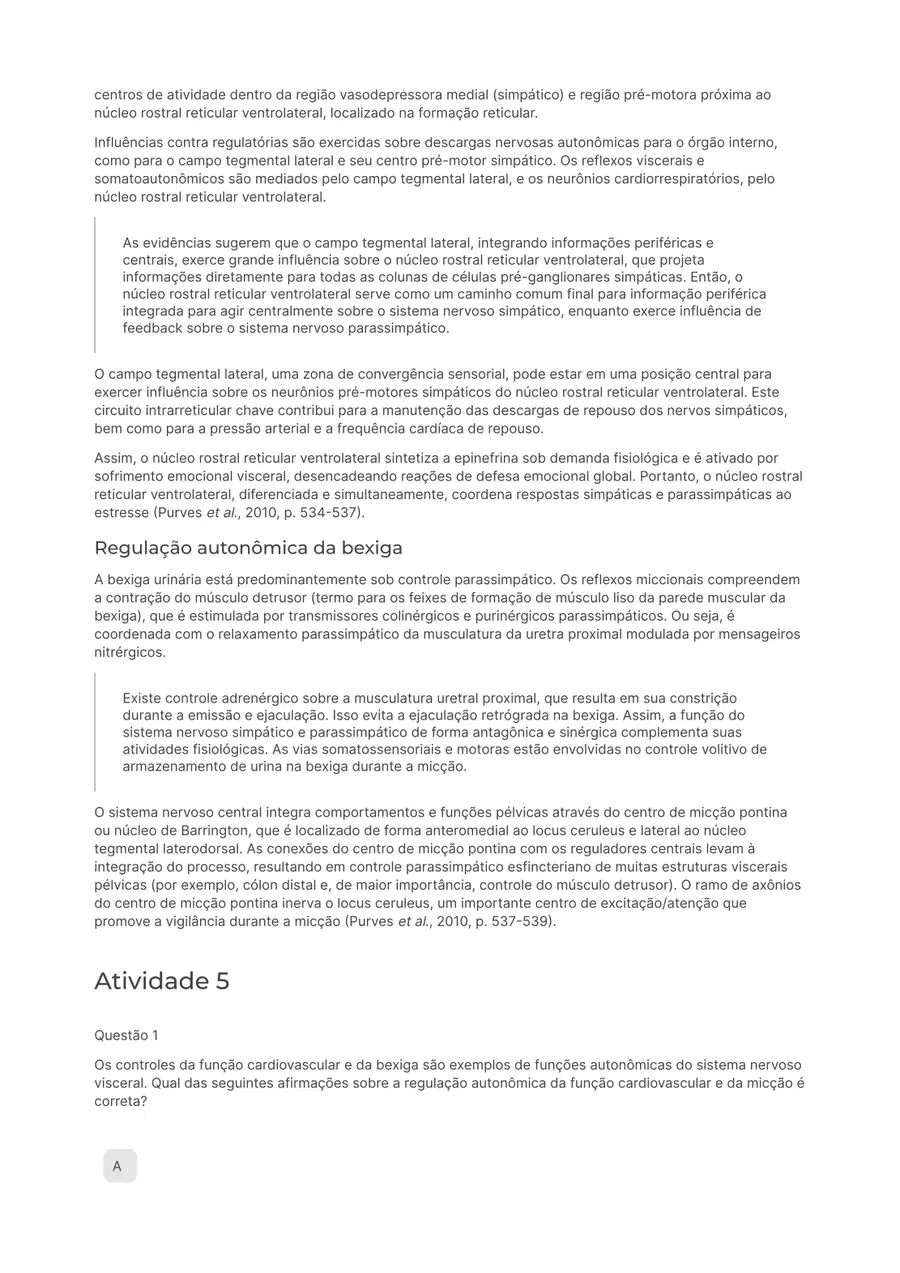
Which of the following are correct regarding the sympathetic and parasympathetic divisions of the autonomic nervous system?
The sympathetic division is also called the thoracolumbar system.
The parasympathetic division uses acetylcholine as its main neurotransmitter for postganglionic fibers.
The sympathetic division's preganglionic fibers emerge from the cranial nerves.
The parasympathetic division is responsible for 'fight or flight' responses.
48
Fill in the Blanks
Type answer...
49

50
Multiple Choice
Which of the following statements about the visceral nervous system is correct?
The sympathetic division is responsible for stimulating digestion and absorption of food.
The parasympathetic division stimulates the 'fight or flight' response during stress.
The enteric division can function independently of the sympathetic and parasympathetic nervous systems.
The main neurotransmitter released by postganglionic fibers of the sympathetic system is acetylcholine.
51
Open Ended
Compare the functions of the myenteric (Auerbach's) plexus and the submucosal (Meissner's) plexus in the enteric nervous system.
52

53

54

55

56

57

58

59

60

61
62

63

64

65

66

67

68

69

70
71

72

73
Multiple Choice
Which of the following is NOT a component of the visceral nervous system?
Sympathetic
Parasympathetic
Enteric
Somatic
74
Open Ended
What are the main differences between the somatic nervous system and the visceral nervous system in terms of their functions and the type of information they transmit?
Show answer
Auto Play
Slide 1 / 74
SLIDE
Similar Resources on Wayground

71 questions
TEN ASEAN MEMBER STATES
Presentation
•
University
69 questions
Topic 6 The Internet
Presentation
•
University
68 questions
energy
Presentation
•
University
68 questions
POM: Process Hazard 2.2 - 2.10
Presentation
•
University - Professi...
68 questions
Management of Creative People and Innovation
Presentation
•
University
70 questions
Untitled Presentation
Presentation
•
University
67 questions
Cost Estimation Techniques
Presentation
•
University
68 questions
CE_101 Review of Lessons
Presentation
•
University
Popular Resources on Wayground
20 questions
Math Review

Quiz
•
3rd Grade
15 questions
Fast food
Quiz
•
7th Grade
20 questions
Context Clues
Quiz
•
6th Grade
20 questions
Inferences
Quiz
•
4th Grade
19 questions
Classifying Quadrilaterals
Quiz
•
3rd Grade
20 questions
Figurative Language Review
Quiz
•
6th Grade
20 questions
Equivalent Fractions
Quiz
•
3rd Grade
10 questions
Identify Fractions, Mixed Numbers & Improper Fractions
Quiz
•
3rd - 4th Grade
Discover more resources for Health Sciences
20 questions
Guess The App
Quiz
•
KG - Professional Dev...
11 questions
NFL Football logos
Quiz
•
KG - Professional Dev...
19 questions
Minecraft
Quiz
•
6th Grade - Professio...
40 questions
8th Grade Math Review
Quiz
•
8th Grade - University
20 questions
Block Buster Movies
Quiz
•
10th Grade - Professi...
10 questions
Would you rather...
Quiz
•
KG - University
40 questions
Flags of the World
Quiz
•
KG - Professional Dev...
14 questions
Superhero
Quiz
•
1st Grade - University