

Chem 5-6 Metal and Nonmetal Reactivity

Presentation
•
Physics
•
10th Grade
•
Practice Problem
•
Easy
Standards-aligned

KARLY CUMMINS
Used 3+ times
FREE Resource
12 Slides • 13 Questions
1

2
Open Ended
Why is it important to understand the reactivity of metals and nonmetals in everyday life?
3

4
Multiple Choice
Which of the following metals is most likely to react with cool or cold water?
Gold
Sodium
Copper
Silver
5

6
Multiple Choice
Which of the following metals is most likely to react with cool water?
Sodium
Iron
Gold
Copper
7
8
Multiple Select
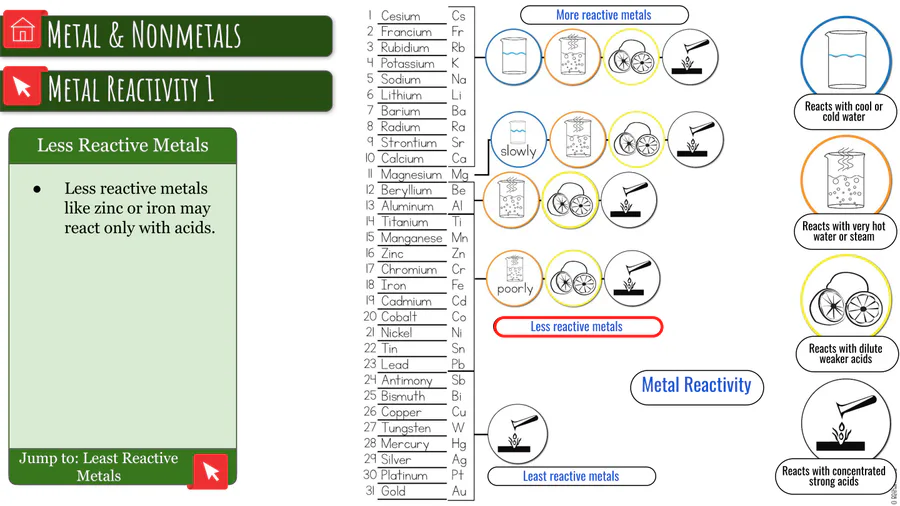
Which of the following statements about less reactive metals are correct?
They react only with acids.
They corrode easily.
They do not react with cool water.
Examples include zinc and iron.
9
10
Fill in the Blanks
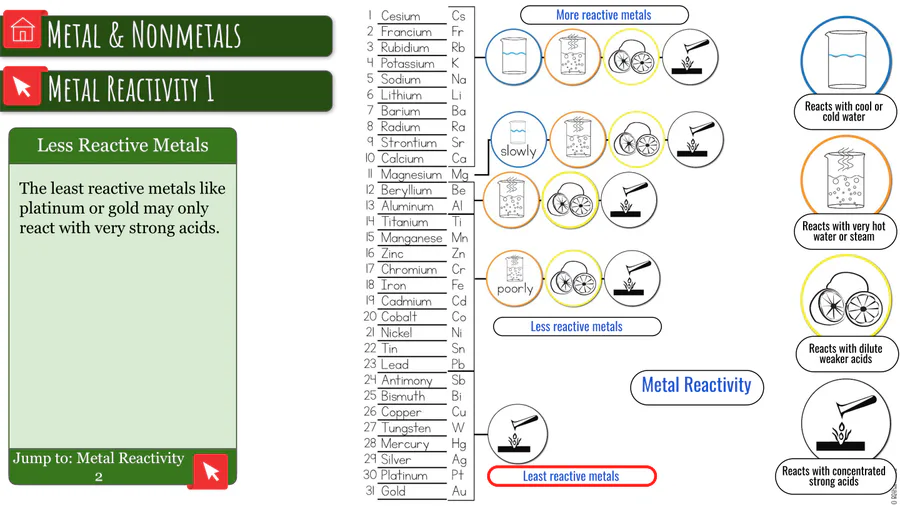
The least reactive metals, such as platinum or gold, may only react with very
Type answer...
11

12
Open Ended
Explain how the periodic table can be used to determine the reactivity of metals.
13

14
Multiple Choice
Why are metals further down in a group usually more reactive?
They have more energy levels, making it easier to remove an electron.
They have fewer protons.
They are heavier.
They have smaller atomic radii.
15

16
Multiple Choice
As you move across a period in the periodic table, what happens to the reactivity of metals?
It usually decreases.
It usually increases.
It stays the same.
It fluctuates randomly.
17

18

19
Multiple Select
Which of the following elements exist as diatomic molecules in nature?
Fluorine
Chlorine
Oxygen
Sulfur
20
Multiple Choice
Which of the following statements best explains why highly reactive nonmetals tend to gain electrons when reacting with metals?
They have large electron affinities.
They have small atomic radii.
They are good conductors of electricity.
They have high melting points.
21

22

23
Open Ended
Explain how the reactivity of nonmetals changes within a group and within a period in the periodic table.
24
Fill in the Blanks
As the atomic number increases across a period, the electron affinity
Type answer...
25
Open Ended
Summarize what you learned about the reactivity of metals with water and acids. How do different metals behave when reacting with these substances?
Show answer
Auto Play
Slide 1 / 25
SLIDE
Similar Resources on Wayground

18 questions
Law of Conservation of Linear Momentum and Impulse
Presentation
•
10th Grade
23 questions
electromagnetic waves
Presentation
•
10th Grade
20 questions
Get Smart Plus 3 Topic 8 was/were
Presentation
•
1st - 4th Grade
20 questions
Boyle's Law and Charles' Law
Presentation
•
10th Grade
20 questions
One Step Equations
Presentation
•
KG - University
20 questions
1.1.2 Cell Transport
Presentation
•
10th Grade
20 questions
Connotation & Denotation
Presentation
•
10th Grade
20 questions
Barisan Aritmatika
Presentation
•
10th Grade
Popular Resources on Wayground
21 questions
Continents and Oceans

Quiz
•
6th Grade
20 questions
Parts of Speech
Quiz
•
5th Grade
16 questions
Subject & Predicate
Quiz
•
5th Grade
25 questions
Multiplication Facts
Quiz
•
5th Grade
12 questions
Map Skills
Quiz
•
3rd Grade
22 questions
Continents and Oceans
Quiz
•
5th Grade
15 questions
Rounding Decimals
Quiz
•
5th Grade
20 questions
Brand Labels
Quiz
•
5th - 12th Grade
Discover more resources for Physics
4 questions
Waves Quiz Part 2 Fall 2026
Quiz
•
9th - 12th Grade
11 questions
Free Fall Motion
Quiz
•
9th - 12th Grade
20 questions
Newton's 2nd Law
Quiz
•
9th - 12th Grade
17 questions
Free Body Diagrams
Quiz
•
9th - 12th Grade
35 questions
Projectiles
Quiz
•
9th - 12th Grade
18 questions
Newton's First law
Presentation
•
9th - 12th Grade
8 questions
Phase Changes
Presentation
•
5th - 12th Grade
10 questions
Significant Figures
Quiz
•
10th - 12th Grade