

Blood Vessels and Blood Pressure

Presentation
•
Biology
•
9th - 12th Grade
•
Practice Problem
•
Easy
Standards-aligned

Tara Arcand
Used 2+ times
FREE Resource
34 Slides • 33 Questions
1

2
Open Ended
How does blood circulate through the body?
3

4
Open Ended
What are the four types of tissues that cells can form in organs?
5

6
7
Multiple Choice
Which of the following structures is present in veins but not in arteries?
Valves
Smooth muscle
Endothelium
Basement membrane
8
Multiple Choice
Which of the following best describes the structural differences between arteries, veins, and capillaries?
Arteries have thick muscular walls, veins have valves, and capillaries are one cell thick.
Arteries have valves, veins have thick muscular walls, and capillaries are elastic.
Veins and arteries are both one cell thick, while capillaries have thick walls.
Capillaries have valves, arteries are one cell thick, and veins are elastic.
9
Multiple Select
Which features are common to both arteries and veins?
Endothelium (Inner skin tissue layer)
Valves
Smooth muscle
Elastic Layer
10
Multiple Select
Based on the diagrams, which of the following statements about veins are correct?
Veins have valves to prevent backflow.
Veins rely on skeletal muscle contraction to help blood flow.
Veins have the thickest walls of all blood vessels.
Veins carry blood away from the heart.
11

12

13

14

15

16
17

18
19

20

21
Open Ended
Explain how the nervous system regulates blood pressure through vasoconstriction and vasodilation.
22
Multiple Choice
How does blood pressure create a pulse in the arteries, and how can it be measured?
Blood pressure creates a pulse only in veins, measured by thermometer
Blood pressure stretches arteries, creating a pulse that can be measured by feeling the artery or using a blood pressure cuff
Blood pressure does not affect pulse, which is measured by X-ray
Blood pressure creates a pulse in capillaries, measured by stethoscope
23
Multiple Choice
What is the main function of arteries in the circulatory system?
To carry blood away from the heart
To connect arteries and veins
To carry blood to the heart
To exchange gases and nutrients
24
Fill in the Blanks
Blood pressure is highest in the ___ and lowest in the ___.
Type answer...
25
Multiple Choice
During which phase do elastic arteries expand due to the increased blood pressure?
Ventricular contraction (systole)
Ventricular relaxation (diastole)
Atrial contraction
Atrial relaxation
26
Multiple Choice
What is the difference between systolic and diastolic blood pressure?
Systolic is the lowest pressure, diastolic is the highest pressure
Systolic is measured in veins, diastolic in arteries
Systolic is the pressure during ventricular contraction, diastolic is during ventricular relaxation
Systolic is only present in capillaries, diastolic only in arteries
27
Fill in the Blanks
Elastic arteries help maintain blood flow during
28

29

30
31

32

33

34

35

36

37

38
Multiple Choice
How do the structure and function of capillaries differ from those of arteries?
Capillaries have thick walls and carry blood away from the heart
Capillaries are thin-walled and allow exchange of substances between blood and tissues
Capillaries have valves to prevent backflow
Capillaries transport blood under high pressure
39
Multiple Choice
Which type of blood vessel has the greatest total cross-sectional area and the lowest velocity of blood flow?
Arteries
Capillaries
Veins
Arterioles
40
Multiple Choice

Which statement best describes how the circulatory system responds when the external environment is cold and body heat needs to be conserved?
Vasoconstriction of the blood vessels near the surface of the skin reduces the amount of heat that is dissipated from the skin.
Vasoconstriction of the blood vessels near the surface of the skin increases the amount of heat that is dissipated from the skin.
Vasodilation of blood vessels near the surface of the skin reduces the amount of heat that is dissipated from the skin.
Vasodilation of blood vessels near the surface of the skin increases the amount of heat dissipated from the skin.
41
Multiple Choice
Which of the following best describes the function of capillaries in the circulatory system?
They carry blood away from the heart under high pressure.
They return blood to the heart under low pressure.
They allow the exchange of gases, nutrients, and wastes between blood and tissues.
They regulate blood pressure by vasoconstriction and vasodilation.
42
Open Ended
Explain how vasodilation and vasoconstriction help regulate body temperature, using the diagrams and images provided.
43
Open Ended
Explain how the structure of capillaries enables the exchange of gases and nutrients with tissues.
44

45

46

47
Multiple Choice
48
Multiple Choice
Which of the following does NOT assist in the return of venous blood to the heart?
veins have one-way valves
the contraction of skeletal muscles squeeze the vein
veins have a larger diameter therefore can hold more blood
the contraction of muscle layers in the veins keeps the blood flowing in the right direction
49
Multiple Choice
What is the main function of valves in veins?
To increase blood pressure
To prevent backflow of blood
To speed up blood flow
To allow exchange of gases
50
Fill in the Blanks
A varicose vein is caused by faulty
51
Multiple Choice
Which of the following statements about veins is correct?
Veins carry blood away from the heart
Veins have thick, elastic walls to withstand high pressure
Veins contain valves to prevent backflow of blood
Veins connect arteries and capillaries
52
53
Open Ended
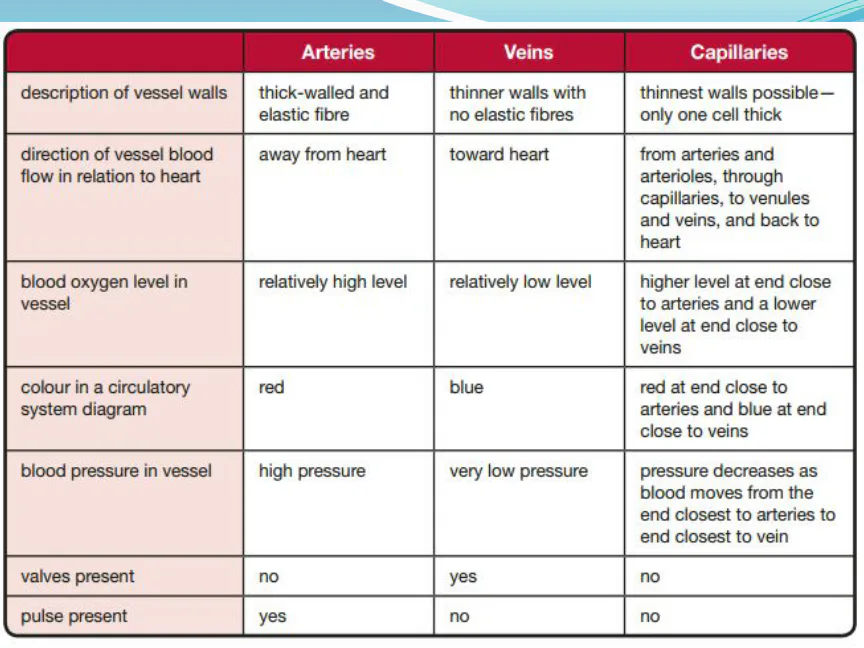
Compare the structure and function of arteries, veins, and capillaries using the information from the table.
54
Fill in the Blanks
Fill in the blank: Blood in veins flows
Type answer...
55

56

57
Multiple Choice

What is blood vessel 2?
Arteries
Veins
Capillaries
58
Multiple Choice
Which of the following characteristics are true for arteries?
Thick-walled and elastic fiber
Valves present
Low pressure
Pulse not present
59

60
Multiple Choice

The large vessel on the left is a(n)
artery
capillary
vein
61
Multiple Choice
At which end of the capillary is tissue fluid reabsorbed?
Arterial end
Venous end
62

63

64
Multiple Choice
How many layers of cells make up the wall of a capillary?
1
2
3
4
65
Multiple Choice

Skeletal muscles help blood to move towards the heart when it
contract.
relax.
66

67
Open Ended
Summarize what you have learned about how blood circulates through the body and the roles of arteries, veins, and capillaries.
Show answer
Auto Play
Slide 1 / 67
SLIDE
Similar Resources on Wayground

63 questions
BIO.3 REVIEW
Presentation
•
9th - 12th Grade
61 questions
FID DAYS GEN BIO
Presentation
•
9th - 12th Grade
61 questions
Parasites of livestock
Presentation
•
9th - 12th Grade
60 questions
HAP5 Respiratory System
Presentation
•
10th - 12th Grade
60 questions
Video on Intro to Human Body
Presentation
•
9th Grade - University
56 questions
BL Ch 10 Gasses ppt
Presentation
•
9th - 12th Grade
57 questions
Senses Part 1: Ear
Presentation
•
11th - 12th Grade
Popular Resources on Wayground
10 questions
Safety Day 2026 – Student Review

Quiz
•
9th Grade
21 questions
Continents and Oceans
Quiz
•
6th Grade
20 questions
Parts of Speech
Quiz
•
5th Grade
16 questions
Subject & Predicate
Quiz
•
5th Grade
25 questions
Multiplication Facts
Quiz
•
5th Grade
12 questions
Map Skills
Quiz
•
3rd Grade
22 questions
Continents and Oceans
Quiz
•
5th Grade
15 questions
Rounding Decimals
Quiz
•
5th Grade
Discover more resources for Biology
20 questions
Cell organelles and functions
Quiz
•
10th Grade
20 questions
Cell Transport
Quiz
•
9th - 12th Grade
25 questions
photosynthesis and cellular respiration
Quiz
•
9th Grade
20 questions
Cell Cycle
Quiz
•
9th Grade
8 questions
DNA vs. RNA
Presentation
•
9th - 12th Grade
14 questions
Ecological Succession: Primary and Secondary
Quiz
•
9th Grade
20 questions
Macromolecules
Quiz
•
10th Grade
20 questions
Characteristics of Life
Quiz
•
9th - 10th Grade