

EM I: Waves

Presentation
•
Science
•
9th - 12th Grade
•
Practice Problem
•
Medium
+4
Standards-aligned

Stacy King
Used 5+ times
FREE Resource
16 Slides • 20 Questions
1

2
Multiple Choice
What element in the third period has the smallest atomic radius?
Argon (Ar)
Aluminum (Al
3
Reorder
Reorder the following elements in order of decreasing electronegativity: He, F, C, Be
F
C
Be
He
4
Multiple Choice
What is the element with the highest electronegativity value?
Cesium
Sulfur
Calcium
Fluorine
5
Reorder
Reorder the following elements in order of increasing atomic radius: F, H, Sr, Fr
H
F
Sr
Fr
6
7
Multiple Choice
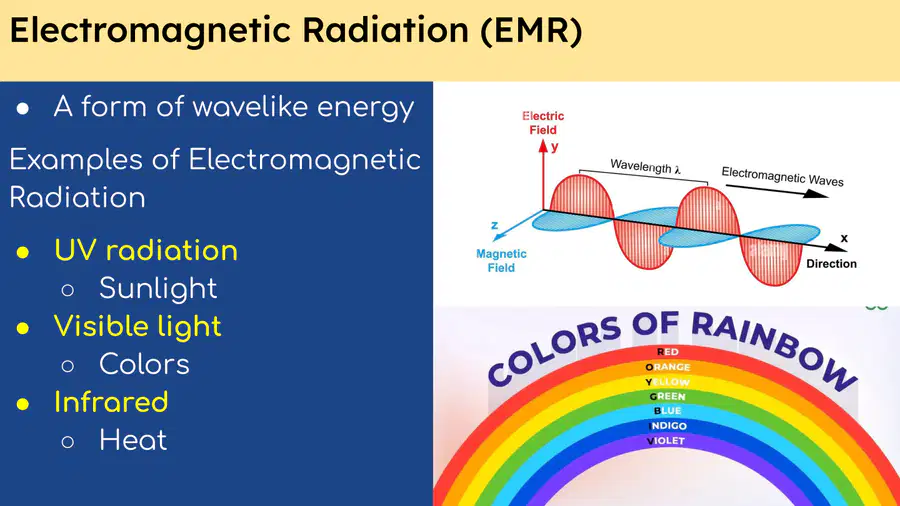
Which of the following best describes the wave description of light?
Light behaves as a continuous stream of particles.
Light can be described as oscillating electric and magnetic fields.
Light only travels in straight lines.
Light does not interact with matter.
8
Open Ended
Why is understanding the emission spectrum of light important in science and technology?
9
10
11
Multiple Choice
Which of the following is NOT an example of electromagnetic radiation?
Sound waves
UV radiation
Visible light
Infrared
12
13
14
Multiple Choice
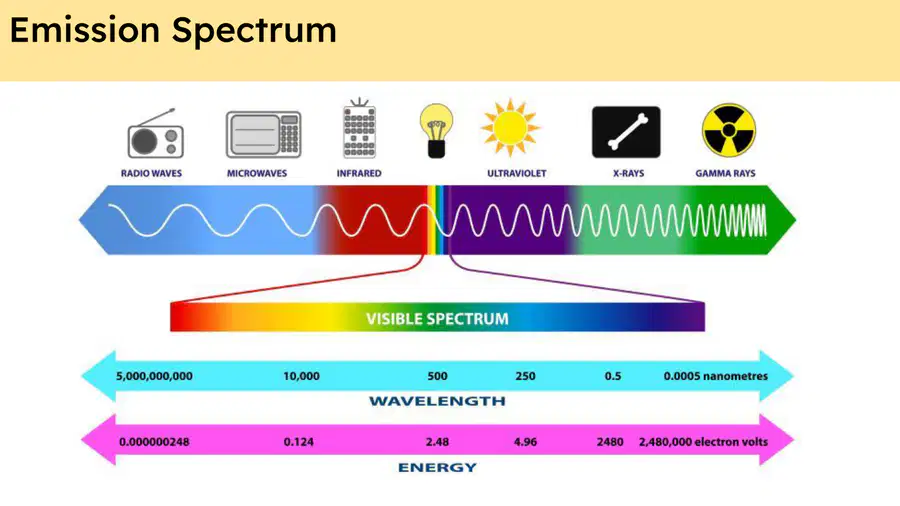
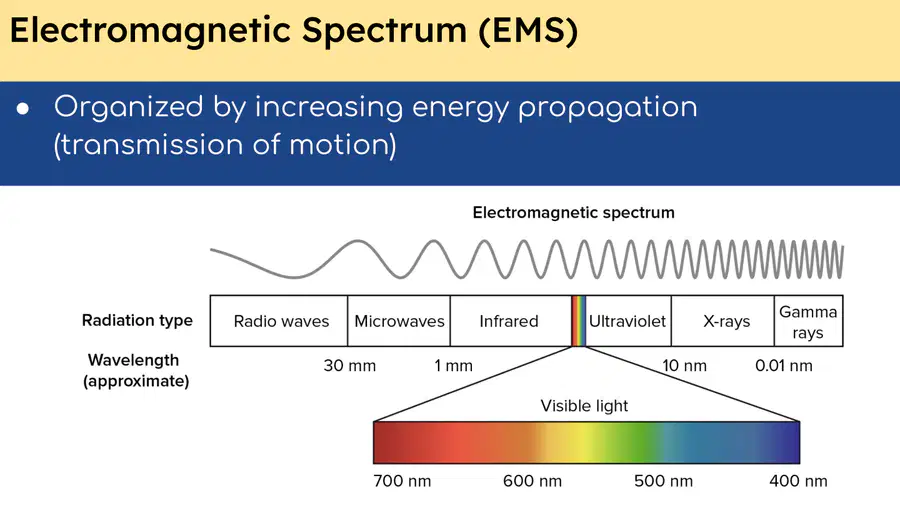
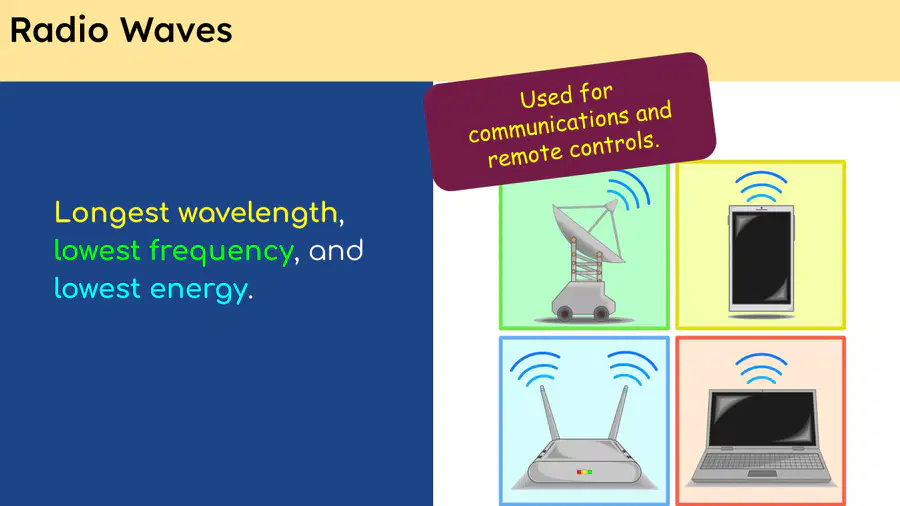
Which of the following types of electromagnetic radiation has the shortest wavelength?
Radio waves
Microwaves
Ultraviolet
Gamma rays
15
16
Drag and Drop
17
18
Multiple Select
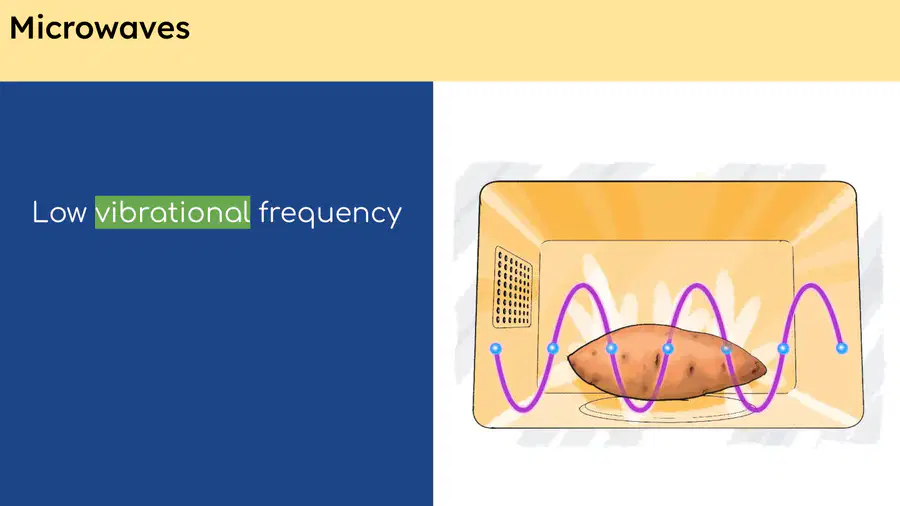
Which of the following statements about microwaves is/are correct?
They have low vibrational frequency.
They have the highest energy in the electromagnetic spectrum.
They have shorter wavelengths than radio waves.
19
20
Open Ended
Explain how we utilize our knowledge of electromagnetic radiation in real-world applications.
21
22
Multiple Select
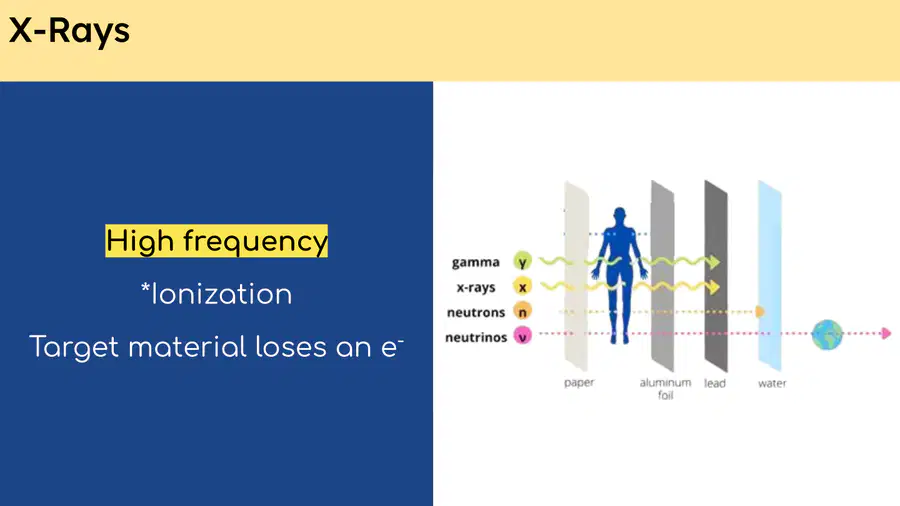
Which of the following statements about X-rays are correct?
They have high frequency.
They cause ionization.
They have the longest wavelength.
They can penetrate materials like paper and aluminum foil.
23
24
Multiple Choice
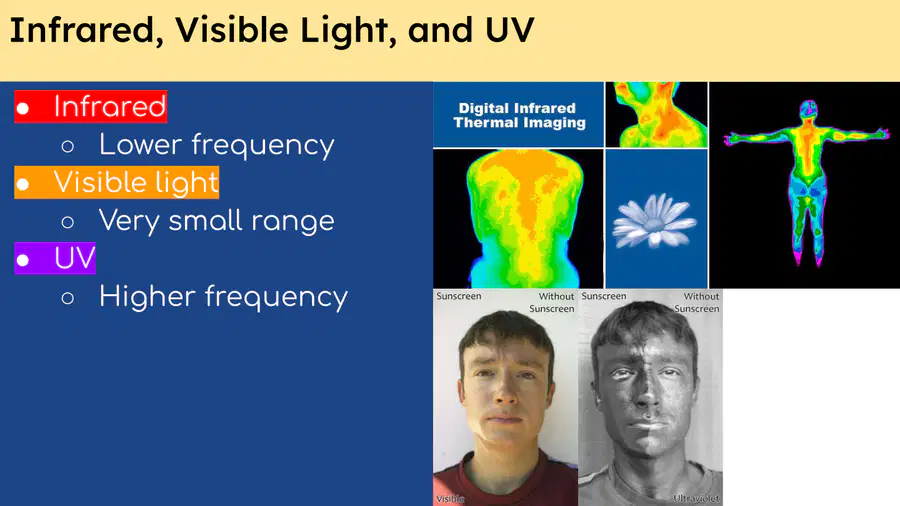
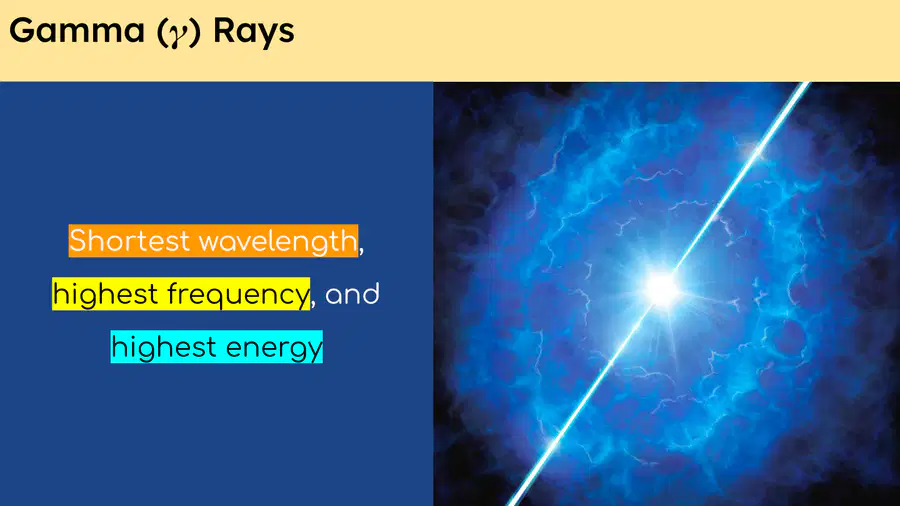
Which type of electromagnetic radiation has the highest frequency?
Infrared
Visible light
UV
Gamma rays
25
26
Fill in the Blanks
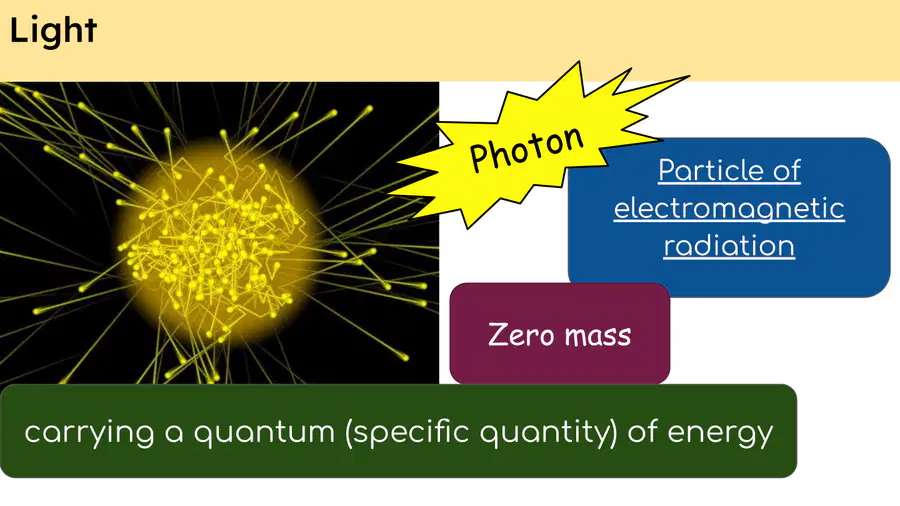
A photon is a particle of electromagnetic radiation with
Type answer...
27
28
Multiple Choice
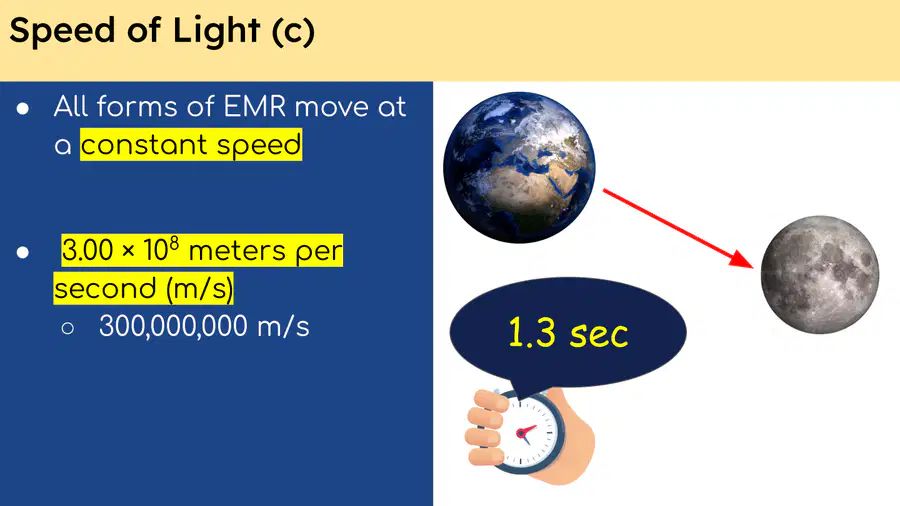
What is the speed of light in a vacuum?
3.00 × 10^6 m/s
3.00 × 10^8 m/s
3.00 × 10^10 m/s
3.00 × 10^12 m/s
29
30
Multiple Choice
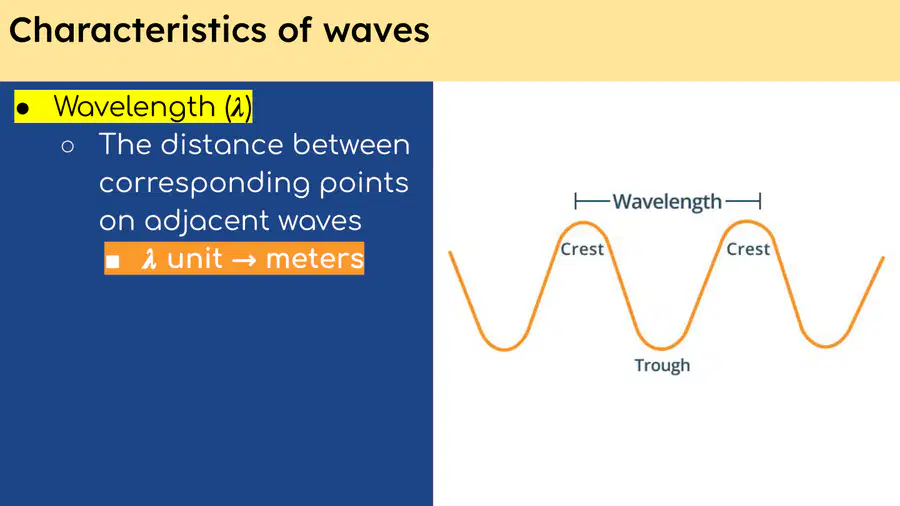
What does the wavelength (λ) of a wave represent?
The height of the wave from crest to trough
The distance between corresponding points on adjacent waves
The speed of the wave
The frequency of the wave
31
32
Multiple Choice
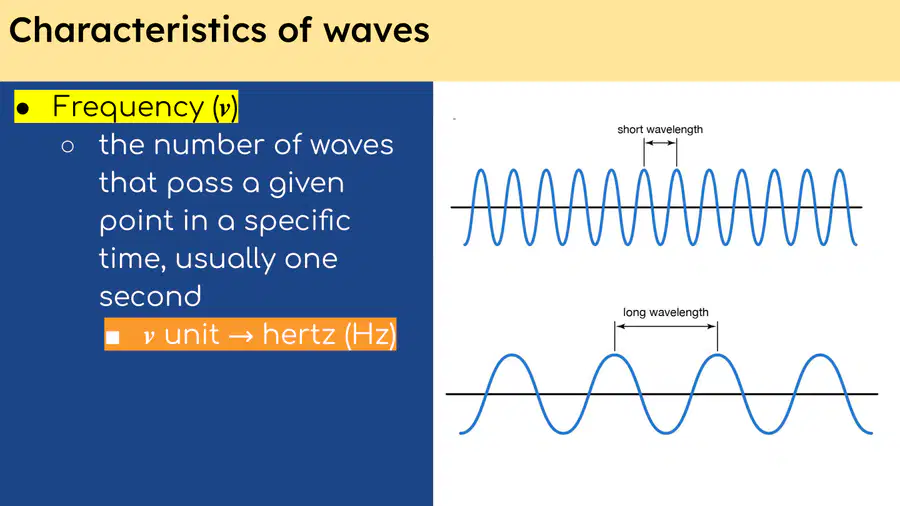
Which of the following statements best describes the relationship between wavelength and frequency as shown in the diagrams?
As wavelength increases, frequency increases.
As wavelength decreases, frequency decreases.
As wavelength increases, frequency decreases.
Wavelength and frequency are not related.
33
34
Open Ended
After learning about the emission spectrum, what is one question you still have or something you would like to explore further about light?
35
Open Ended
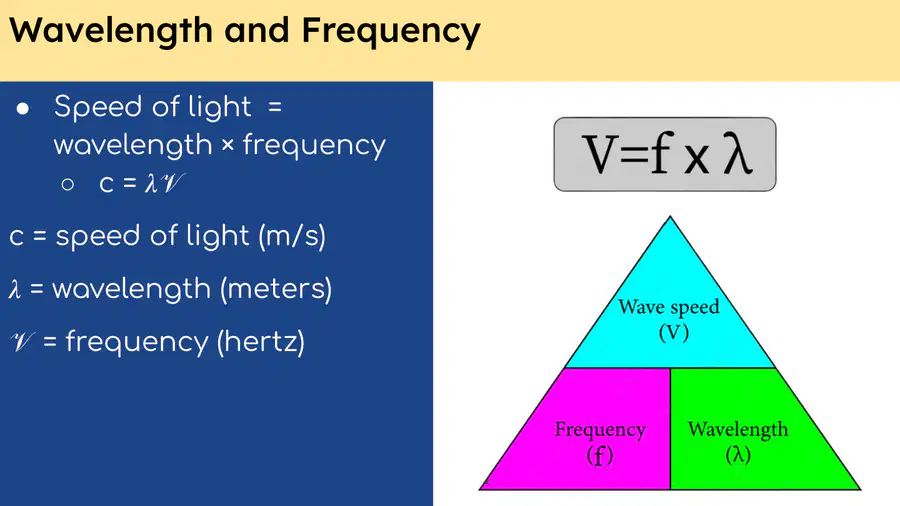
Explain how the speed of light is related to wavelength and frequency, and provide the formula that connects these quantities.
36
Multiple Choice
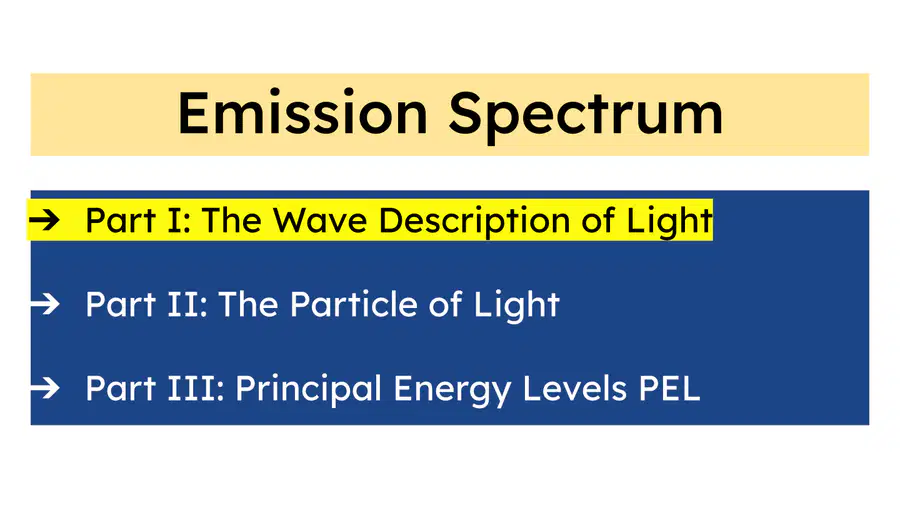
What are the three main parts covered in the study of the emission spectrum as shown in the lesson outline?
The Wave Description of Light, The Particle of Light, Principal Energy Levels (PEL)
The Reflection of Light, The Refraction of Light, The Absorption of Light
The Color Spectrum, The Sound Spectrum, The Heat Spectrum
The Chemical Properties of Light, The Physical Properties of Light, The Biological Effects of Light
Show answer
Auto Play
Slide 1 / 36
SLIDE
Similar Resources on Wayground

32 questions
Types of Chemical Reactions
Presentation
•
9th - 12th Grade
28 questions
Reading a Triple Beam Balance
Presentation
•
9th - 12th Grade
32 questions
Waves Part 2
Presentation
•
9th - 11th Grade
25 questions
Solar and Wind Energy
Presentation
•
9th - 12th Grade
26 questions
Properties of Life LESSON
Presentation
•
10th - 12th Grade
29 questions
Parts of the Ear
Presentation
•
10th - 12th Grade
32 questions
SI Units and measurement
Presentation
•
KG
31 questions
Doppler Effect
Presentation
•
9th - 12th Grade
Popular Resources on Wayground
10 questions
How much do you know about our Portrait of an Eagle?

Quiz
•
10th Grade
10 questions
Fast Food Slogans
Quiz
•
6th - 8th Grade
21 questions
Continents and Oceans
Quiz
•
6th Grade
20 questions
Parts of Speech
Quiz
•
5th Grade
16 questions
Subject & Predicate
Quiz
•
5th Grade
25 questions
Multiplication Facts
Quiz
•
5th Grade
12 questions
Map Skills
Quiz
•
3rd Grade
22 questions
Continents and Oceans
Quiz
•
5th Grade
Discover more resources for Science
10 questions
Exploring Chemical and Physical Changes

Interactive video
•
6th - 10th Grade
20 questions
Atomic Structure
Quiz
•
9th Grade
10 questions
Decoding the Periodic Table of Elements
Interactive video
•
6th - 10th Grade
10 questions
Exploring the Periodic Table
Interactive video
•
6th - 10th Grade
14 questions
Physical and Chemical Changes
Quiz
•
10th Grade
22 questions
Periodic Table Review
Quiz
•
9th - 12th Grade
20 questions
Observation vs. Inference
Quiz
•
7th - 9th Grade
14 questions
Periodic Trends
Interactive video
•
11th Grade