

2. Bonding Capacity of C element

Presentation
•
Chemistry
•
10th Grade
•
Easy
Standards-aligned

Faik Bolat
Used 19+ times
FREE Resource
12 Slides • 11 Questions
1


2

Carbon (6C) has configuration 1s²2s²2p² with 4 valence electrons (2 unpaired). In bonding, one 2s electron is promoted to 2p, giving 4 unpaired electrons. The 2s and 3×2p orbitals then hybridize to form four identical sp3 orbitals.


3


4
Example : Explain the bond structure of the CF4 molecule by using electron dot structure.
Carbon forms 4 sp³ orbitals, each bonding with 1 unpaired electron from 4 F atoms → CF4.
C–F bonds are polar, but tetrahedral symmetry cancels dipoles → CF4 is nonpolar.


5

Atoms like carbon, oxygen, and nitrogen can form single, double, or triple bonds. When orbitals overlap, two bond types arise: sigma (σ) and pi (π). A single bond is always a σ bond. π bonds form only after a σ bond. Thus, a double bond has 1 σ + 1 π, and a triple bond has 1 σ + 2 π. Let’s look at how σ and π bonds form.
SIGMA (σ) BONDS
Sigma (σ) bonds form by end-to-end overlap of orbitals, which can be s, p, or hybrid orbitals. In CH₄, the carbon atom’s four sp³ orbitals overlap with the 1s orbitals of four hydrogen atoms, forming four C–H σ bonds.

6
In C2H6, each C–H σ bond forms by end-to-end overlap of a carbon sp³ orbital with a hydrogen 1s orbital. The C–C σ bond forms from the end-to-end overlap of the two carbon sp³ orbitals. Thus, C2H6 has six C–H σ bonds and one C–C σ bond, totaling seven σ bonds.


7
Pi (π) BONDS
Pi (π) bonds form by the side-by-side overlap of two parallel p orbitals. The electron cloud of a π bond lies above and below the plane of the σ bonds. π bonds are generally weaker than σ bonds.

A π bond cannot exist by itself; it forms only after a σ bond if unhybridized p orbitals are available. In other words, a σ bond must form first before a π bond can be created.
8
Formation of The Pi (π) Bond in The Ethylene Molecule
In C2H4, each carbon is sp² hybridized, forming five σ bonds (four C–H and one C–C) and one π bond between the carbons, giving a total of six bonds.


9
Formation of Pi (π) Bonds in The Acetylene Molecule
In C2H2, both carbons are sp hybridized. Each forms a C–H σ bond, and their sp orbitals form a C–C σ bond. The unhybridized p orbitals overlap to form two C–C π bonds, giving one σ and two π bonds between the carbons.


10
Example : The chemical formula of methyl methacrylate, a key monomer used in making plexiglass, is given below: How many σ (sigma) and π (pi) bonds are present in this molecule?

Example : The chemical formula of styrene, an important monomer in the production of polystyrene plastics, is given below: How many σ (sigma) and π (pi) bonds are present in this molecule?

11
Multiple Choice
What type of bond is formed by the head-to-head overlap of orbitals?
Sigma (σ) bond
Pi (π) bond
Hydrogen bond
Ionic bond
12
Multiple Choice
Greater the overlap of the orbitals, _________________________
lesser the bond strength
greater the bond strength
bond strength remains the same
no bond formation
13
Multiple Choice
A π (pi) bond is the result of the
overlap of two s orbitals
overlap of an s orbital and a p orbital
overlap of two p orbitals along their axes
sidewise overlap of two parallel p orbitals
sidewise overlap of two s orbitals
14
Multiple Choice
What is the angle between the sp hybrid orbitals?
90°
120°
180°
109.5°
15
Multiple Choice

The hybridisation of the carbon atom is?
sp hybridization
sp2 hybridization
sp3 hybridization
sp3d hybridization
16
Multiple Choice

What is the hybridization of each Carbon atom in benzene (C6H6)?
sp
sp3
sp2
sp3 d
17
Multiple Choice
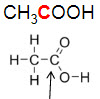
What is the hybridization of the Carbon atom indicated by the arrow?
sp hybridization
sp2 hybridization
sp3 hybridization
dsp3 hybridization
18
Multiple Choice

Type of hybridization in C number 3
sp4
sp3
sp2
sp
19
Multiple Choice

How many sigma bond in this molecule?
1
2
3
4
20
Multiple Choice
Type of hybridization in C number 2
sp4
sp3
sp2
sp
21
Multiple Choice
Type of hybridization in C number 1
sp4
sp3
sp2
sp
22

In some molecules, the theoretical structure may differ from reality. For ozone (O₃), rules suggest one single and one double bond so that each oxygen completes its octet, giving the predicted structure.

An O–O single bond is normally longer than an O=O double bond, but in the O₃ molecule, both oxygen–oxygen bonds are equal in length. This bond length is intermediate—shorter than a single bond but longer than a double bond.


23


Show answer
Auto Play
Slide 1 / 23
SLIDE
Similar Resources on Wayground

16 questions
Photosynthesis and Cellular Respiration
Presentation
•
10th Grade
18 questions
Families in the PT
Presentation
•
10th Grade
20 questions
Noble Gas Notation
Presentation
•
10th Grade
20 questions
Electron Structure
Presentation
•
10th Grade
15 questions
24-25 Unit 4 Bonding lesson 8: molecular geometry lab
Presentation
•
10th Grade
17 questions
Biochemistry Introduction
Presentation
•
9th Grade
17 questions
Bonding- Covalent, Metallic, and Ionic
Presentation
•
10th Grade
21 questions
Molecular Geometry
Presentation
•
10th Grade
Popular Resources on Wayground
10 questions
Safety Day 2026 – Student Review

Quiz
•
9th Grade
21 questions
Continents and Oceans
Quiz
•
6th Grade
20 questions
Parts of Speech
Quiz
•
5th Grade
16 questions
Subject & Predicate
Quiz
•
5th Grade
25 questions
Multiplication Facts
Quiz
•
5th Grade
12 questions
Map Skills
Quiz
•
3rd Grade
22 questions
Continents and Oceans
Quiz
•
5th Grade
15 questions
Rounding Decimals
Quiz
•
5th Grade
Discover more resources for Chemistry
20 questions
electron configurations and orbital notation
Quiz
•
9th - 12th Grade
25 questions
Writing and Naming Binary Ionic compounds
Quiz
•
10th Grade
20 questions
COUNTING ATOMS
Quiz
•
10th Grade
20 questions
Physical or Chemical Change/Phases
Quiz
•
8th Grade - University
15 questions
Periodicity Module Exam Practice Quiz
Quiz
•
9th - 12th Grade
20 questions
Naming Ionic Compounds
Quiz
•
10th Grade
45 questions
Chem Unit 3 Review
Quiz
•
10th Grade
16 questions
History of the Atomic Theory
Quiz
•
10th Grade