

Wave Behavior

Presentation
•
Science
•
6th - 8th Grade
•
Practice Problem
•
Medium
Standards-aligned

Barbara White
Used 8+ times
FREE Resource
10 Slides • 10 Questions
1

Wave Behavior
Middle School

2
Learning Objectives
Define reflection, refraction, absorption, and diffraction of waves.
Explain how wavelength affects the diffraction of a wave.
Differentiate between constructive and destructive interference when waves overlap.
Apply wave concepts to explain real-world phenomena like echoes.


3
Key Vocabulary
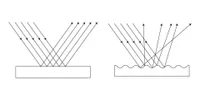
Reflection
The bouncing back of waves from a surface they cannot pass through, like a sound echo.
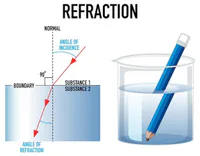
Refraction
The bending of waves caused by a change in speed as they pass from one medium to another.
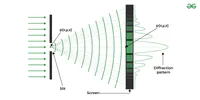
Diffraction
The bending and spreading of waves as they move around an obstacle or pass through an opening.

Absorption
The process by which a material takes in the energy of a wave instead of reflecting it.
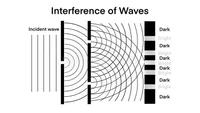
Interference
The combination of two or more waves that meet, resulting in a single new wave.
4
What Is Reflection?
Reflection occurs when a wave bounces off a surface it cannot pass through.
We see objects because light reflects from them and into our eyes.
An echo is a common example of sound waves reflecting off surfaces.
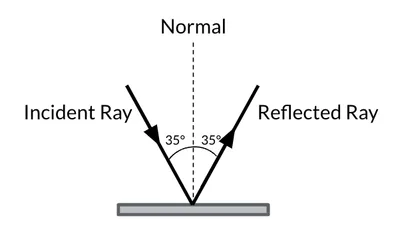
The Law of Reflection states the angle of incidence equals the angle of reflection.
5
Multiple Choice
According to the Law of Reflection, if a light wave strikes a mirror at a 30-degree angle of incidence, what will the angle of reflection be?
30 degrees
60 degrees
90 degrees
0 degrees
6
What Is Refraction?
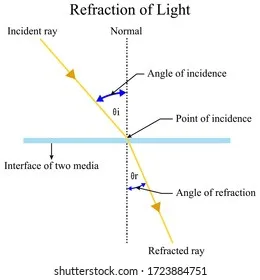
Refraction is a wave bending as it enters a new medium at an angle.
This happens because the wave’s speed changes when it enters the new substance.
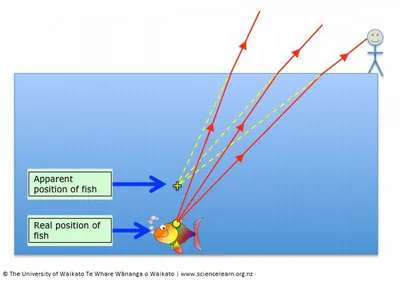
For example, light travels more slowly in water than it does in air.
A wave entering a new medium at a 90° angle does not bend.
7
Multiple Choice
Why does refraction occur?
Because the wave's speed changes as it enters a new medium.
Because the wave bounces off a surface.
Because the wave spreads around a barrier.
Because the wave's amplitude decreases.
8
What Is Diffraction?
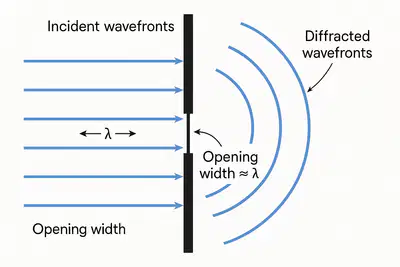
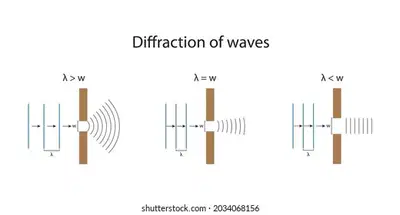
Diffraction is the bending and spreading of waves around an obstacle or opening.
It’s why you can hear sounds from around a corner.
The amount of diffraction depends on the wavelength and the opening’s size.
Diffraction is greatest when the wavelength is similar to the opening's size.
9
Multiple Choice
Under which condition is wave diffraction most pronounced?
When the wavelength is similar in size to the opening.
When the opening is much larger than the wavelength.
When the wave is traveling very fast.
When the wave reflects off a surface.
10
Absorption and Transmission
Absorption
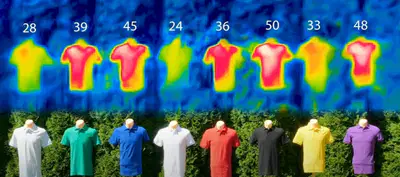
Absorption occurs when a wave’s energy is taken in by an object it hits.
The absorbed energy is often converted into another form of energy, such as heat.
A dark shirt feels warmer in the sun because it absorbs more light energy.
Transmission
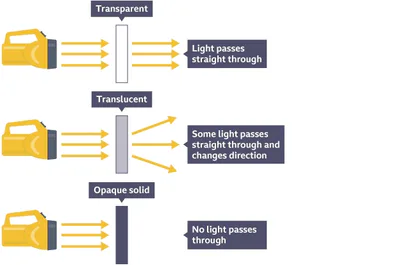
Transmission is when a wave passes all the way through an object instead of being absorbed.
Transparent objects let light pass through clearly, while translucent objects scatter the light.
Opaque objects do not let any light pass through them at all; they block it.
11
Multiple Choice
What is the primary difference between absorption and transmission?
Absorption is when wave energy is taken in by an object, while transmission is when it passes through.
Absorption is the bending of waves, while transmission is the bouncing of waves.
Absorption only happens with sound waves, while transmission only happens with light waves.
Absorption makes objects look darker, while transmission makes them look lighter.
12
Interference
Constructive
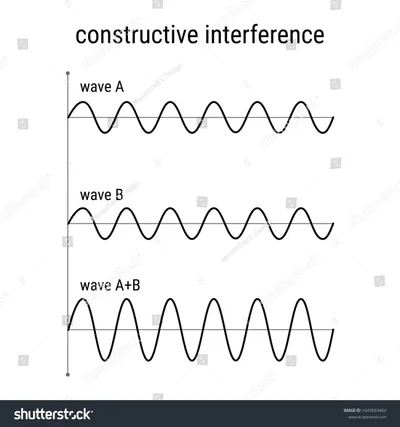
This happens when the high points, or crests, of two waves overlap each other.
The overlapping waves combine to create a new wave with a much larger amplitude.
This makes the resulting wave bigger and more powerful than the original waves.
Destructive
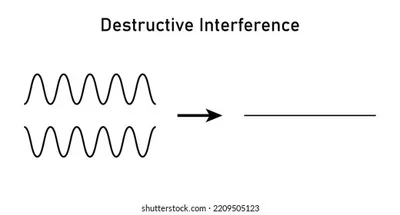
This occurs when a wave's crest overlaps with the trough of another wave.
The two waves work against each other, creating a new wave with a smaller amplitude.
If the original waves are the same size, they can cancel each other out completely.
13
Multiple Choice
What happens during constructive interference?
The combined wave has a larger amplitude.
The waves cancel each other out.
The waves bend around a barrier.
The waves bounce off a surface.
14
Common Misconceptions
Misconception | Correction |
|---|---|
We see objects because they create their own light. | We see objects because light reflects off them. |
Waves bend for the same reason. | Waves bend for different reasons, like refraction or diffraction. |
An echo is a new sound. | An echo is a reflection of the original sound wave. |
Wave interference permanently destroys waves. | Interference is temporary; waves continue on their original paths. |
15
Multiple Choice
Why can you hear a person talking from around a corner, but you cannot see them?
Sound waves diffract more than light waves around a barrier.
Light waves are absorbed by the corner, but sound waves are not.
Sound waves reflect off the corner, but light waves do not.
The sound is louder than the light is bright.
16
Multiple Choice
If you look at a fish in the water from the side of a tank, the fish appears to be in a different place than it really is. Which wave behavior explains this phenomenon?
Refraction, because the light from the fish bends as it passes from water to air.
Reflection, because the light from the fish bounces off the surface of the water.
Diffraction, because the light spreads out as it leaves the water.
Absorption, because the water absorbs some of the light from the fish.
17
Multiple Choice
You are tasked with designing a room to be as soundproof as possible. Which two wave behaviors are most important to control to prevent sound from entering or leaving the room?
Absorption and Reflection
Refraction and Diffraction
Interference and Reflection
Absorption and Refraction
18
Multiple Choice
Imagine two sound waves meet. The first wave's crest has an amplitude of +5 units, and the second wave's trough has an amplitude of -5 units. What will be the result at the moment they perfectly overlap?
Destructive interference, resulting in an amplitude of 0 (silence).
Constructive interference, resulting in an amplitude of +10 units.
Destructive interference, resulting in an amplitude of -10 units.
The waves will reflect off each other with no change.
19
Summary
Waves can reflect (bounce) off surfaces or refract (bend) through different materials.
Diffraction is the bending and spreading of waves around an obstacle or opening.
A wave's energy can be absorbed by an object or transmitted through it.
Interference happens when waves meet, either adding together or canceling each other out.
20
Poll
On a scale of 1-4, how confident are you about explaining the different ways waves interact with matter?
1
2
3
4
Wave Behavior
Middle School
Show answer
Auto Play
Slide 1 / 20
SLIDE
Similar Resources on Wayground

18 questions
Tides
Presentation
•
6th - 8th Grade
18 questions
Wave Interactions
Presentation
•
6th - 8th Grade
18 questions
Seasons and Earth's Tilt
Presentation
•
6th - 8th Grade
18 questions
Continental Drift
Presentation
•
6th - 8th Grade
16 questions
Nutrition and Food Health 1
Presentation
•
6th - 7th Grade
15 questions
Levels of Ecological organization
Presentation
•
6th - 8th Grade
14 questions
Plate Tectonic Theory
Presentation
•
6th - 8th Grade
16 questions
Food Chains and Food Webs
Presentation
•
6th - 8th Grade
Popular Resources on Wayground
24 questions
PBIS-HGMS Day 10

Quiz
•
6th - 8th Grade
10 questions
HCS SCI 03 Summer School Review 3
Quiz
•
3rd Grade
11 questions
Home Scope
Quiz
•
7th - 8th Grade
15 questions
HCS SCI 05 Summer School Assessment 3 Review
Quiz
•
5th Grade
35 questions
Lufkin Road Middle School Student Handbook & Policies Assessment
Quiz
•
7th Grade
18 questions
Geo 11.3 Area of Circles and Sectors
Quiz
•
9th - 11th Grade