

Carbohydrates FINAL

Presentation
•
Fun
•
Professional Development
•
Practice Problem
•
Easy

MARIA ARENAL
Used 1+ times
FREE Resource
29 Slides • 28 Questions
1

2

3
Multiple Choice
Why are carbohydrates considered essential for fueling human physiology?
Because they provide energy, structure, and signaling functions in the body.
Because they are the only source of vitamins.
Because they are not digested by the body.
Because they are only found in animal products.
4

5
Multiple Choice
Which of the following is NOT a primary role of carbohydrates in the cell membrane?
Energy
Structure
Signaling
Genetic coding
6

7
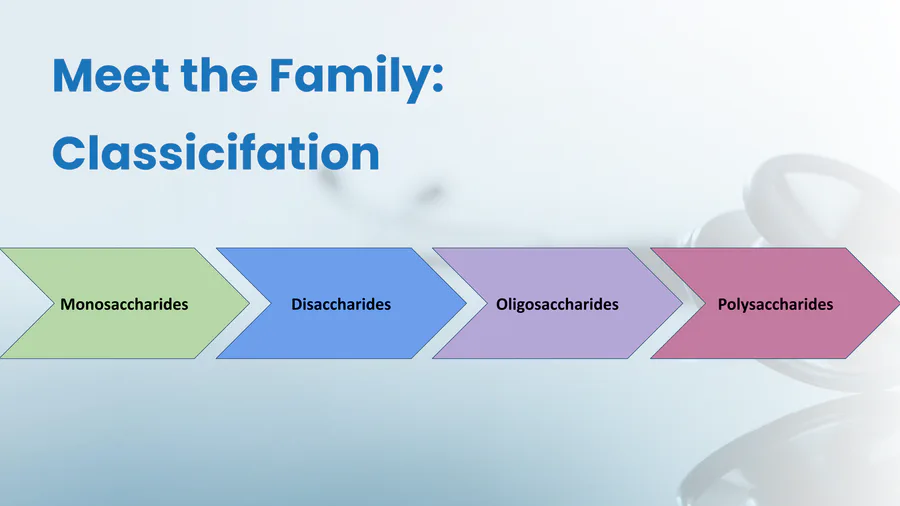
Fill in the Blanks
Simple sugars can be classified as polyhydroxy ketose or
8
9

10
Multiple Select
Which of the following are examples of simple sugars (monosaccharides)?
Glucose
Fructose
Galactose
Sucrose
11
12
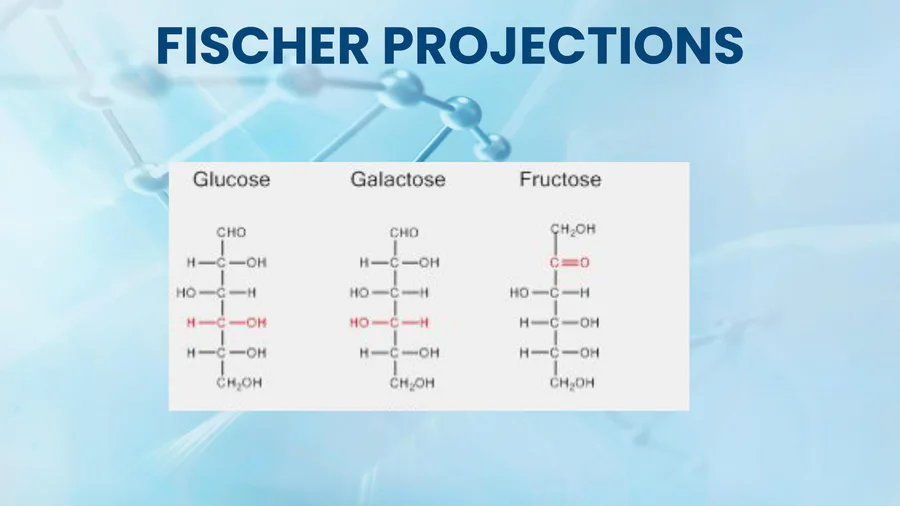
Multiple Choice
In the Fischer projections shown, which sugar has a ketone group instead of an aldehyde group?
Glucose
Galactose
Fructose
Maltose
13

14
Fill in the Blanks
Isomers have the same chemical
15

16
Multiple Choice
Which of the following best describes structural isomers, as illustrated by D-glucose and D-fructose?
They have the same formula but different bond orders.
They have different formulas and different bond orders.
They have the same formula and the same bond orders.
They have different formulas but the same bond orders.
17

18
Multiple Select
Which of the following statements are true about stereoisomers, based on the examples of enantiomers and epimers?
They have the same molecular formula.
They differ in the arrangement of atoms in space.
They have different bond orders.
They can include enantiomers and epimers.
19

20
Fill in the Blanks
The stable six-membered ring form of glucose is called a
Type answer...
21

22
Multiple Choice
What is the critical structural difference between alpha (α) and beta (β) glucose?
The position of the OH group on carbon 1.
The number of carbon atoms in the ring.
The presence of a glycosidic bond.
The type of monosaccharide involved.
23

24

25
Multiple Choice
In the formation of sucrose, which two monosaccharides are joined by an alpha 1-2 beta glycosidic bond?
Glucose and fructose
Glucose and galactose
Glucose and glucose
Fructose and galactose
26

27
Multiple Choice
Which type of glycosidic bond links the two glucose molecules in maltose?
Alpha 1-4 glycosidic bond
Beta 1-4 glycosidic bond
Alpha 1-6 glycosidic bond
Beta 1-6 glycosidic bond
28

29
Multiple Select
Which of the following statements about lactose and maltose is/are correct?
Both are disaccharides.
Lactose contains a beta 1-4 glycosidic bond.
Maltose is formed from two alpha-glucose units.
Lactose is broken down by the enzyme maltase.
30

31

32
Fill in the Blanks
Polysaccharides are long-chain polymers of
33

34
Multiple Choice
What is the main structural difference between the main chain and branch points in glycogen?
Type of glycosidic bond
Number of glucose units
Presence of nitrogen
Degree of saturation
35
36
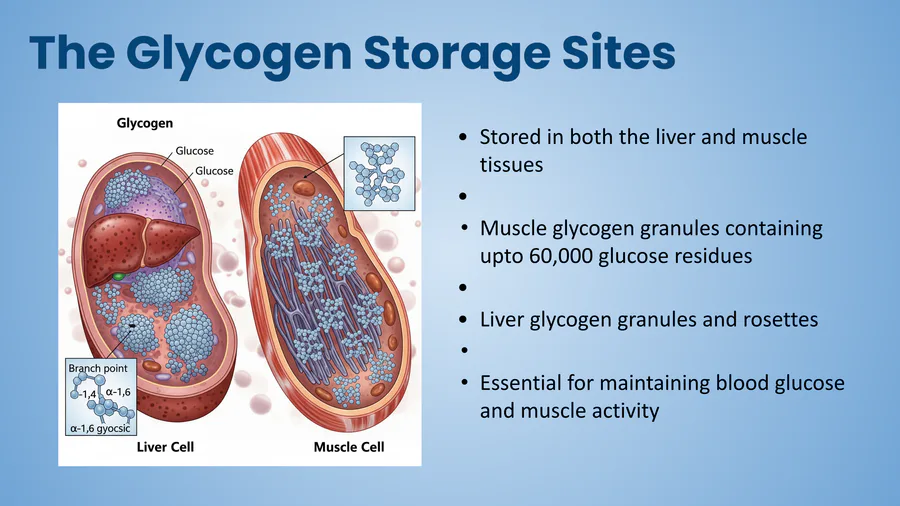
Open Ended
Describe the roles of liver and muscle glycogen in maintaining blood glucose and muscle activity.
37
38
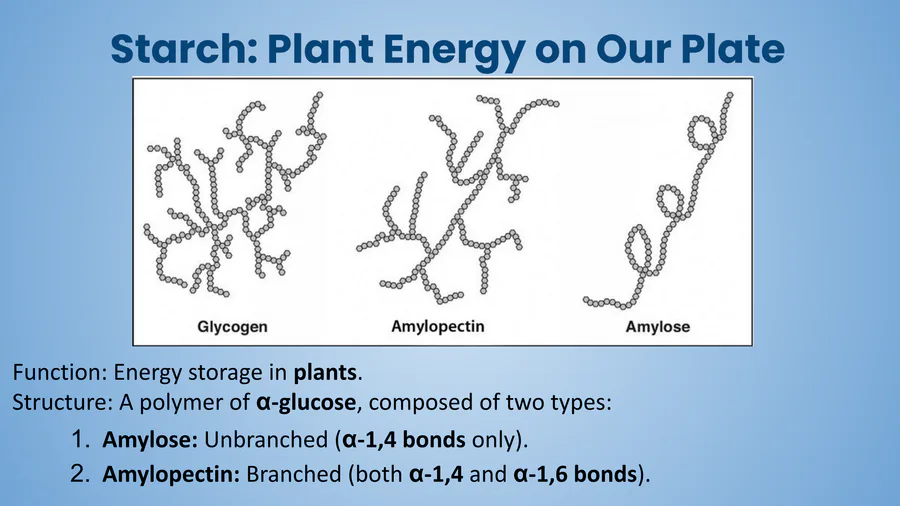
Open Ended
Explain how the structure of amylopectin differs from that of amylose and how this difference affects their function in plants.
39
Multiple Choice
Which type of starch is unbranched and contains only α-1,4 bonds?
Amylopectin
Amylose
Glycogen
Cellulose
40

41
Multiple Choice
The primary goal of carbohydrate digestion is to convert
protein to glucose
glucose to protein
poly- and disacharides to monosacharides and then to glucose.
glucose to fiber and starch.
42
Multiple Choice
Which of the following enzymes, involved in breaking down carbohydrates, is found in the mouth?
lactase
maltase
pancreatic amylase
salivary amylase
43
Multiple Choice
The majority of carbohydrate digestion and absorption occurs in the _______________.
mouth
stomach
small intestine
large intestine
44

45
Multiple Select
Which of the following factors impact the glycemic index of a carbohydrate?
Digestibility
Hydrolysis rate
Protein content
Fat content
46
Multiple Choice
What does the glycemic index measure?
The amount of protein in food
How fast carbohydrates raise blood glucose
The fat content in food
The vitamin content in food
47

48
Fill in the Blanks
Cellulose is a polymer of
49

50
Multiple Choice
Which sugar is the pentose component of DNA?
Ribose
Glucose
Deoxyribose
Fructose
51

52

53

54
Open Ended
Explain the significance of the difference between alpha and beta linkages in glucose for human nutrition and health.
55
Multiple Choice
Which type of linkage in glucose is used for energy storage in humans, and why can't humans digest the other type?
Alpha-linkages are used for energy storage; humans can't digest beta-linkages because they lack the necessary enzymes.
Beta-linkages are used for energy storage; humans can't digest alpha-linkages because they lack the necessary enzymes.
Alpha-linkages are used for structure; humans can't digest beta-linkages because they lack the necessary enzymes.
Beta-linkages are used for structure; humans can't digest alpha-linkages because they lack the necessary enzymes.
56

57
Multiple Choice
What are the primary roles of carbohydrates in the human body?
Energy, structure, and signaling
Digestion, absorption, and excretion
Hormone production, muscle contraction, and vision
DNA replication, protein synthesis, and cell division
Show answer
Auto Play
Slide 1 / 57
SLIDE
Similar Resources on Wayground

56 questions
REPORTED SPEECH REVIEW
Presentation
•
KG
52 questions
SIDI and IBIQ
Presentation
•
Professional Development
52 questions
Design Pattern - Presentazione e Autovalutazione
Presentation
•
Professional Development
53 questions
Asthma outpatient
Presentation
•
Professional Development
53 questions
Quizizz 101 QuickByte: Kinnikinnick Elementary
Presentation
•
Professional Development
52 questions
Untitled Presentation
Presentation
•
Professional Development
48 questions
POPULAR MEMBER SERVICES DIAGNOSTICS, HOSPITILIZATION AND SURGERY
Presentation
•
KG
51 questions
Copy of G1_K7_L7_22-23
Presentation
•
KG - Professional Dev...
Popular Resources on Wayground
10 questions
Safety Day 2026 – Student Review

Quiz
•
9th Grade
21 questions
Continents and Oceans
Quiz
•
6th Grade
20 questions
Parts of Speech
Quiz
•
5th Grade
16 questions
Subject & Predicate
Quiz
•
5th Grade
25 questions
Multiplication Facts
Quiz
•
5th Grade
12 questions
Map Skills
Quiz
•
3rd Grade
22 questions
Continents and Oceans
Quiz
•
5th Grade
15 questions
Rounding Decimals
Quiz
•
5th Grade