

ITHP Lesson 3.2.2

Presentation
•
Health Sciences
•
9th - 12th Grade
•
Practice Problem
•
Easy

Angela Balch
Used 2+ times
FREE Resource
22 Slides • 8 Questions
1
Intro to Healthcare Professionals
Unit 3: Allied Health Professions
Topic 1: Technicians and Other Allied Health Providers
2
define emergency medical services
explain how EMTs and paramedics provide emergency care to a patient
identify certifications and career progression necessary to become an EMT or paramedic
identify the skills and personal qualities that enable EMTs and paramedics to do their jobs
3
emergency medical services - provide immediate pre-hospital treatment, stabilization, and transportation to appropriate care for patients with serious illnesses and injuries.
EMR - emergency medical responders also known as first responders.
EMT - provide medical attention to patients from the site of the accident to the hospital throughout their ambulance transport.
Paramedics - can offer more comprehensive prehospital care
4
Open Ended
Can you give an example of an emergency medical service provider?
5
Provide immediate pre-hospital treatment, stabilization, and transportation to appropriate care for patients with serious illnesses and injuries
Emergency medical services carry a recognizable symbol called the "Star of Life". It is a blue 6-pointed star with a white border around it. It can be found on ambulances, medical personnel uniforms, and othe emergency medicine and first-aid related items
The 6 points symbolize the 6 tasks of the emergency service providers
6

1) Early Detection- The initial recognition of an emergency
2) Early Reporting- Calling for professional help, which connects to emergency dispatch
3) Response- The arrival of first responders and their initial provision of first aid.
4) On-Scene Care- Emergency medical personnel provide care at the indident location
5) Care in Transit- Transporting the patient by ambulance or helicopter to a hospital.
6) Transfer to Definitive Care- the patient receives specialized care at the hospital
7
Multiple Choice
EMS is a coordinated network of professionals that provide
Long-term medical care
Short term medical care
Care for minor injuries
Pre-hospital medical and trauma care
8
EMR
EMT
Advanced EMT
Paramedic
9
Training: ~50–60 hours (shortest training level).
Scope of Practice:
Provides immediate lifesaving care until higher-level providers arrive.
Basic skills: CPR, using an AED, bleeding control, splinting, oxygen administration, assisting with childbirth.
Limitations: Cannot transport patients in an ambulance (unless paired with higher-level personnel).
10
Training: ~150–200 hours (most common entry level).
Scope of Practice:
Builds on EMR skills.
Patient assessment, basic airway management, administering some medications (like epinephrine auto-injectors, glucose, oxygen, naloxone depending on state protocols).
Can transport patients in ambulances.
Role: Foundation of most emergency medical services (EMS) systems.
11
Training: ~300–400 hours.
Scope of Practice:
Includes all EMT skills plus more advanced care.
IV therapy, advanced airway devices (like supraglottic airways), administering a broader range of medications (dextrose, nitroglycerin, albuterol, etc. depending on protocols).
Role: Bridges the gap between EMT and Paramedic. Often used in rural or resource-limited systems.
12
Training: 1,000–2,000+ hours (often a 2-year associate degree program).
Scope of Practice:
Highest prehospital care level.
Advanced airway management (including intubation), cardiac monitoring, defibrillation, pacing, synchronized cardioversion.
Interpreting EKGs, giving a wide variety of medications, starting IVs and intraosseous (IO) lines.
Can perform invasive procedures (needle decompression, surgical airway in emergencies).
Role: Considered the “mobile intensive care unit” provider in the field.
13

14
Immediate response-responding to 911 requests promptly
Treatment course- assessing and evaluating the patient's condition, determing the best course of treatment, and documenting the details of the patient's condition
Pre-hospital care-dispensing pre-hospital care and giving first-aid or life-saving care
Patient transfer-carrying a stretcher, securing the patient, transporting the patient, moving patients
Equipment disinfection- disinfecting the ambulance's interior, managing the stock of emergency medicines and medical supplies in the ambulance
15
16
Complete your High School Diploma or GED
Gain CPR Certification
Complete an EMT Program
Pass the Cognitive Exam- computerized test covering medical topics
Pass the Psychomotor Exam- demonstrate a number of emergency skills
17
Open Ended
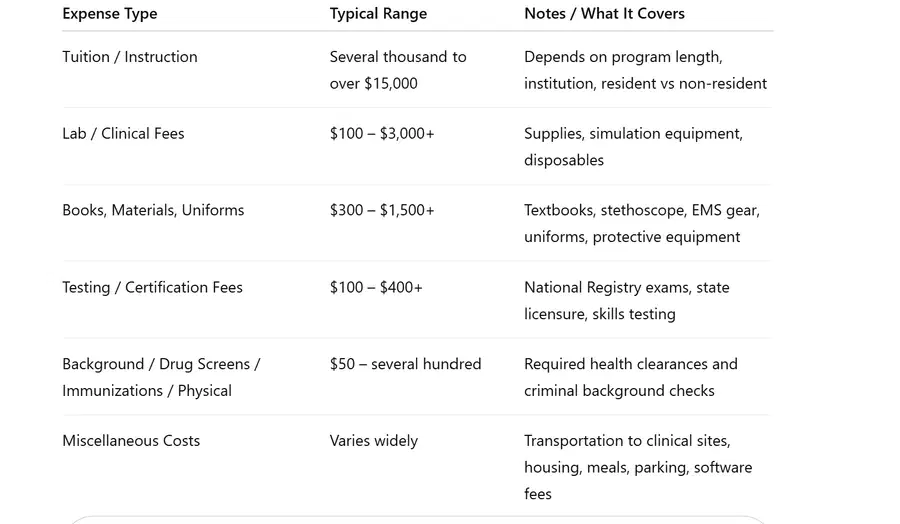
Take a minute, do a quick Google search: How much does an average EMT certification program cost?
18

19
Open Ended
Take a minute, do a quick Google search: How much does an average Paramedic certification program cost?
20
21

22
Medical and Technical Skills
Critical Thinking and Problem-Solving- rapid decision-making, situational awareness, prioritization
Interpersonal and Communication Skills- calm under pressure, compassion and empathy, teamwork, clear and concise communication
Personal Qualities and Physical Skills- physical stamina, emotional resilience, adaptability, professionalism
23
According to the U.S. Bureau of Labor Statistics (BLS), employment of EMTs and paramedics is projected to grow 5% from 2024 to 2034, which is faster than average for all occupations.
As of May 2024:
EMTs: median annual wage ~$41,340
Paramedics: median annual wage ~$58,410 For paramedics, there is a wide range:
Lower 10th percentile: ~$40,130
Upper 90th percentile: more than ~$82,420
Pay will vary depending on:
Geographic location (urban vs rural, cost of living)
Type of employer (municipal EMS, hospital-based EMS, private ambulance services)
Experience, certifications, special skills
Shift differentials, overtime, hazard pay
24
Open Ended
Now do an internet search. Ask how much does an EMT get paid in (fill in your own zip code)? Now do it for a Paramedic.
What hourly rates or salaries did it give you?
25

26
Open Ended
What do you think the most challenging part of this job would be?
27
Next Steps / Roles | Examples |
|---|---|
EMS supervisor / manager | Oversee staff, operations |
EMS educator / instructor | Teaching EMT/Paramedic students |
Community paramedicine / mobile integrated health | Providing non-emergency care, follow-up services |
Firefighter / Fire-Paramedic | Many fire departments hire paramedics |
Hospital roles | ED technician, critical care support roles |
Other healthcare roles | Nursing, physician assistant, or other allied health roles |
Administrative / policy / leadership roles | EMS system leadership, public health |
28
Poll
Based on what you learned today, is an EMT or Paramedic a career you would be interested in?
29
Next Class: Friday, 3/20/26
Lesson 3.2.3- Phlebotomists and Lab Technicians
30
Poll
How well did you understand today's lesson?
Intro to Healthcare Professionals
Unit 3: Allied Health Professions
Topic 1: Technicians and Other Allied Health Providers
Show answer
Auto Play
Slide 1 / 30
SLIDE
Similar Resources on Wayground

25 questions
ITHP Lesson 3.1.2
Presentation
•
9th - 12th Grade
23 questions
50/30/20 Rule
Presentation
•
9th - 12th Grade
27 questions
The American Revolution 1775 - 1783
Presentation
•
8th - 12th Grade
22 questions
How to change a tire
Presentation
•
9th - 12th Grade
23 questions
Note taking for the test
Presentation
•
KG
23 questions
Untitled Lesson
Presentation
•
9th - 12th Grade
23 questions
Personal Finance Vocab
Presentation
•
9th - 12th Grade
25 questions
Safety at Home and in the Community
Presentation
•
9th - 12th Grade
Popular Resources on Wayground
10 questions
Safety Day 2026 – Student Review

Quiz
•
9th Grade
21 questions
Continents and Oceans
Quiz
•
6th Grade
20 questions
Parts of Speech
Quiz
•
5th Grade
16 questions
Subject & Predicate
Quiz
•
5th Grade
25 questions
Multiplication Facts
Quiz
•
5th Grade
12 questions
Map Skills
Quiz
•
3rd Grade
22 questions
Continents and Oceans
Quiz
•
5th Grade
15 questions
Rounding Decimals
Quiz
•
5th Grade
Discover more resources for Health Sciences
10 questions
Safety Day 2026 – Student Review
Quiz
•
9th Grade
20 questions
REGULAR Present tense verbs
Quiz
•
8th - 9th Grade
26 questions
SLIME!!!!!
Quiz
•
KG - 12th Grade
20 questions
Cell organelles and functions
Quiz
•
10th Grade
10 questions
Test Your Knowledge on Bullying
Quiz
•
9th Grade
12 questions
Absolute Value Equations
Quiz
•
9th Grade
20 questions
Position vs. Time Graphs
Quiz
•
9th Grade
20 questions
Function or Not a Function
Quiz
•
8th - 9th Grade