
- Resource Library
- Social Studies
- History
- Pacific Theater Of World War 2
- Bataan Death March, Midway & Island Hopping

Bataan Death March, Midway & Island Hopping

Presentation
•
Social Studies
•
10th - 12th Grade
•
Practice Problem
•
Medium

Savanna Jones
Used 166+ times
FREE Resource
16 Slides • 7 Questions
1
Bataan Death March, Battle of Midway & Island Hopping
I can analyze major military events of WWII such as fighting the war on multiple fronts, military advancement through the Bataan Death March, the Pacific Islands, and the Battle of Midway. I can identify reasons for U.S. involvement in World War II such as Pearl Harbor.

2
Bataan Death March
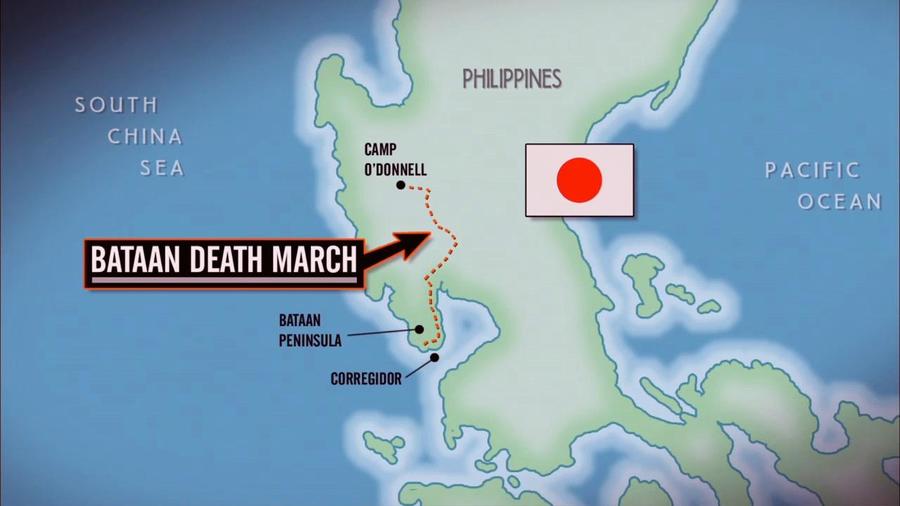
Several hours after the bombing of Pearl Harbor on December 7, 1941, the Japanese attacked the Philippines, which was then a U.S. territory.
3
Bataan Death March
The combined forces of American troops and Filipino soldiers attempted to resist the Japanese invasion of the island. With lack of naval and air support, the embattled soldiers retreated to the Bataan Peninsula. The Battle of Bataan ended on April 9,1942 with Filipino and American soldiers surrendering to the Japanese.

4
Bataan Death March
About 12,000 Americans and 63,000 Filipinos became prisoners of war. (POW)

5
Open Ended

Making Predictions!!!
What do you think will happen to the POW’s under Japanese control?
Sentence Stem: I think what will happen to the POWs under Japanese control is _____________
6
Bataan Death March
Tens of thousands of U.S. and Filipino soldiers were forced to become prisoners of war to the Japanese. The soldiers were deprived of food, water, medical attention, and were forced to march 65 miles through the scorching jungles of the Philippines to confinement camps. Thousands died and those who survived faced the hardships of prisoner of war camps and the brutality of their Japanese captors. The POWs would not see freedom until 1945.

7
8
Battle of Midway
The Battle of Midway is often described as the turning point of World War II in the Pacific.

9
Battle of Midway
The Japanese Pacific fleet commander had devised a plan to lure (bring in) the U.S. Pacific fleet into a battle near Midway, a tiny mid-Pacific island, where he believed he could destroy them.
However, the U.S. Navy could decipher (figure out) Japanese secret codes and knew that a surprise attack by the Japanese fleet was at hand.

10
Battle of Midway
Here, American forces dealt a decisive blow to the Japanese Navy, sinking four of its aircraft carriers, downing over 200 aircraft, and inflicting more than 3,000 casualties.
These Japanese losses could not easily be replaced, and allowed the U.S. to take the offensive in the Pacific.

11
Battle of Midway
Not only did we cripple their fleet, we forced the Japanese to start retreating towards Japan, something they hadn’t done the entire war.
Chester Nimitz, U.S. Navy Admiral, played an important role in this victory.

12

The key to Allied victory was the island hopping campaign, which required the military to fight for control of small, unknown islands across the vast Pacific Ocean.
13
Island Hopping
Island Hopping was a strategy designed to enable the Allies to reach Japan without having to conquer every island held by the Japanese. The Allies picked strategically important islands, attacked them, and set up bases to support future attacks.
This enabled the Allies to “hop” over more fortified Islands and cut the defenders off from supplies while minimizing losses of men and supplies. The Island Hopping strategy gave the Allies the ability to surprise the Japanese on any given island.

14
15
Admiral Chester Nimitz - Pacific Front
From Texas. In December 1941, he was designated as Commander in Chief, Pacific Fleet and Pacific Ocean Areas, where he served throughout the war. He led an island hopping campaign. September 2, 1945, was the United States signatory to the surrender terms aboard the battleship USS Missouri in Tokyo Bay.

16
Gen. Douglas MacArthur - Pacific Front
On December 8, 1941, his air force was destroyed in a surprise attack by the Japanese, who soon invaded the Philippines. MacArthur’s forces retreated to the Bataan peninsula, where they struggled to survive. In March 1942, on orders from the President, MacArthur, his family and members of his staff fled. Shortly afterward, MacArthur promised, “I shall return.” U.S.-Philippine forces fell to Japan in May 1942. In April 1942, MacArthur was appointed supreme commander of Allied forces in the Southwest Pacific. He spent the next two and a half years commanding an island-hopping campaign in the Pacific before famously returning to liberate the Philippines in October 1944.

17
18
Multiple Choice

Date: April 9, 1942
Headline: Japanese Forces Occupy Bataan Peninsula
Many U.S. Soldiers involved in the event mentioned in this headline -
19
Fill in the Blanks
20
Multiple Choice
21
Fill in the Blanks
22
Poll
23
Poll
Bataan Death March, Battle of Midway & Island Hopping
I can analyze major military events of WWII such as fighting the war on multiple fronts, military advancement through the Bataan Death March, the Pacific Islands, and the Battle of Midway. I can identify reasons for U.S. involvement in World War II such as Pearl Harbor.
Show answer
Auto Play
Slide 1 / 23
SLIDE


