Search Header Logo
grade 1à

grade 1à

Assessment

Presentation

Physics

10th Grade

Easy

NGSS
HS-PS4-1, MS-PS4-2, MS-PS4-1

+2

Standards-aligned

Created by

youssef work

Used 5+ times

FREE Resource

107 Slides • 17 Questions

1

media

2

media

3

Multiple Choice

Light is a kind of.....
1
reflection
2
energy
3
heat
4
matter

4

media

5

Multiple Choice

Question image

Which section of the spectrum is the ONLY one we can see?

1

Ultraviolet Rays

2

Gamma Rays

3

X-Rays

4

Visible Light

6

media

7

Multiple Choice

Question image
The shortest wavelength in visible light is______.
1
violet
2
red
3
blue
4
yellow

8

media

9

Multiple Choice

Question image
_______ carry the greatest amount of energy. 
1
x-rays
2
gamma rays
3
infrared rays
4
visible light

10

media

11

media

12

Multiple Choice

What are luminous objects?

1
Objects that absorb all light.
2
Luminous objects are objects that emit their own light.
3
Objects that are only visible in darkness.
4
Objects that reflect light from other sources.

13

media

14

media

15

media

16

media

17

media

18

media

19

media

20

Multiple Choice

Question image
These waves travel in a __________ line.
1
jagged
2
squiggly
3
straight
4
obstructive 

21

media
media

22

media

23

media

24

Multiple Choice

Question image

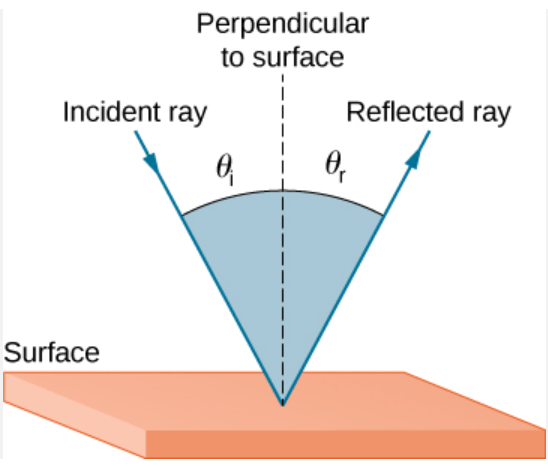
The illustration shows a light ray striking an object.
In the illustration, the light ray striking the object is .........

1

reflected

2

refracted

3

stopped

4

absorbed

25

media

26

media

27

media

28

Multiple Choice

Question image

What is the angle of reflection equal to?

1

The angle of refraction

2

The angle of absorption

3

The angle of incidence

4

The angle of light

29

Multiple Choice

Question image

In the diagram, which letter represents the angle of incidence?

1

A

2

B

3

C

4

D

30

media

31

Multiple Choice

Question image

According to the Law of reflection, a light ray striking a mirror

1

continues moving through the mirror in the same direction

2

moves into the mirror at a slightly different angle

3

bounces off the mirror toward the direction it came from

4

bounces off the mirror at the same angle it hits.

32

media

33

Multiple Choice

Question image

If the angle of incidence is 20 degrees, what will be the value of the angle of reflection?

1

0

2

10

3

20

4

30

34

media

35

media

36

media

37

media

38

media

39

media

40

media

41

media

42

media

43

media

44

media

45

Multiple Choice

Question image

The size of an object and its image are the same in this type of mirror...

1

Plane

2

Convex

3

Concave

46

media

47

media

48

media

49

media

50

media

51

media

52

media

53

Multiple Choice

Question image

True or False: This diagram shows the correct position of the mirrors so that the light hits the target

1

True

2

False

54

media

55

media

56

Multiple Select

Question image

A person views his image in front of a mirror. His image is virtual, upright, and smaller than him. What kind of mirror is he using?

1

plane

2

concave

3

convex

57

media
media

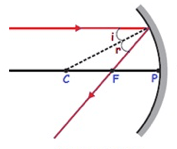
​the central point of the circle that best approximates a curve at a given point

58

media

59

media
media

Focal point is the specific point where parallel light rays either converge or appear to diverge from after passing through the lens or reflecting off the mirror

60

media

61

media

62

Multiple Choice

Question image
The point where the rays meet is known as....
1
Fire
2
the focal point
3
refraction
4
Plane of the lens

63

media
media
media

64

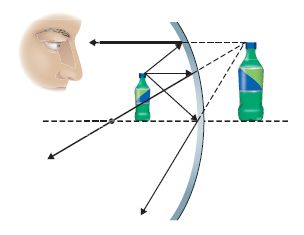
​Ray Diagrams - Convex Mirrors

media

​Step 1: From the top of the object, draw two rays
one aimed toward the focal point (but stop at the mirror)
and one parallel to the principal axis.

65

​Ray Diagrams - Convex Mirrors

media

​Step 2: Reflect the rays
the focal-point ray reflects parallel
and the parallel ray reflects as if coming from the focal point.

66

​Ray Diagrams - Convex Mirrors

media

​Step 3: Extend the reflected rays backward with dashed lines until they meet.
This intersection is the image of the top of the object.

67

​Ray Diagrams - Convex Mirrors

media

​Step 4: Repeat the process for the bottom of the object (on the principal axis). Connect top and bottom image points to complete the image.

68

media

​Case 1: beyond the center of curvature (C)
Case 2: at the center of curvature (C)
Case 3: between the center of curvature (C) and the focal point (F)
Case 4: at the focal point (F)
Case 5: in front of the focal point (F)

​​Ray Diagrams - Convex Mirrors

69

media

Case 1: beyond the center of curvature (C)

70

media

Case 2: at the center of curvature (C)

71

media

Case 3: between the center of curvature (C) and the focal point (F)

72

media

Case 4: at the focal point (F)

73

media

Case 5: in front of the focal point (F)

74

media

75

media

76

media

77

media

78

Multiple Choice

Question image

This ray diagram is for which mirror?

1

concave

2

convex

3

plane

4

window

79

Multiple Choice

Question image
Which terms describe the reflection seen in this image?
1
virtual, upright
2
virtual, inverted
3
real, upright
4
real, inverted

80

media

81

media

82

media

83

media

84

media

85

media

86

media

87

media

88

media

89

media

90

media

91

media

92

media

93

media

94

media

95

media

96

media

97

media

98

media

99

media

100

media

101

media

102

media

103

media

104

media

105

media

106

media

107

media

108

media

109

media

110

media

111

media

112

media

113

media

114

media

115

media

116

media

117

media

118

media

119

media

120

media

121

media

122

media

123

media

124

media
media

Show answer

Auto Play

Slide 1 / 124

SLIDE