Search Header Logo
Siege of Jerusalem PBA

Siege of Jerusalem PBA

Assessment

Presentation

History

9th Grade

Practice Problem

Easy

Created by

Allison Bair

Used 4+ times

FREE Resource

7 Slides • 20 Questions

1

Open Ended

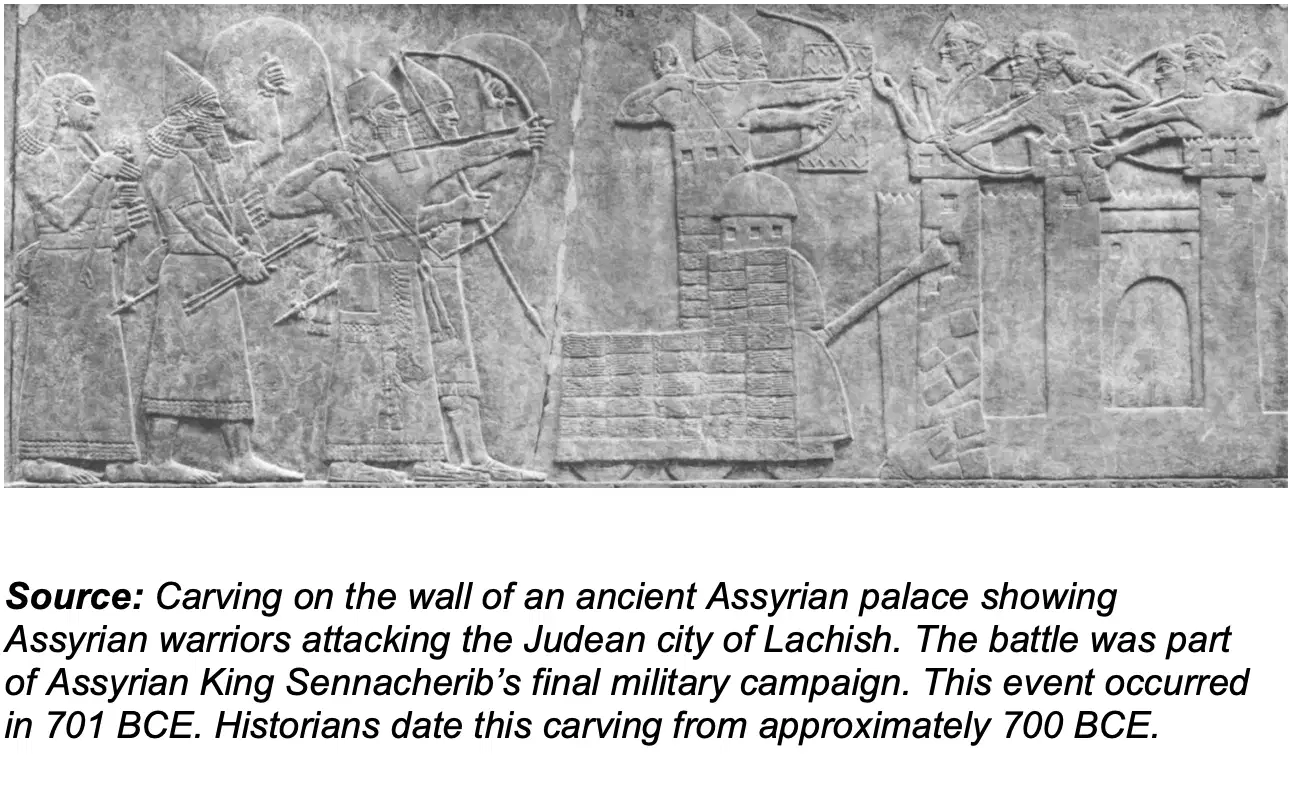
Question image

Describe what you see in this carving.

2

Open Ended

Question image

What event do you think this carving portrays?

3

Open Ended

Question image

When do you think this carving was made?

4

Open Ended

Question image

What do you think the purpose of making this carving was?

5

Multiple Choice

Question image

Whose perspective do you think it shows?

1

Assyrian

2

Hebrew

6

Poll

Question image

Do you think this carving provides a trustworthy picture of this account?

Yes

No

7

Document A: The Sennacherib Prism

Questions

What type of document is this?
When was it written?
Why do you think it was written?
According to this document, what did Sennacherib’s forces do to the towns surrounding Jerusalem?
According to this account, what happened when Sennacherib tried to conquer Jerusalem? Was he successful?
What parts of this document corroborate the palace carving’s account of Sennacherib’s conquest of Lachish?

8

Document A: The Sennacherib Prism

Use highlighters to mark any information that answers the questions.

The passage below comes from the Sennacherib Prism, an object with

cuneiform text describing Sennacherib’s military campaigns. Archeologists

found the prism in ruins of Sennacherib’s palace. It was written in

approximately 701 BCE.

9

Document A: The Sennacherib Prism

Use highlighters to mark any information that answers the questions.

In my [Sennacherib’s] third campaign, Hezekiah the Jew did not submit to

my control. I surrounded and conquered 46 of his strongly fortified cities

and countless small towns using siege ramps, battering rams, and

relentless attacks of foot soldiers, using mines, as well as trenches. I

drove out 200,150 people, young and old, male and female, horses, mules,

donkeys, camels, big and small cattle beyond counting, and made them

slaves.

10

Document A: The Sennacherib Prism

Use highlighters to mark any information that answers the questions.

I made Hezekiah a prisoner in Jerusalem, his royal residence, like a bird in

a cage. I surrounded him with earthwork in order to hinder those who were

leaving his city's gate. Thus I made his country smaller, but I still increased

the tribute and the presents to me as overlord, to be delivered annually.

Hezekiah sent 30 talents of gold, 800 talents of silver, precious stones,

large cuts of red stone, couches and chairs made of ivory, elephant hides,

ebony-wood, boxwood and all kinds of valuable treasures.

11

Open Ended

Question image

1. (Sourcing) What type of document is this?

12

Open Ended

Question image

2. (Sourcing) When was it written?

13

Open Ended

Question image

3. (Sourcing) Why do you think it was written?

14

Open Ended

Question image

4. (Close Reading) According to this document, what did Sennacherib’s forces do to the towns surrounding Jerusalem?

15

Open Ended

Question image

5. (Close Reading) According to this account, what happened when Sennacherib tried to conquer Jerusalem? Was he successful?

16

Open Ended

Question image

6.(Corroboration) What parts of this document corroborate (agree with) the palace carving’s account of Sennacherib’s conquest of Lachish?

17

Document B: The Book of Kings

Questions

What type of document is this?
When was it written?
Why do you think it was written?
According to this account, what happened when Sennacherib tried to conquer Jerusalem? Was he successful?
What is a major difference between this document and the account in the Sennacherib prism [Document A]?
What parts of this document corroborate Document A?

18

Document B: The Book of Kings

Use highlighters to mark any information that answers the questions.

The Book of Kings is from the Hebrew Bible. It presents a biblical view of

Jewish history from 960-560 BCE. Historians believe it includes parts

written by different people at different times between the 680 BCE and 500

BCE. Historians also point out that it mixes history, folktales, myths, and

religious miracles. The excerpt below describes Sennacherib’s siege of

Jerusalem.

19

Document B: The Book of Kings

Use highlighters to mark any information that answers the questions.

In the fourteenth year of King Hezekiah, the king of Assyria [Sennacherib] went on an expedition against all the fortified cities of Judah and captured them. Hezekiah, king of Judah, sent this message to the king of Assyria at Lachish: "I have done wrong. Leave me, and I will pay whatever tribute you impose on me." The king of Assyria exacted 300 talents of silver and 30 talents of gold from Hezekiah, king of Judah. Hezekiah paid him all the funds there were in the temple of the Lord and in the palace treasuries. . . . That night the angel of the Lord went forth and struck down 185,000 men in the Assyrian camp. Early the next morning, the Assyrian camp was full of corpses. So Sennacherib, the king of Assyria, broke camp and went back home to Nineveh.

20

Open Ended

Question image

1. (Sourcing) What type of document is this?

21

Open Ended

Question image

2. (Sourcing) When was it written?

22

Open Ended

Question image

3. (Sourcing) Why do you think it was written?

23

Open Ended

Question image

4. (Close Reading) According to this document, what happened when Sennacherib tried to conquer Jerusalem? Was he successful?

24

Open Ended

Question image

5. (Corroboration) What is a major difference between this document and the account in the Sennacherib prism [Document A]?

25

Open Ended

Question image

6. (Corroboration) What parts of this document corroborate Document A?

26

Open Ended

Why do you think these documents present such different versions of Sennacherib’s siege of Jerusalem?

27

Open Ended

Do you think these documents provide trustworthy accounts of what happened during Sennacherib’s siege of Jerusalem? Why or why not?

Question image

Describe what you see in this carving.

Show answer

Auto Play

Slide 1 / 27

OPEN ENDED