
U2_L7 Tonicity and osmolarity

Presentation
•
Biology
•
12th Grade
•
Hard
Standards-aligned

Christine Collins
Used 2+ times
FREE Resource
17 Slides • 6 Questions
1

2

3

4

5

6

7

8
Multiple Choice
Which of the following statements about osmosis is correct?
Osmosis is the movement of solvent from low solute concentration to high solute concentration through a semipermeable membrane.
Osmosis is the movement of solute from high concentration to low concentration through a semipermeable membrane.
Osmosis is the movement of solvent from high solute concentration to low solute concentration through a semipermeable membrane.
Osmosis is the movement of solute from low concentration to high concentration through a semipermeable membrane.
9

10

11
Multiple Choice
Which of the following conditions will cause a red blood cell to swell?
Hypotonic solution
Isotonic solution
Hypertonic solution
Supersaturated solution
12
Multiple Choice
What is the main difference between osmolarity and tonicity?
Osmolarity considers all solutes, while tonicity considers only non-penetrating solutes.
Osmolarity considers only non-penetrating solutes, while tonicity considers all solutes.
Osmolarity is not related to solute concentration, while tonicity is.
Tonicity is the total solute concentration, while osmolarity is not.
13
Multiple Choice

14
Multiple Choice

15

16

17

18

19
Multiple Choice
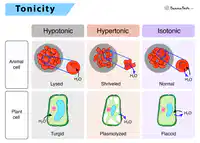
Match the following tonicity terms to the correct plant cell diagram: Hypertonic, Isotonic, Hypotonic.
First diagram: Hypertonic, Second diagram: Isotonic, Third diagram: Hypotonic
First diagram: Isotonic, Second diagram: Hypertonic, Third diagram: Hypotonic
First diagram: Hypotonic, Second diagram: Hypertonic, Third diagram: Isotonic
First diagram: Hypotonic, Second diagram: Isotonic, Third diagram: Hypertonic
20

21

22

23

Show answer
Auto Play
Slide 1 / 23
SLIDE
Similar Resources on Wayground

19 questions
Intelligence
Presentation
•
12th Grade
17 questions
Diabetes
Presentation
•
12th Grade
19 questions
Cell Membrane & ATP
Presentation
•
12th Grade
19 questions
Controlling the strength of a contraction (essentials)
Presentation
•
12th Grade
14 questions
2.2 Enzymes
Presentation
•
12th Grade
20 questions
Tides Notes
Presentation
•
12th Grade
20 questions
Counting Principle L1
Presentation
•
12th Grade
Popular Resources on Wayground
10 questions
How much do you know about our Portrait of an Eagle?

Quiz
•
10th Grade
10 questions
Fast Food Slogans
Quiz
•
6th - 8th Grade
21 questions
Continents and Oceans
Quiz
•
6th Grade
20 questions
Parts of Speech
Quiz
•
5th Grade
16 questions
Subject & Predicate
Quiz
•
5th Grade
25 questions
Multiplication Facts
Quiz
•
5th Grade
12 questions
Map Skills
Quiz
•
3rd Grade
22 questions
Continents and Oceans
Quiz
•
5th Grade
Discover more resources for Biology
10 questions
Exploring the 4 Major Macromolecules and Their Functions

Interactive video
•
9th - 12th Grade
20 questions
Cell Transport
Quiz
•
9th - 12th Grade
16 questions
Population Ecology
Quiz
•
9th - 12th Grade
16 questions
AP Biology: Unit 1 Review (CED)
Quiz
•
9th - 12th Grade
10 questions
Quick 10Q: Carbohydrates
Quiz
•
9th - 12th Grade
10 questions
Macromolecules and Enzymes Quiz
Quiz
•
9th - 12th Grade
10 questions
Exploring the Structure and Function of DNA
Interactive video
•
9th - 12th Grade
16 questions
Water Modeling Activity
Presentation
•
11th Grade - University