
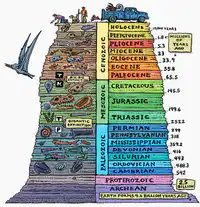
History of Life - Fossil Record

Presentation
•
Biology
•
9th - 12th Grade
•
Practice Problem
•
Easy
+6
Standards-aligned

Leigh Cooper
Used 2+ times
FREE Resource
24 Slides • 17 Questions
1

2

3
Open Ended
What are some ways scientists gather evidence about the origin of life on Earth?
4
Multiple Choice
Why is it important for scientists to study the history of life and the fossil record?
To understand how life has changed over time
To predict future weather patterns
To learn about the structure of atoms
To improve computer technology
5

6

7
Multiple Choice
Why did early attempts to estimate Earth's age using sedimentary rocks fail?
The techniques were not accurate enough.
There were no fossils in sedimentary rocks.
Sedimentary rocks are too young.
Scientists did not know about isotopes.
8
Multiple Choice
What is one method scientists use to determine the age of rocks and fossils?
Radioactive dating
Carbonation
Evaporation
Photosynthesis
9

10

11
Multiple Select
Which of the following statements about isotopes are correct?
Isotopes have the same number of protons.
Isotopes have different atomic masses.
Isotopes have the same number of neutrons.
Isotopes have the same atomic number.
12

13
Multiple Choice
What is the main difference between stable and radioactive isotopes?
Radioactive isotopes undergo decay, releasing particles or energy.
Stable isotopes have more protons than neutrons.
Radioactive isotopes have the same atomic mass as stable isotopes.
Stable isotopes are only found in living organisms.
14

15
Fill in the Blanks
The amount of time it takes for one-half of a sample of isotope to decay is called its
Type answer...
16

17
Multiple Choice
Which isotope of carbon is radioactive and used in dating ancient biological materials?
Carbon-12
Carbon-13
Carbon-14
Carbon-16
18

19

20
Fill in the Blanks
The half-life of carbon-14 is
Type answer...
21

22

23
Multiple Choice
Why can't potassium-40 and uranium-238 be used to date most fossils directly?
They are unstable isotopes.
Their half-lives are too short.
Living organisms do not incorporate these isotopes into their bodies.
They are only found in water.
24

25
Fill in the Blanks
If a fossil is found in a particular rock layer, it can be assumed that the
Type answer...
26

27
Fill in the Blanks
The oldest sedimentary rock layers are found at the
Type answer...
28
Multiple Choice
What does relative dating help scientists determine about fossils?
The exact age of a fossil in years
The placement of a fossil in relation to other fossils
The chemical composition of a fossil
The environment where a fossil was found
29

30

31

32

33

34

35
Fill in the Blanks
Many of the organisms that were once common on Earth are now
Type answer...
36
Multiple Choice
What does the fossil record show about the history of life on Earth?
There have been great changes in the kinds of organisms that dominated life at different times.
All organisms have remained the same over time.
Only plants have changed over time.
Fossils only show extinct organisms.
37

38

39
Multiple Select
Which of the following are reasons why the fossil record is considered incomplete?
Many organisms did not die in the right place at the right time to be preserved as fossils.
Many fossils have been destroyed by geologic processes.
All fossils have been found.
Only a fraction of the fossils have been found.
40

41
Multiple Choice
Which characteristic increases the likelihood that a species will be represented in the fossil record?
Having hard shells or skeletons
Being rare and short-lived
Living only in one small area
Being soft-bodied
Show answer
Auto Play
Slide 1 / 41
SLIDE
Similar Resources on Wayground

38 questions
Cellular Transport
Presentation
•
8th - 12th Grade
34 questions
Quizizz: Translation
Presentation
•
9th - 12th Grade
36 questions
Conjugaciones -ar, -er, -ir
Presentation
•
9th - 12th Grade
35 questions
Biomolecule terms Part 1
Presentation
•
9th - 12th Grade
35 questions
The Scientific Method Notes Check
Presentation
•
9th - 12th Grade
38 questions
Rhetorical Appeals and Strategies
Presentation
•
9th Grade
34 questions
Biology Tutorials DNA and Genetics Part 2
Presentation
•
9th - 12th Grade
Popular Resources on Wayground
10 questions
How much do you know about our Portrait of an Eagle?

Quiz
•
10th Grade
10 questions
Fast Food Slogans
Quiz
•
6th - 8th Grade
21 questions
Continents and Oceans
Quiz
•
6th Grade
20 questions
Parts of Speech
Quiz
•
5th Grade
16 questions
Subject & Predicate
Quiz
•
5th Grade
25 questions
Multiplication Facts
Quiz
•
5th Grade
12 questions
Map Skills
Quiz
•
3rd Grade
22 questions
Continents and Oceans
Quiz
•
5th Grade
Discover more resources for Biology
20 questions
Characteristics of Life
Quiz
•
9th - 10th Grade
10 questions
Exploring the 4 Major Macromolecules and Their Functions

Interactive video
•
9th - 12th Grade
20 questions
Cell organelles and functions
Quiz
•
10th Grade
20 questions
Cell Transport
Quiz
•
9th - 12th Grade
25 questions
photosynthesis and cellular respiration
Quiz
•
9th Grade
20 questions
Macromolecules
Quiz
•
10th Grade
16 questions
Population Ecology
Quiz
•
9th - 12th Grade
20 questions
Cell Organelles
Quiz
•
9th Grade