- Resource Library
- Math
- Probability And Statistics
- Conditional Probability
- 4.7 To 4.9 Conditional Probability, Events & Union Of Events

4.7 to 4.9 Conditional Probability, Events & Union of Events
Presentation
•
Mathematics
•
9th - 12th Grade
•
Practice Problem
•
Medium
+12
Standards-aligned
Jeffrey Reed
Used 5+ times
FREE Resource
15 Slides • 19 Questions
1
2
Multiple Choice
What are the two types of random variables discussed in this chapter?
Discrete Random Variables
Continuous Random Variables
Both Discrete and Continuous
Neither Discrete nor Continuous
3
4
Multiple Choice
What are the differences between discrete and continuous random variables?
Discrete random variables can take on any value within a range.
Continuous random variables can only take on specific values.
Discrete random variables are countable, while continuous random variables are measurable.
Both types of random variables are used in probability distributions.
5
6
Multiple Choice
Which of the following expressions correctly shows an expected value calculation for the probability distribution below?
EV=(−5⋅1⋅8)+(0.4⋅0.35⋅0.25)
EV=(−5+8+1)⋅(0.4+0.35+0.25)
EV=(−5⋅0.4)+(1⋅0.35)+(8⋅0.25)
EV=(−5÷0.4)+(1÷0.35)+(8÷0.25)
7
8
Multiple Choice
A discrete random variable X has the probability distributions shown in the table. Find the value of k. (Remember that a valid probability distribution must add up to 1)
1/3
7/12
1/12
1/4
9
10
Multiple Choice
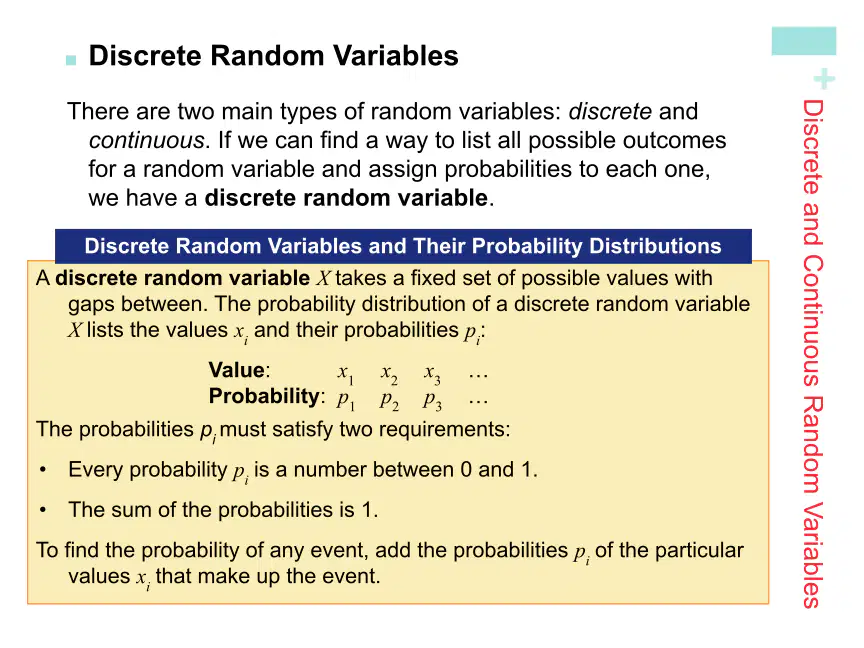
What are the two requirements that the probabilities of a discrete random variable must satisfy?
They must be between 0 and 1, and their sum must be 1
They must be whole numbers, and their sum must be 100
They must be less than 1, and their sum must be 0
They must be greater than 0, and their sum must be 10
11
12
Multiple Choice
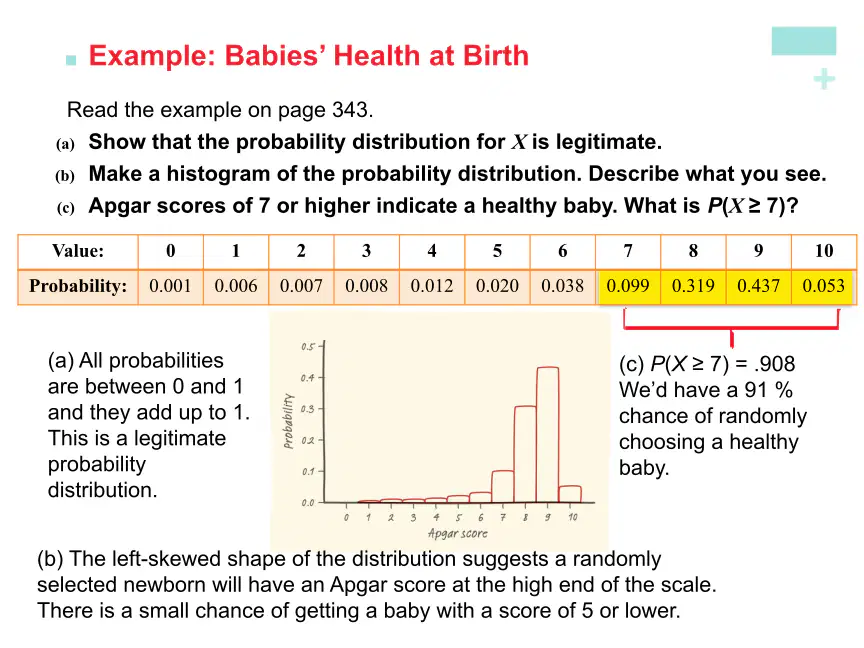
What is the probability of randomly choosing a healthy baby with an Apgar score of 7 or higher?
0.001
0.319
0.908
0.437
13
14
Multiple Choice
Find the mean (expected value) of the probability distribution.
85
83.2
87.1
84.4
15
16
Open Ended
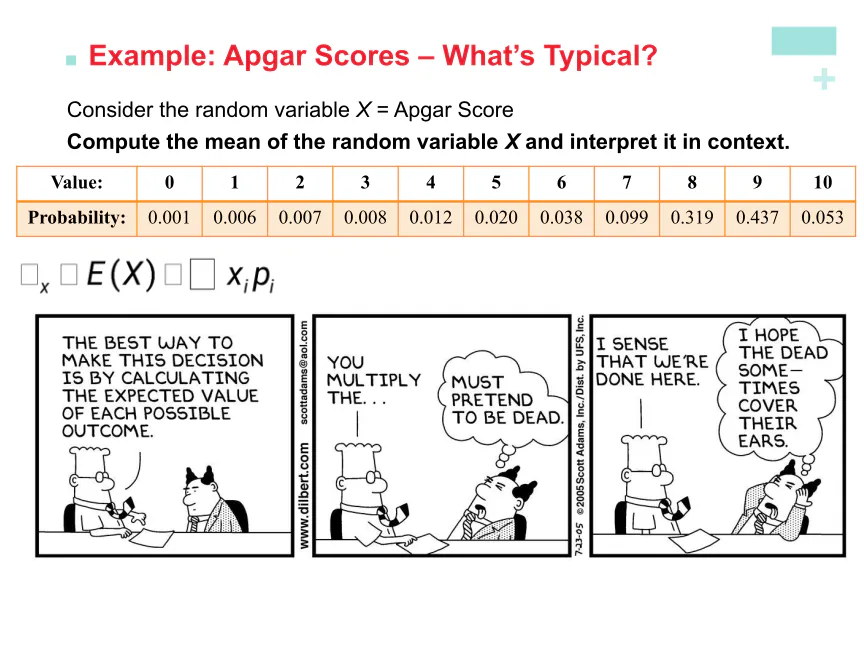
Compute the mean of the random variable X and interpret it in context.
17
18
Multiple Choice
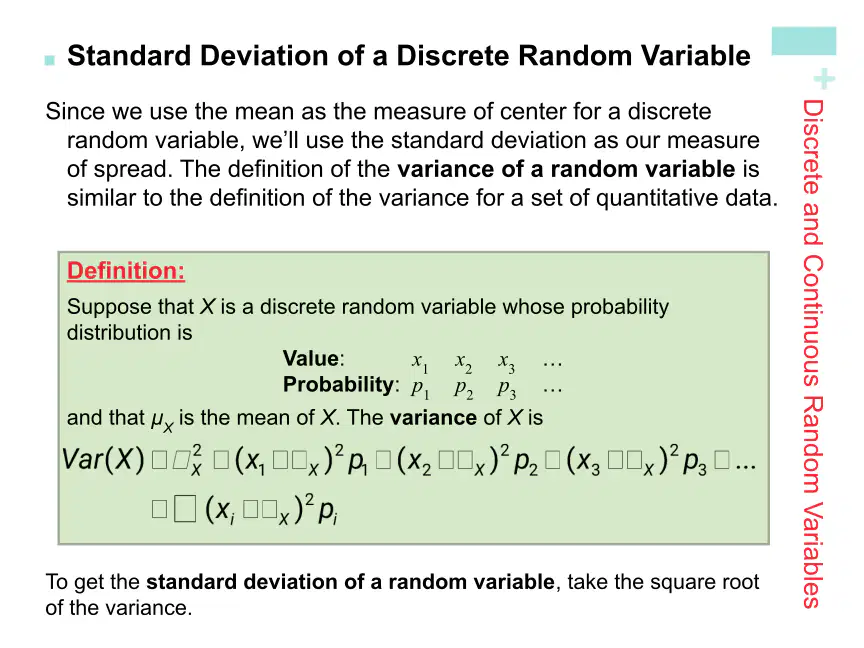
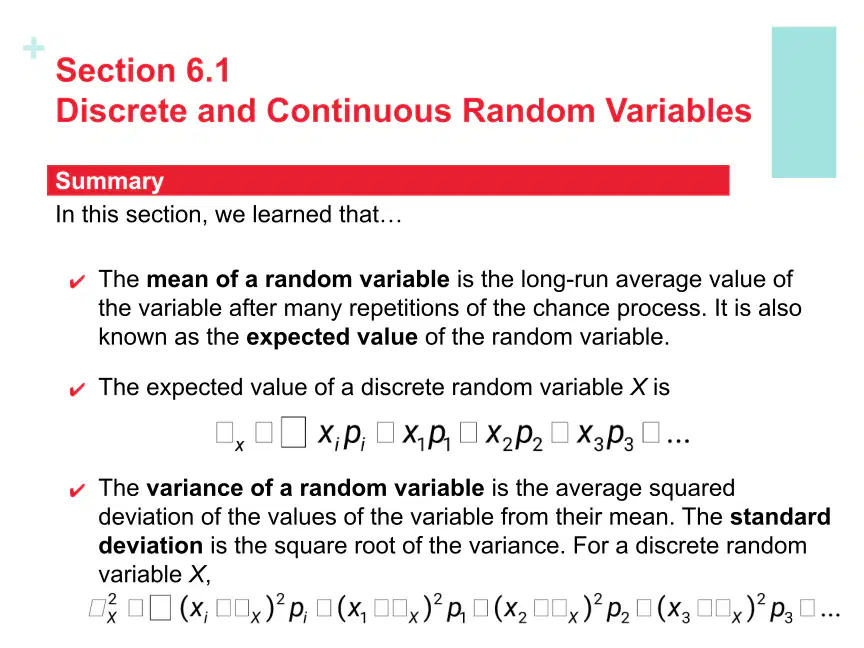
What is the formula for the variance of a discrete random variable X?
Var(X) = Σ (xi - μX)² pi
Var(X) = Σ (xi)² pi
Var(X) = μX²
Var(X) = Σ (xi - μX) pi
19
20
Multiple Choice
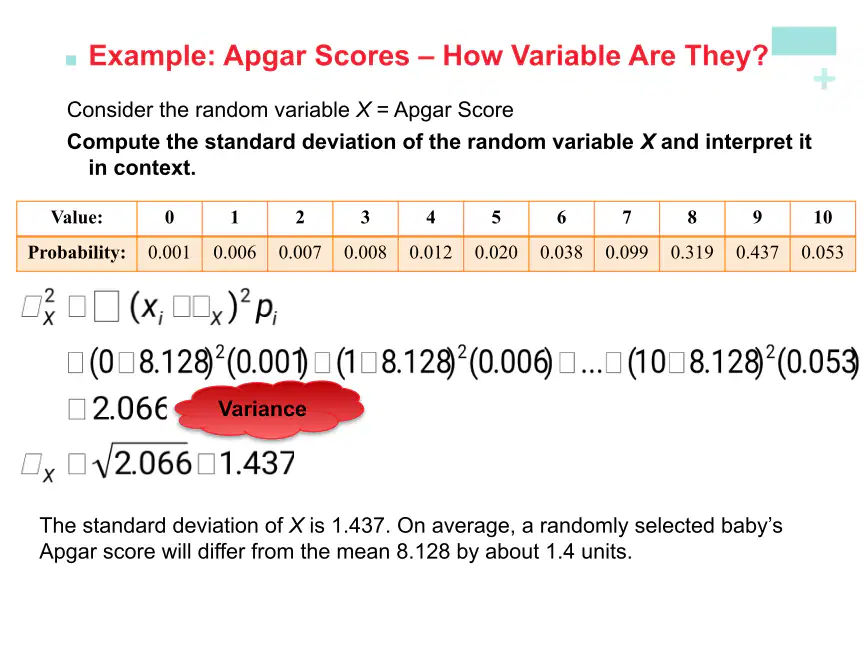
Compute the standard deviation of the random variable X and interpret it in context.
1.437
8.128
2.066
0.001
21
22
Multiple Choice
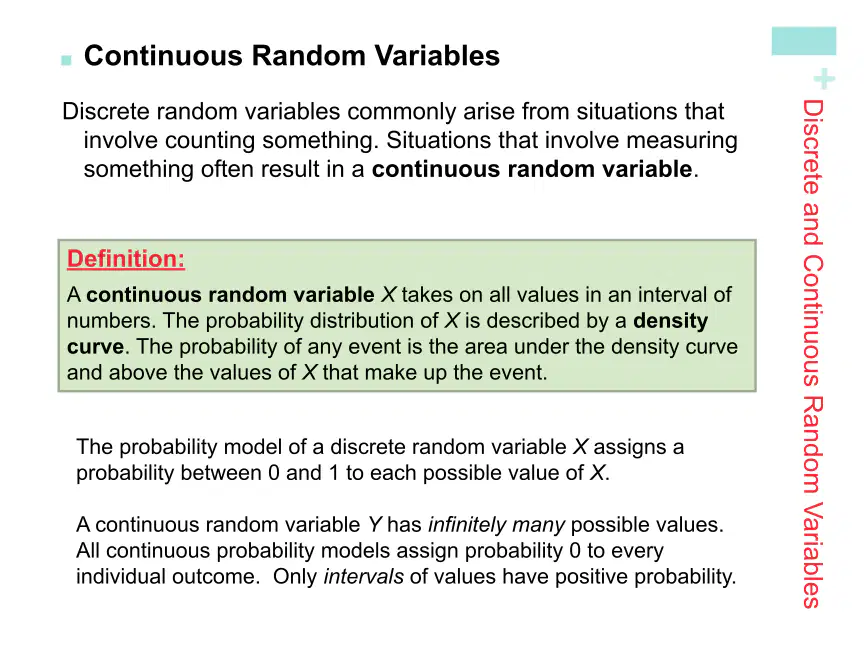
What is a continuous random variable?
A variable that takes on all values in an interval of numbers
A variable that can only take on discrete values
A variable that is always positive
A variable that is always negative
23
24
Multiple Choice
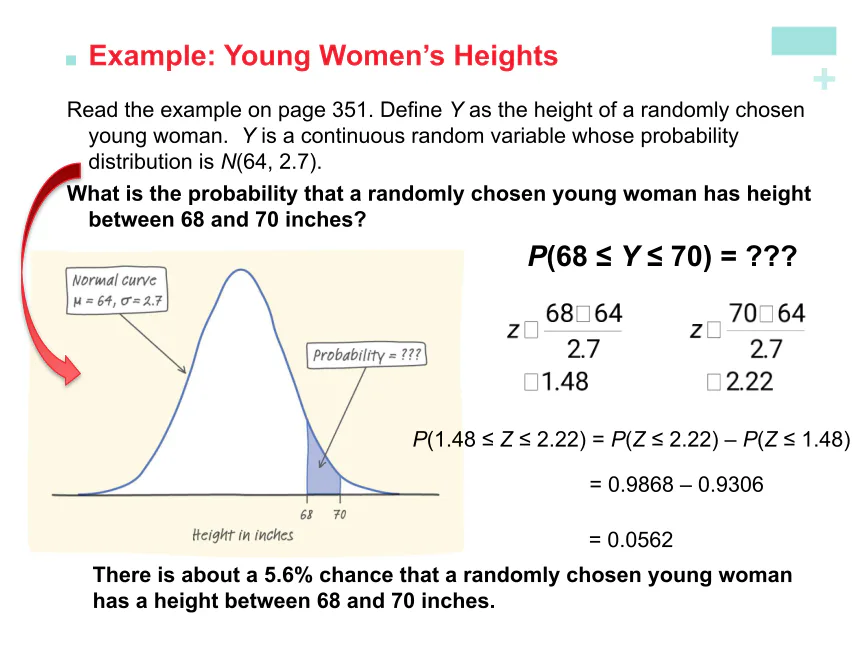
What is the probability that a randomly chosen young woman has height between 68 and 70 inches?
0.0562
0.9868
0.9306
0.5
25
26
Multiple Choice
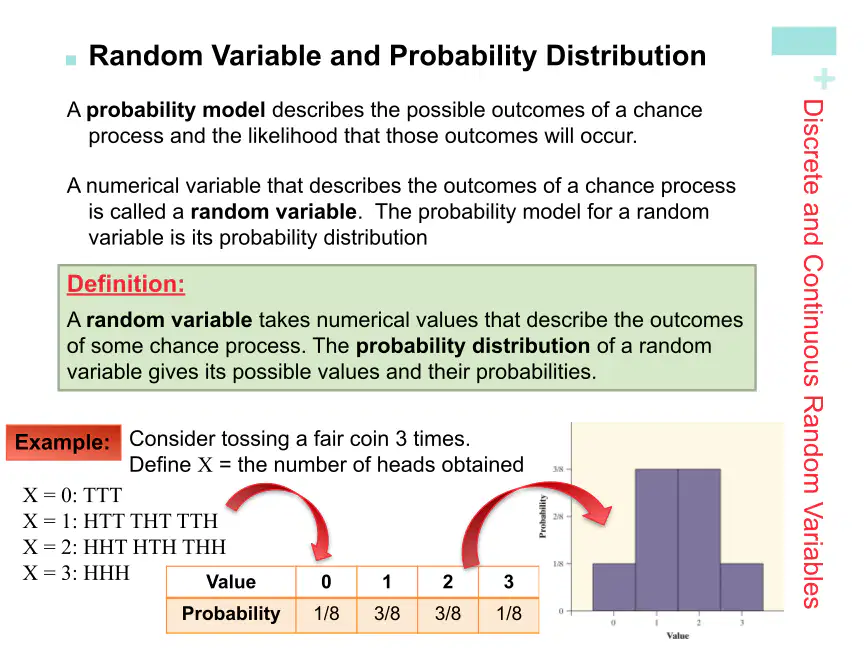
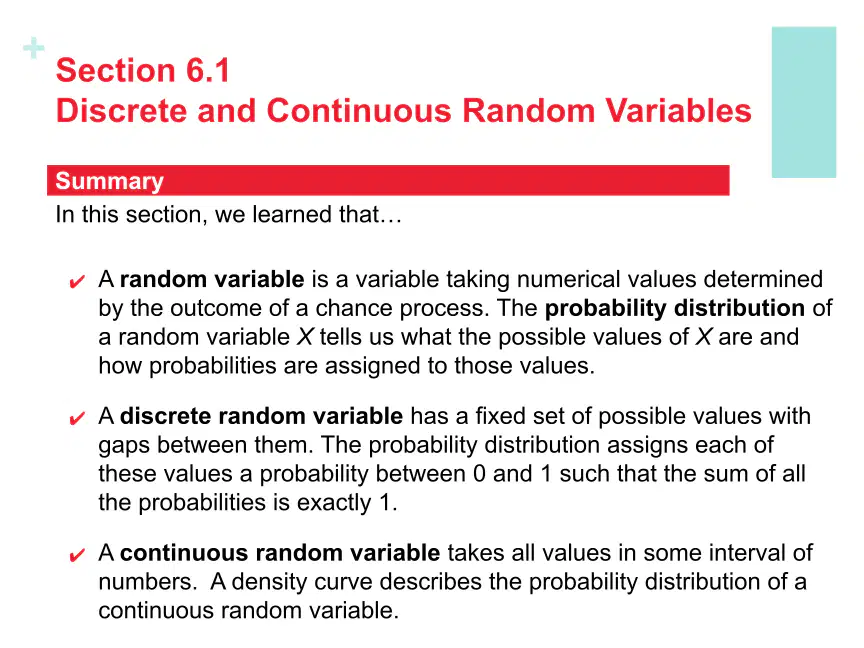
What is a random variable?
A variable that takes numerical values determined by the outcome of a chance process
A fixed set of possible values with gaps between them
A variable that takes all values in some interval of numbers
A variable that describes the probability distribution of a continuous random variable
27
28
Multiple Choice
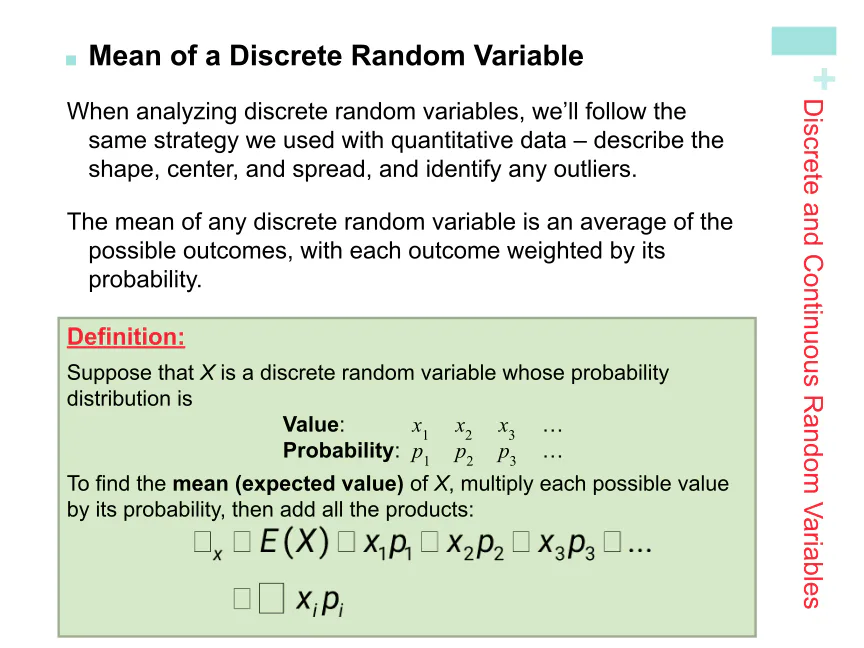
What is the expected value of a discrete random variable X?
X = Σ Xi pi
X = X1 p1 + X2 p2 + X3 p3
X = average of all possible values
X = variance of the random variable
29
30
Multiple Choice
The mean amount of time to mix the batter for a cake is 14 minutes with a standard deviation of 2.5 minutes. The mean amount of time to bake the cake is 35 minutes with a standard deviation of 6.2 minutes. What is the mean time to make and bake a cake? What is the standard deviation?
mean = 49 min sd = 8.7 min
mean = 49 min sd = 6.685 min
mean = 21 min sd = 8.7 min
mean = 21 min sd = 6.685 min
31
Fill in the Blanks
32
Draw
What is the probability of getting “heads” 5x in a row? Solve this problem first by drawing a tree diagram.
33
Open Ended
What is the probability of getting “heads” 5x in a row? Solve the problem without a tree diagram, with work.
34
Poll
How confident do you feel about this topic now?
Show answer
Auto Play
Slide 1 / 34
SLIDE

Similar Resources on Wayground
22 questions
Joint and Marginal Frequency
Presentation
•
9th - 12th Grade
23 questions
Line of best fit - Scatter Plots
Presentation
•
9th - 12th Grade
27 questions
Solving Absolute Value Equations
Presentation
•
9th - 12th Grade
27 questions
Graphs of Polynomials
Presentation
•
9th - 12th Grade
33 questions
Exponential Functions Intro/Review
Presentation
•
9th - 12th Grade
24 questions
Make valid claims, Identify Population and sample
Presentation
•
9th - 12th Grade
28 questions
Week #3 Day 3: Domain, Range & End Behavior
Presentation
•
9th - 12th Grade
30 questions
Key Features of Exponential Functions
Presentation
•
10th - 11th Grade
Popular Resources on Wayground
15 questions
Grade 3 Simulation Assessment 1
Quiz
•
3rd Grade
22 questions
HCS Grade 4 Simulation Assessment_1 2526sy
Quiz
•
4th Grade
16 questions
Grade 3 Simulation Assessment 2
Quiz
•
3rd Grade
19 questions
HCS Grade 5 Simulation Assessment_1 2526sy
Quiz
•
5th Grade
17 questions
HCS Grade 4 Simulation Assessment_2 2526sy
Quiz
•
4th Grade
20 questions
Equivalent Fractions
Quiz
•
3rd Grade
24 questions
HCS Grade 5 Simulation Assessment_2 2526sy
Quiz
•
5th Grade
20 questions
Math Review
Quiz
•
3rd Grade
Discover more resources for Mathematics
20 questions
Algebra 1 EOC Review 1
Quiz
•
9th Grade
20 questions
Graphing Inequalities on a Number Line
Quiz
•
6th - 9th Grade
5 questions
A.F/ST Quizizz Day 1
Quiz
•
9th - 12th Grade
5 questions
G.PC/DF Quizizz Day 2
Quiz
•
9th - 12th Grade
5 questions
A.F/ST Quizizz Day 5
Quiz
•
9th - 12th Grade
15 questions
Combine Like Terms and Distributive Property
Quiz
•
8th - 9th Grade
15 questions
Algebra 1 EOC Review #1
Quiz
•
9th Grade
5 questions
A.F/ST Quizizz Day 3
Quiz
•
9th - 12th Grade