

Chapter 19 Antianxiety Drugs Google Slides

Presentation
•
Health Sciences
•
Vocational training
•
Practice Problem
•
Hard

Marilyn Goodman
FREE Resource
30 Slides • 28 Questions
1

2

3
Multiple Choice
Which of the following is a key assessment activity a nurse should perform before administering an antianxiety drug to a client?
Review the client's allergy history
Monitor the client's blood pressure
Assess the client's level of anxiety
Check the client's temperature
4
Open Ended
Why is it important for healthcare professionals to understand the uses and potential adverse reactions of antianxiety drugs before administering them to patients?
5

6
Multiple Choice
Which of the following is a correct definition of anxiety?
A feeling of apprehension, worry, or uneasiness that can be normal
A disorder that always requires medication
A condition that never interferes with daily living
A type of depression
7

8
Open Ended
Explain how benzodiazepines and nonbenzodiazepines differ in their actions on neurotransmitter systems.
9

10
Multiple Select
Which of the following are common uses for antianxiety drugs?
Isolated episodes of intense anxiety
Temporary use with severe functional impairment
Preanesthetic sedation and muscle relaxation
Treatment of bacterial infections
11

12
Fill in the Blanks
Type answer...
13

14
Multiple Select
Which of the following are considered other adverse reactions of antianxiety drugs?
Lethargy, apathy, fatigue
Disorientation
Nausea, constipation, dry mouth
Increased appetite
15
16
Open Ended
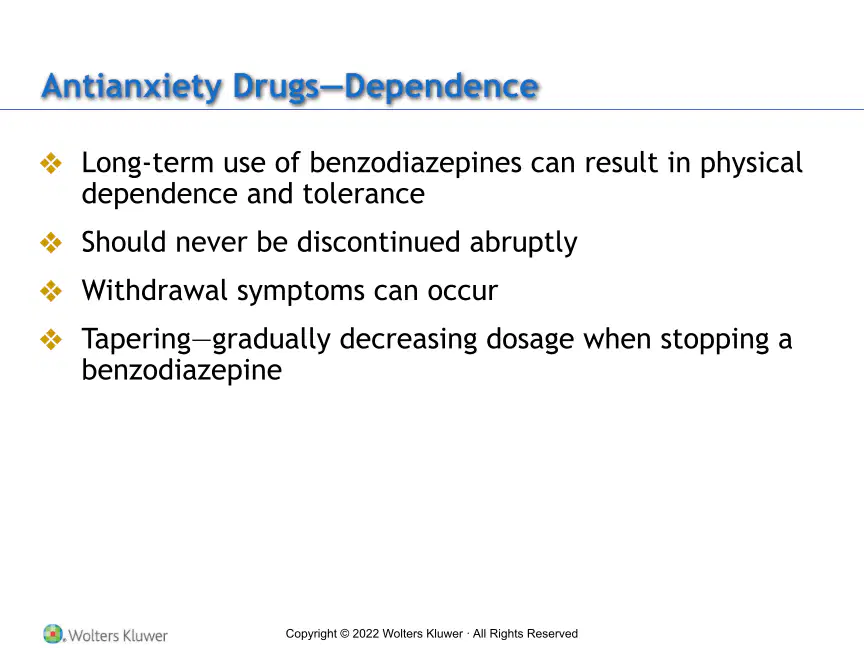
What precautions should be taken when discontinuing long-term use of benzodiazepines?
17

18
Multiple Choice
Which of the following is NOT a symptom of benzodiazepine withdrawal?
Increased anxiety and panic
Fatigue
Metallic taste
Weight gain
19

20
Multiple Choice
A client on benzodiazepine therapy for 4 weeks comes to an adult day health facility. The EHR indicates the drug was stopped abruptly. The nurse should monitor for which of the following?
Increased RBC count
Decreased pulse rate
Increased anxiety
Increased appetite
21

22
Open Ended
Based on the information from the slides, list three conditions in which antianxiety drugs are contraindicated.
23

24
Fill in the Blanks
Type answer...
25

26
Multiple Select
Which of the following drugs, when taken with antianxiety drugs, increases the risk for CNS depression? Select all that apply.
Alcohol
Analgesics
Digoxin
Tricyclic antidepressants
27
28
Multiple Select
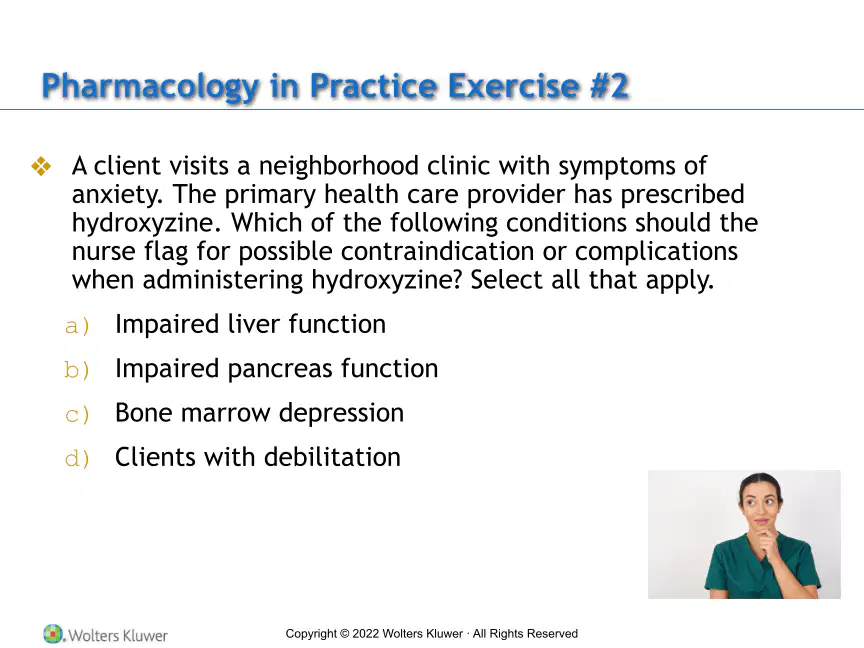
A client visits a neighborhood clinic with symptoms of anxiety. The primary health care provider has prescribed hydroxyzine. Which of the following conditions should the nurse flag for possible contraindication or complications when administering hydroxyzine? Select all that apply.
Impaired liver function
Impaired pancreas function
Bone marrow depression
Clients with debilitation
29

30
Multiple Choice
Which of the following are examples of objective data collected during the preadministration assessment for a client receiving an antianxiety drug?
Description of general appearance and vital signs
Rating of anxiety level and coping mechanisms
Medical, social, and health history
Review of chart for drugs affecting mental health
31

32
Open Ended
Explain the difference between objective and subjective data in the context of assessing a client prior to administering an antianxiety drug.
33

34
Multiple Choice
Which actions are included in the ongoing assessment of a client receiving an antianxiety drug?
Check blood pressure before drug administration
Monitor for adverse reactions
Ask client or family about adverse effects of drug
All of the above
35
36
Fill in the Blanks
Type answer...
37

38
Multiple Select
Which of the following are expected client outcomes when planning care for a client receiving an antianxiety drug?
Optimal response to therapy
Management of adverse drug reactions
Confidence in understanding the medication regimen
All of the above
39

40
Open Ended
Why are antianxiety drugs not recommended for long-term use, and what should a nurse do if a client requires larger doses or shows increased anxiety?
41

42
Multiple Choice
Which of the following is the best choice of antianxiety medication for elderly clients to minimize the risk of adverse reactions and toxicity?
Buspirone
Diazepam
Alprazolam
Clonazepam
43

44
Open Ended
After parenteral administration of an antianxiety drug, why should the client be kept lying down for 30 minutes to 3 hours, especially in elderly clients?
45

46
Multiple Choice
Which interventions can help prevent constipation in clients receiving antianxiety drugs?
Encourage fluids and provide fiber-rich meals
Restrict fluids and offer high-protein meals
Encourage bed rest and limit fiber intake
Offer only clear liquids
47

48
Open Ended
What are some open-ended questions a nurse might use to assess a client's response to antianxiety therapy during outpatient visits?
49

50
Multiple Choice
An adult family home client is prescribed chlordiazepoxide for anxiety. Which of the following dietary changes should the nurse instruct the caregivers to perform to prevent the occurrence of constipation in the client?
Provide vitamin supplements
Restrict the client’s diet to fluids only
Provide the client with a fiber-rich diet and plenty of fluids
Restrict client to a strict vegetarian diet
51
52
Fill in the Blanks
Type answer...
53

54

55

56

57
Multiple Choice
Which of the following is NOT a learning objective for the chapter on antianxiety drugs?
Explain the uses, actions, adverse reactions, and precautions of antianxiety drugs.
Distinguish important preadministration and ongoing assessment activities for clients taking antianxiety drugs.
Describe the history of antianxiety drug development.
Examine ways to promote optimal therapy response and manage adverse reactions.
58
Open Ended
Reflecting on today's lesson about antianxiety drugs, what is one key point you learned that you think will be most useful in your nursing practice?
Show answer
Auto Play
Slide 1 / 58
SLIDE
Similar Resources on Wayground

54 questions
B1 Unit 1 Test Revision
Presentation
•
Professional Development
53 questions
12/01
Presentation
•
Professional Development
54 questions
English for Salesperson
Presentation
•
Professional Development
56 questions
Examen Parcial 2 - Semana 3
Presentation
•
Professional Development
52 questions
Quizizz 101 - Cognita Schools
Presentation
•
Professional Development
55 questions
Unit 305 Session 7 Properties of water
Presentation
•
Professional Development
55 questions
CEFR: Speaking Skill
Presentation
•
Professional Development
52 questions
Knowledge Hub 1.5 hours
Presentation
•
Professional Development
Popular Resources on Wayground
6 questions
Secondary Safety Quiz
Presentation
•
9th - 12th Grade
10 questions
MyPath Diagnostic Overview
Presentation
•
6th - 8th Grade
20 questions
Lab Safety Quiz

Quiz
•
6th Grade
21 questions
Continents and Oceans
Quiz
•
6th Grade
20 questions
Adding and Subtracting Decimals
Quiz
•
5th Grade
20 questions
Parts of Speech
Quiz
•
5th Grade
16 questions
Subject & Predicate
Quiz
•
5th Grade
21 questions
Lab Safety
Quiz
•
10th Grade