

Metabolic Diseases

Presentation
•
Science
•
Vocational training
•
Easy

Sarah Evans
Used 1+ times
FREE Resource
33 Slides • 24 Questions
1

2

3

4

5
Multiple Choice
What does the term "aetiology" refer to in medicine?
The study of the cause or origin of a disease
The treatment of a disease
The symptoms of a disease
The prevention of a disease
6

7
Multiple Choice
What does the term "pathogenesis" refer to?
The sequence of events and mechanisms by which a disease develops
The process of curing a disease
The prevention of disease transmission
The study of healthy body functions
8
Multiple Choice
Pathogenesis describes the process from the initial cause of a disease to which of the following?
The clinical signs observed
The recovery of the patient
The spread of the disease to others
The genetic mutation of the pathogen
9

10

11

12
Multiple Choice
Which type of cell in the Islets of Langerhans produces insulin to lower blood sugar?
Beta cells
Alpha cells
Delta cells
Gamma cells
13
Multiple Choice
What is the function of alpha cells in the Islets of Langerhans?
Make insulin to lower blood sugar
Make glucagon to raise blood sugar
Make somatostatin to balance other hormones
Make adrenaline to increase heart rate
14

15
Multiple Choice
What do beta cells release when blood sugar rises, such as after eating?
Glucagon
Insulin
Adrenaline
Cortisol
16
Multiple Choice
In diabetes, what is the main difference between dogs and cats regarding beta cell function?
In dogs, beta cells work normally; in cats, they stop working.
In dogs, beta cells stop working; in cats, the body becomes resistant to insulin.
In both dogs and cats, beta cells stop working.
In both dogs and cats, the body becomes resistant to insulin.
17

18

19

20

21
Multiple Choice
What is the most common type of diabetes mellitus in dogs?
Insulin-deficient (Type 1-like) diabetes
Insulin-resistant (Type 2-like) diabetes
Gestational diabetes
Secondary diabetes
22
Multiple Choice
Which of the following dog breeds is predisposed to diabetes mellitus?
Samoyed
Beagle
Golden Retriever
Boxer
23

24

25
Multiple Choice
Which of the following is a classic clinical sign combination mentioned in the material?
PU/PD and weight loss
Fever and cough
Diarrhea and itching
Sneezing and runny nose
26
Multiple Choice
Which clinical sign is noted as being very common in dogs?
Cataracts
Seizures
Ear infections
Limping
27

28
Multiple Choice
What is the main effect of cataracts in diabetic dogs?
Cloudiness of the lens leading to blurry vision or blindness.
Increased tear production.
Loss of fur around the eyes.
Enlargement of the eyeball.
29

30

31

32
Multiple Choice
What is a common insulin used in insulin therapy for treatment?
Caninsulin (Vetsulin)
Humulin N
Lantus
Novolog
33
Multiple Choice
Which of the following is important in dietary management for treatment?
Consistent diet/timing
High-fat diets
Irregular meal times
Low fiber intake
34

35

36

37
Multiple Choice
Which of the following is a symptom of hypoglycaemia?
Weakness
Anorexia
Blindness
Glucosuria
38
Multiple Choice
What complication is associated with cataracts that may cause blindness?
Cataracts
Hypoglycaemia
Diabetic ketoacidosis (DKA)
Urinary tract infections (UTIs)
39

40

41
Multiple Choice
What is the most common type of diabetes mellitus seen in cats?
Type 2-like diabetes
Type 1 diabetes
Gestational diabetes
Juvenile diabetes
42
Multiple Choice
Which of the following is a breed predisposed to diabetes mellitus in cats?
Burmese cats
Siamese cats
Persian cats
Maine Coon cats
43

44
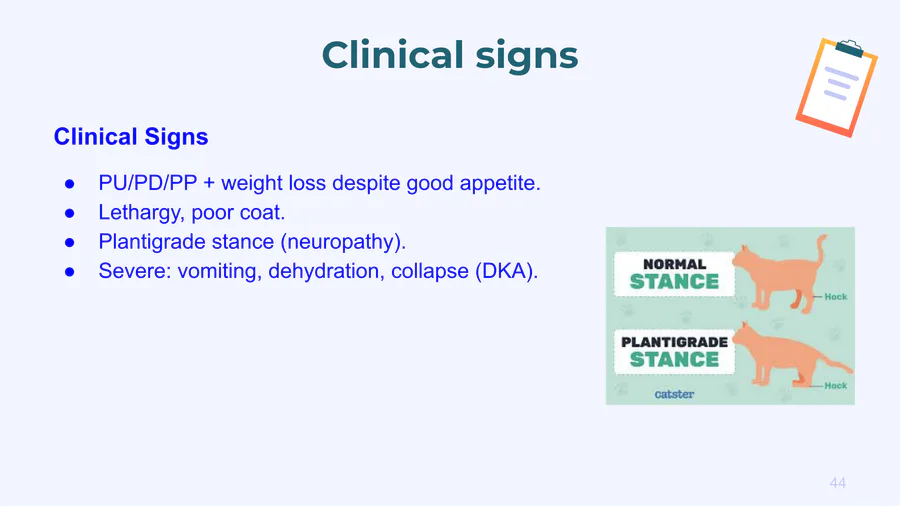
45
Multiple Choice
Which of the following is NOT a clinical sign mentioned in the slide?
PU/PD/PP with weight loss despite good appetite
Lethargy and poor coat
Plantigrade stance (neuropathy)
Increased muscle mass
46
Multiple Choice
What is a plantigrade stance most commonly associated with, according to the slide?
Neuropathy
Obesity
Hyperactivity
Skin infection
47

48

49
Multiple Choice
Which of the following is considered the mainstay of treatment in insulin therapy?
Oral medications
Insulin therapy
Herbal supplements
Physical therapy
50
Multiple Choice
What type of diet is recommended for dietary management according to the treatment guidelines?
High-carb, low-protein diets
Low-fat, high-sugar diets
Low-carb, high-protein diets
High-carb, high-fat diets
51

52

53
Multiple Choice
Which of the following is a possible complication of hypoglycaemia?
Tremors, seizures, collapse
Anorexia, vomiting, collapse
Hypertension, fever, rash
Diarrhea, dehydration, cough
54
Multiple Choice
What is a plantigrade stance most commonly associated with in the context of complications?
Neuropathy
Hypoglycaemia
DKA
Hypertension
55

56

57

Show answer
Auto Play
Slide 1 / 57
SLIDE
Similar Resources on Wayground

52 questions
Quizizz 101 - Cognita Schools
Presentation
•
Professional Development
53 questions
12/01
Presentation
•
Professional Development
51 questions
EVERYDAY CONVERSATIONS 1: Informal Greetings
Presentation
•
Professional Development
51 questions
Materi Quizizz Santy
Presentation
•
Professional Development
54 questions
B1 Unit 1 Test Revision
Presentation
•
Professional Development
52 questions
Knowledge Hub 1.5 hours
Presentation
•
Professional Development
48 questions
F&F 6 Units 10-12 Review
Presentation
•
KG
51 questions
Spring 2023 ACT Staff Training
Presentation
•
Professional Development
Popular Resources on Wayground
10 questions
Safety Day 2026 – Student Review

Quiz
•
9th Grade
21 questions
Continents and Oceans
Quiz
•
6th Grade
20 questions
Parts of Speech
Quiz
•
5th Grade
16 questions
Subject & Predicate
Quiz
•
5th Grade
25 questions
Multiplication Facts
Quiz
•
5th Grade
12 questions
Map Skills
Quiz
•
3rd Grade
22 questions
Continents and Oceans
Quiz
•
5th Grade
15 questions
Rounding Decimals
Quiz
•
5th Grade