

DFIA FLA Workshop

Presentation
•
Other
•
9th - 12th Grade
•
Practice Problem
•
Easy

Zesarinna Vivica Padre
Used 2+ times
FREE Resource
24 Slides • 44 Questions
1
Developing Filipino Identity in the Arts
By Zesarinna Vivica Padre
Film and Literary Arts
2
Open Ended
REVIEW: What is your key take away from our last canvas activity?
3
Multiple Choice
Who is the foundational artists who defined Filipino identity on screen during the Golden age [1970's-1980's]?
Ishmael Bernal
Lino Brocka
4
Multiple Choice
Who is the Iconic actress who personified the struggling Filipino masa. Her raw, non-glamorous portrayals in films like Himala challenged Western beauty standards and became a symbol of national resilience and identity.
Marilou Diaz-Abaya
Nora Aunor
Sharon Cuneta
Vilma Santos
5
Multiple Choice
Who is Known for complex character studies and films tackling gender, class, and disillusionment.
Lino Brocka
Nora Aunor
Marilou Abaya
Ishmael Bernal
6
Multiple Choice
Classic Era films were primarily shot on expensive 35mm film, making the industry heavily dependent on major film studios.
TRUE
FALSE
7
Multiple Choice
The Contemporary Era (Digital/Indie Boom) is characterized by the use of allegory and heavy symbolism to critique political regimes.
TRUE
FALSE
8
Multiple Choice
A major thematic shift in Contemporary Cinema is the focus on "Man vs. Self" conflicts, such as identity crises or personal struggles.
TRUE
FALSE
9
Multiple Choice
Directors like Lino Brocka and Ishmael Bernal were key figures who spearheaded the digital transition in the early 2000s.
TRUE
FALSE
10
Audio Response
Record "Ang Relo ni Leroy ay nagkalurayluray" If you are ready for the next phase of lesson and to know if you are in front of your MLD.

11

Developing Filipino Identity in the Arts [FLA 2.0]
12
Open Ended
“What's the best stage play you’ve ever seen or read?”
13
SCREEN VS. STAGE
15
Multiple Choice
Immediacy (The Time Constraint):
The performance is live and unedited. The action unfolds in real time, from start to finish. This forces the playwright to use dialogue and internal tension to sustain drama over long periods. If an actor messes up, the show must go on! 🏃
STAGE
SCREEN
16
Multiple Choice
Fixed Location (The Space Constraint):
You have unlimited locations. The camera is your audience's eyes and can go anywhere: inside a closet, across a continent, or into outer space. This means the screenwriter primarily writes with visuals—show, don't tell—because the camera does the describing.
STAGE
SCREEN
17
Multiple Choice
Fixed Location (The Space Constraint):
You are typically restricted to one or a few fixed locations (the stage). You can't write: "The character escapes the car crash and then jumps onto a speeding train." Therefore, the playwright must rely on dialogue to describe events that happen offstage (expository dialogue) and must keep the action focused and intimate.
STAGE
SCREEN
18
Multiple Choice
Reliance on Actor and Design (The Focus Constraint):
The performance relies heavily on the camera (close-ups, angles, editing) and sound (microphones). Screen acting is subtle, realistic, and intimate; a close-up can reveal a single tear. The writer has less control over the final visual interpretation, which is largely decided by the director and editor.
STAGE
SCREEN
19
Multiple Choice
Reliance on Actor and Design (The Focus Constraint):
he performance relies heavily on the actor's projection (voice and body language) and the design elements (lights, minimal set/props). To be seen from the back row, stage acting is often bigger, broader. The writer must trust the actor and director.
STAGE
SCREEN
20
Open Ended
This activity forces you to apply these constraints to a single plot idea.
The Scenario: A massive fight breaks out over a lost wallet.
Your Task: write down the most important thing a writer would focus on for each medium:
STAGE WRITER (Dialogue Focus): Where would you set the scene, and what is the single line of dialogue that reveals the stakes of the fight? (e.g., Maybe they're stuck in a tiny room, and the line is about the wallet containing a secret confession.)
SCREEN WRITER (Visual Focus): Where would you set the scene, and what is the single action/visual that shows the extreme scale or intimacy of the conflict? (e.g., Maybe they're fighting on the ledge of a skyscraper, or a camera close-up shows a bloodstain on the wallet.)
Quick Share: Be ready to share your setting and your single line (or visual) choice. Why does your choice work best for that specific medium?
21
The Blueprint: Script Anatomy
22
Multiple Choice
What is the first page of the script?
Character Names
Title Page
Scene Heading
Dialogue
23
Open Ended
Why do you think the title page should be the first page of the script?
24
The title page should be the first page of the script
Provides essential administrative and production information. It is the first impression of the work.
example:
Title: The Red Shoe Conflict
Author: [Student Name]
Dramatis Personae: JAY, The Mentor; VINCE, The Trickster
25
Multiple Choice
This is the part of the script where a brief description at the start of a new scene, often in ALL CAPS. It quickly establishes the location and time.
Stage Directions
Dialogue
Scene heading
Character Names
26
Scene heading
Purpose of the playwright
Signals a change in the physical setting or time of day, which cues the director and lighting/set designers. On stage, scene changes are usually minimal.
INT. DUSTY ATTIC - NIGHT EXT. BUS STOP - DAY
27
Multiple Choice
This is the part of the script where the name of the character speaking, written in ALL CAPS and typically followed by a colon or centered above the dialogue.
Character Names
Dialogue
Scene Heading
Stage Directions
28
Character Name
Clearly identifies who is speaking, preventing confusion for actors, directors, and readers.
29
Multiple Choice
This is the lines of speech spoken by the characters. It is the principal method of storytelling in a play.
30
Dialogue
Drives the plot forward, reveals the characters' inner thoughts (subtext), and establishes conflict. Dialogue is King on the stage.
31
Multiple Choice
This is the descriptive text, usually written in italics or enclosed in parentheses, that outlines character action, setting details, or sound/lighting cues.
32
Stage Directions
Guides the actors' physical movements and emotions, and provides necessary instructions for the technical crew. They should be action-oriented.
33
Open Ended
Any questions about the Script Anatomy?
34
The Power of Archetype
35
Open Ended
Write your idea about: What is archetype?
36
Archetype
Archetype comes from the Greek words arkhe (original or primitive) and typos (model or type).
An archetype is a universal, recurring model of a character, plot, or image that is recognizable across many different cultures and stories. Think of them as pre-loaded character batteries for drama.
37
Why use them in playwriting?
Archetypes allow a playwright to quickly establish a character's core motivation and voice. The audience instantly understands the role the character is expected to play (e.g., they know the Mentor will offer wisdom, and the Trickster will cause chaos).
38
| | Theatrical Goal |
|---|---|---|
The Hero | To prove worth through courageous action. | To overcome a great challenge. |
The Mentor | To guide the Hero toward wisdom and truth. | To train, protect, or offer advice. |
The Villain/Shadow | To destroy or obstruct the Hero's journey. | To cause conflict and chaos. |
The Trickster | To disrupt the status quo through mischief. | To inject comedy or reveal absurdity. |
The Innocent | To maintain goodness, safety, and purity. | To seek happiness or avoid corruption. |
39
Poll
choose the two most theatrically opposite archetypes
The Hero and the Villain
The Hero and the Trickster
40
Open Ended
Define the conflict: Prompt: The two chosen archetypes walk into a bank (a neutral location). What do they each want based purely on their nature, and how does that immediately create conflict?
Example of Expected Outcome (The Innocent vs. The Trickster):
Innocent Wants: To open a simple savings account and leave safely.
Trickster Wants: To pull a non-violent prank on the teller or swap the labels on the deposit slips.
Immediate Conflict: The Innocent's desire for order is immediately threatened by the Trickster's need for chaos. The Innocent will try to correct or apologize for the Trickster's actions.
41
Open Ended
Instruction: Write one line of dialogue that only your chosen archetype would say in this bank scenario.
EXAMPLE
Archetype | Line | Why it works
The Innocent: "Oh, goodness, I think you might have accidentally put my slip in the shredder. It's totally fine, though! I can start over!"
Shows their inherent belief in goodness and avoidance of confrontation.
The Trickster: "No, no, that slip's for the 'Emergency Unicorn Fund.' Standard policy, sir. Don't worry, it's tax-deductible."
Creates disruption through absurdity and playful lies.
42
Poll
Now that you have a background knowledge about the anatomy of the script and archetype, are you ready to make one on your own?
If yes [you may open your canvas and start working on the given activity]
If not yet [Please stay and I am willing to explain what you think you need to know about]
YES💕
NOT YET 😬
43
The Heart of the Play: Dialogue
44
Dialogue & Action
Dialogue Functions:
1. Reveal Character (motivation, backstory).
2. Advance Plot (move action forward).
3. Establish Conflict (what characters want).
Concept: Subtext (what's not being said).
45
A character's language choice can subtly hint at their past (backstory) or what they truly believe (motivation).
Dialogue shows the audience who the character is, often through their choice of words and their unique voice.
Reveal Character (Motivation, Backstory):
46
If a line could be cut without affecting the action that follows, it's not advancing the plot. A character saying "I'm leaving" is dialogue that moves the action forward.
Dialogue must change the situation on stage. It contains the inciting incidents and the turning points.
Advance Plot (Move Action Forward):
47
The most dramatic dialogue involves characters fighting to achieve their goal with words, which makes the outcome unclear.
Conflict is the heart of drama. Dialogue often establishes conflict by showing the clash between what Character A wants and what Character B wants.
Establish Conflict (What Characters Want):
48
Multiple Choice
What do you think is a SUBTEXT?
49
Multiple Choice
What do you think is the subtext of this script: : "I'm just so glad you could make it. I truly am." (Spoken with a forced smile.)
50
Developing Filipino Identity in the Arts
By Zesarinna Vivica Padre
Film and Literary Arts
51
Open Ended
REVIEW: What is your key take away from the first part of the workshop?
52
Categorize
Immediacy [The time constraint]
Title Page
Dialogue
Character List
Scene Headings
Stage Direction
Fixed Location
Reliance on Actor and design
The Innocent
Subtext
Advance Plot
Reveals Character
Exposition /Backstory
Establish Conflict
Organize these options into the right categories
53
Stage Directions & Visuals
54
Stage Directions
SHOW DON'T TELL
55
Open Ended
What do you think about about "SHOW DON'T TELL"?
56
Stage Directions
Directions are for the actor and director. Use evocative language for setting and movement. Avoid: telling actors how to feel.
Example: Instead of (John is angry), write (John smashes the glass on the table).
57
Open Ended
Questions?
58
Draw
Draw your very own version of Sir James HAPPY FACE if you are ready to move forward to our ACTIVITY.
59
Before we start our activity lets have a quick ICE BREAKER.
60
Multiple Choice

Totoo bang nagsasalamin si Sir James
LEGIT, YES!
LIAR, NO!
61
Open your Written Work 4 on canvas
62
Poll
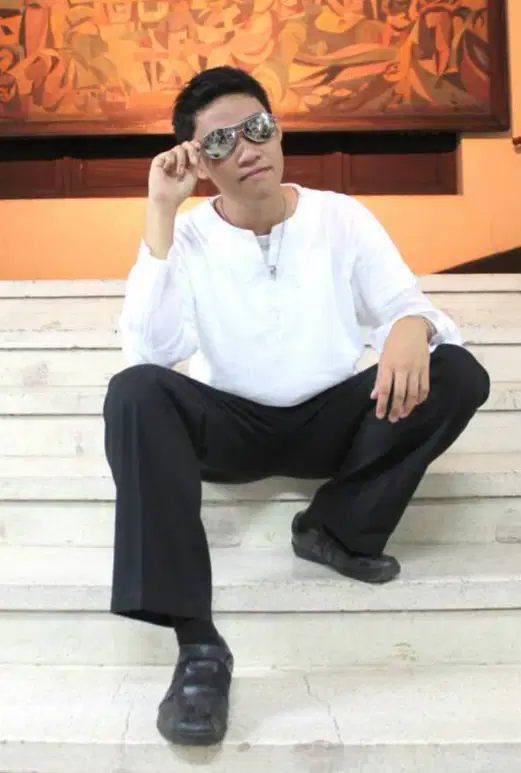
ANO ANG FINIFLEX ni SIR JAMES dito, may karapatan ba sya?
MERON, LODI!
WALA📢
63
Hotspot
Where is Sir James?
64
Multiple Choice

In this picture, one of SIr James's friend commented "James, ano na?" What do you think is his reply?
Ahahahahaha! Nakapikit pala ako dito!
Ang dialogue ko jan ay, "Ano na, nasaan na ung Iced Tea? Malapit na ako MATULOG wala pa rin ha!" Hahahahaha
Ahahahahaha! Nakapikit pala ako dito!
Ang dialogue ko jan ay, "Ano na, nasaan na ung Iced Tea? Malapit na ako MATAPOS wala pa rin ha!" Hahahahaha
Ahahahahaha! Nakapikit pala ako dito!
Ang dialogue ko jan ay, "Ano na, nasaan na ung Iced Tea? Malapit na ako MAGING BUTTERFLY wala pa rin ha!" Hahahahaha
Ahahahahaha! Nakapikit pala ako dito!
Ang dialogue ko jan ay, "Ano na, nasaan na ung Iced Tea? Malapit na ako MAGWALA wala pa rin ha!" Hahahahaha
65
Open Ended

What university did Sir James graduate from? Do you think he was a real graduate?
66
Poll

Who is this?
Carlo Dalisay
Ramon Tanggol Montenegro
Coco Martin
Nata de coco
67
Multiple Choice

What do you think is Based on the phot , what is Sir James favorite color?
Yellow
Red
Skintone
Black
68
Audio Response

Record your birthday message for Sir James
Developing Filipino Identity in the Arts
By Zesarinna Vivica Padre
Film and Literary Arts
Show answer
Auto Play
Slide 1 / 68
SLIDE
Similar Resources on Wayground

61 questions
Dimensining
Presentation
•
9th - 12th Grade
64 questions
Elements of Fiction Review
Presentation
•
9th - 12th Grade
61 questions
Right Triangles, Pythagorean Theorem & Distance Formula
Presentation
•
8th - 12th Grade
59 questions
America's Evolving Relationship with the World
Presentation
•
9th - 12th Grade
64 questions
Ch. 3 Matter Properties and Changes
Presentation
•
9th - 12th Grade
64 questions
Investments
Presentation
•
9th - 12th Grade
64 questions
VII-Crisis of Faith IV
Presentation
•
9th - 12th Grade
Popular Resources on Wayground
24 questions
PBIS-HGMS Day 10

Quiz
•
6th - 8th Grade
10 questions
HCS SCI 03 Summer School Review 3
Quiz
•
3rd Grade
11 questions
Home Scope
Quiz
•
7th - 8th Grade
15 questions
HCS SCI 05 Summer School Assessment 3 Review
Quiz
•
5th Grade
35 questions
Lufkin Road Middle School Student Handbook & Policies Assessment
Quiz
•
7th Grade
18 questions
Geo 11.3 Area of Circles and Sectors
Quiz
•
9th - 11th Grade