

RELATIVE DATING & LAW OF SUPERPOSITION

Presentation
•
Science
•
2nd Grade
•
Practice Problem
•
Easy
+1
Standards-aligned

Emely Tragua
Used 2+ times
FREE Resource
13 Slides • 15 Questions
1

2

3
Multiple Choice
Why is studying fossil evidence important for understanding Earth's history?
It helps us predict future earthquakes
It reveals information about past life and environments
It tells us how to find gold and minerals
It explains the formation of the moon
4
Open Ended
How do you think geologists use rock layers and fossils to learn about the past?
5

6
Multiple Choice
Which of the following best describes what a fossil is?
A living organism found in sedimentary rock
A preserved remain or trace of a past organism
A type of mineral found in rocks
A layer of volcanic ash
7

8
Multiple Choice
How do sedimentary rock layers help geologists learn about Earth's history?
They show the exact age of the Earth
They contain fossils and represent different time periods
They are always the same color
They only form in deserts
9

10
Multiple Choice
Explain how relative dating helps scientists determine the sequence of events in Earth's history.
11

12
Fill in the Blanks
According to the Law of Superposition, in undisturbed rock layers, the oldest rocks are found at the
13

14
Multiple Select
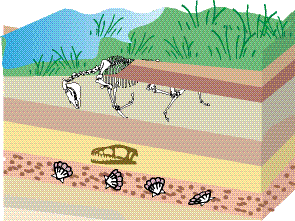
Based on the diagrams, which of the following statements are correct about how rock layers and fossils are deposited over time?
The youngest fossils are always at the bottom
Rock layers are deposited from the bottom up
Older fossils are found in deeper layers
Fossils are only found in the top layer
15

16
Multiple Choice
Describe the three main steps geologists use when applying relative dating to determine the ages of fossils and rock layers.
17
Multiple Choice
18

19
Multiple Choice
What does each colorful band of rock in the Grand Canyon represent?
A different era in Earth's history
A different type of mineral
A different climate zone
A different river path
20

21

22

23
Multiple Choice
Which of the following statements about the Law of Superposition is correct?
It determines the relative age of rock layers and fossils.
It determines the exact numerical age of fossils.
It only applies to marine fossils.
It is used to identify the chemical composition of rocks.
24

25
Multiple Choice
Explain how fossils and rock layers act as a 'history book' for Earth.
26
Fill in the Blanks
By using the Law of Superposition and
27
Open Ended
How do geologists use the Law of Superposition to study Earth's history?
28
Open Ended
What is one concept from today's lesson on fossil evidence and relative dating that you found most interesting or would like to learn more about?
Show answer
Auto Play
Slide 1 / 28
SLIDE
Similar Resources on Wayground

20 questions
One Step Equations
Presentation
•
KG - University
18 questions
2nd Grade Science Solids, Liquids, and Gases Review
Presentation
•
2nd Grade
20 questions
S2 Forces and Friction
Presentation
•
2nd Grade
23 questions
Electricity and Magnetism
Presentation
•
3rd Grade
21 questions
2nd Grade Reading
Presentation
•
2nd Grade
22 questions
Reading Comprehension 4_Grade 2
Presentation
•
2nd Grade
20 questions
living things and non living things
Presentation
•
KG
20 questions
Get Smart Plus 3 Topic 8 was/were
Presentation
•
1st - 4th Grade
Popular Resources on Wayground
10 questions
Impact of 9/11 and the War on Terror

Interactive video
•
10th - 12th Grade
21 questions
Continents and Oceans

Quiz
•
6th Grade
5 questions
9/11
Interactive video
•
9th Grade
20 questions
Parts of Speech
Quiz
•
5th Grade
16 questions
Subject & Predicate
Quiz
•
5th Grade
10 questions
Riddles Riddles fun Riddles
Quiz
•
6th - 12th Grade
21 questions
Lab Safety
Quiz
•
10th Grade
6 questions
PRIDE in the Hallways and Bathrooms
Presentation
•
12th Grade
Discover more resources for Science
10 questions
Identifying Physical and Chemical Changes
Interactive video
•
1st - 5th Grade
10 questions
Exploring the Conservation of Mass in Everyday Life
Interactive video
•
1st - 5th Grade
10 questions
Exploring Properties of Matter
Interactive video
•
1st - 5th Grade
10 questions
Discovering the Properties of Matter
Interactive video
•
1st - 5th Grade
10 questions
Elementary Science: Mixtures and Solutions
Quiz
•
1st - 5th Grade
10 questions
Exploring Food Chains and Webs in Ecosystems
Interactive video
•
1st - 5th Grade
12 questions
Properties of Matter
Quiz
•
2nd Grade
10 questions
2nd RC1 English
Quiz
•
2nd Grade