Unit 3 & Univ. Grav. Test Review Projectile Motion
Presentation
•
Physics
•
9th Grade
•
Medium
Standards-aligned
Maria Cerca
Used 8+ times
FREE Resource
4 Slides • 25 Questions
1
By Maria Cerca
2
Horizontal time is the same as vertical time.
Which angle will allow an object to travel the farthest?
3
Acceleration (m/s2)
Force (N)
Velocity (m/s)
4
Directly Proportional:
Force and mass
Inversely Proportional:
Force and distance
5
Multiple Choice
In any projectile motion problem, which variable is constant?
horizontal distance
horizontal time
acceleration
vertical distance
6
Multiple Choice
If you throw a baseball straight up, what is its velocity at the highest point?
9.8 m/s2
0 m/s2
9.8 m/s
0 m/s
7
Multiple Choice
A ball rolls off a table that is 4m high and hits a target 8m away. What is the initial horizontal velocity?
8.9 m/s
5.0 m/s
10.0 m/s
7.5 m/s
8
Multiple Choice
An athlete throws a football off the stands onto a football field, 20m below, at a speed of 8m/s. Using equations for projectile motion, describe how far away the football lands from the athlete.
16.2 m.
10.5 m.
18.3 m.
22.7 m.
9
Multiple Choice
A swimmer runs off a pool’s diving board at 5m/s and lands in the water 10 meters away from the edge of the diving board. Calculate how high above the swimming pool the diving board is located.
19.6 m
15.6 m
10.7 m
5.0 m
10
Multiple Choice
What is the centripetal acceleration required to keep a 2000 kg car moving in a circular path of radius 25.0 meters with a velocity of 10 m/s?
4 m/s²
5 m/s²
3 m/s²
0.4 m/s²
11
Multiple Choice
At the instant shown in the image, in which direction is the car's velocity?
Toward E
Toward W
Toward N
Toward S
12
Multiple Choice
At the instant shown in the image, in which direction is the car's centripetal force?
Toward E
Toward W
Toward N
Toward S
13
Multiple Choice
A rock tied to a string is traveling at a constant speed of 4 m/s in a circle of a radius 1.5 m. Calculate the magnitude of the centripetal acceleration of the rock. What is the direction of the acceleration?
10.7 m/s²
8.0 m/s²
12.5 m/s²
2.7 m/s²
14
Multiple Choice
A rock tied to the end of a string moves in a circle at a constant speed of 2.5 m/s and experiences an acceleration of 4.0 m/s². What is the radius of the circle of its motion?
1.6 m
2.0 m
1.2 m
25 m
15
Multiple Choice
The force vector should be drawn ___, the velocity vector should be drawn ___ of the circular path.
towards the center,
tangent
tangent, towards the center
outwards, tangent
tangent, outwards
16
Draw
Draw the force, velocity and, acceleration vectors and make sure that you label each. Use a different color for each vector.
17
Multiple Choice
18
Multiple Choice
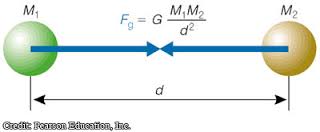
If I double the mass of one object, but don't change anything else... What happens to the gravitational force between two objects?
19
Multiple Choice
20
Multiple Choice
21
Multiple Choice
The gravitational force between the two spheres is 40N.
Scenario: The distance between the two masses is then halved. What will the magnitude of the new force be when this happens.
20 N
40 N
80 N
160 N
22
Multiple Choice
23
Multiple Choice
24
Multiple Choice
25
Multiple Choice
Find the distance between two objects whose masses are m1 = 4,500 kg, and m2 = 8,700 kg; if the gravitational force between them is F = 2.0 x 10⁻⁸ N.
130565.25 m
361.3 m
0.1958 m
0.783 m
26
Multiple Choice
Calculate the force of attraction between Jupiter and Saturn. Jupiter has a mass of 1.898 x 1027 kg and Saturn has a mass of 5.683 x 1026 kg. The approximate distance between them is 7.786 x 10¹¹ m.
1.187 x 10²⁰ N
9.876 x 10¹⁹ N
2.345 x 10²⁰ N
3.786 x 10²⁰ N
27
Multiple Choice
Mercury is the closest planet to the sun and has a mass of 3.30 x 1024 kg. The sun has a mass of 1.99 x 1030 kg. Mercury is 5.79 x 10¹⁰ m away from the sun. What is the gravitation force between them?
1.31 x 10²² N
2.59 x 1033 N
4.12 x 1027 N
3.37 x 1025 N
28
Multiple Choice
A satellite with a mass of 200 kg is orbiting a planet at a distance of 500,000 meters, and the gravitational force is 0.1 N. Determine the mass of the second planet.
1.0×1024 kg
1.5×1024 kg
2.0×1024 kg
2.5×1024 kg
29
Fill in the Blanks
Convert 135 cm to meters. Include the unit in your response.
Type answer...
By Maria Cerca
Show answer
Auto Play
Slide 1 / 29
SLIDE

Similar Resources on Wayground
21 questions
Balancing Chemical Equations
Presentation
•
9th Grade
21 questions
Work and Power
Presentation
•
9th Grade
22 questions
Parallel and Perpendicular Lines
Presentation
•
9th Grade
22 questions
G9 Chap 1.3 - Methods of Science
Presentation
•
9th Grade
22 questions
Natural Selection & Speciation
Presentation
•
9th Grade
23 questions
6C: Protein Synthesis
Presentation
•
9th Grade
23 questions
Waves, Matter, & the Earth Quiz
Presentation
•
9th Grade
21 questions
lección 5.3 - Reflexive verbs
Presentation
•
9th Grade
Popular Resources on Wayground
10 questions
How much do you know about our Portrait of an Eagle?
Quiz
•
10th Grade
10 questions
Fast Food Slogans
Quiz
•
6th - 8th Grade
21 questions
Continents and Oceans
Quiz
•
6th Grade
20 questions
Parts of Speech
Quiz
•
5th Grade
16 questions
Subject & Predicate
Quiz
•
5th Grade
25 questions
Multiplication Facts
Quiz
•
5th Grade
12 questions
Map Skills
Quiz
•
3rd Grade
22 questions
Continents and Oceans
Quiz
•
5th Grade
Discover more resources for Physics
20 questions
Position vs. Time Graphs
Quiz
•
9th Grade
20 questions
Calculating Net Force
Quiz
•
6th - 9th Grade
18 questions
Interpreting Motion Graphs
Presentation
•
9th - 12th Grade
10 questions
Exit Check 4.1 - Destructive Processes
Quiz
•
9th Grade
21 questions
Distance/Time Graphs
Quiz
•
9th Grade
20 questions
Unit 2 - Waves Test - 2026
Quiz
•
9th - 12th Grade
10 questions
Exit Check 4.2 - Constructive Forces
Quiz
•
9th Grade
10 questions
Exit Check 4.3 - Conservation of Momentum
Quiz
•
9th Grade