

Newton's First Law - Conceptual Lesson

Presentation
•
Physics
•
9th - 12th Grade
•
Practice Problem
•
Medium
+6
Standards-aligned

LYDIA FILLHART
Used 8+ times
FREE Resource
29 Slides • 25 Questions
1
2
Multiple Choice
Why is it significant to understand how forces cause changes in motion?
Because it helps us predict the movement of objects in everyday life.
Because it is only relevant for scientists.
Because it has no impact on our daily experiences.
Because forces only affect objects in space.
3
4
Open Ended
Describe a situation from your own experience where you observed a change in motion and identified the cause behind it.
5
6
Multiple Choice
Which of the following best describes Aristotle's classification of motion?
Natural motion and violent motion
Linear motion and circular motion
Rest and motion
Pushed motion and pulled motion
7
8
Multiple Select
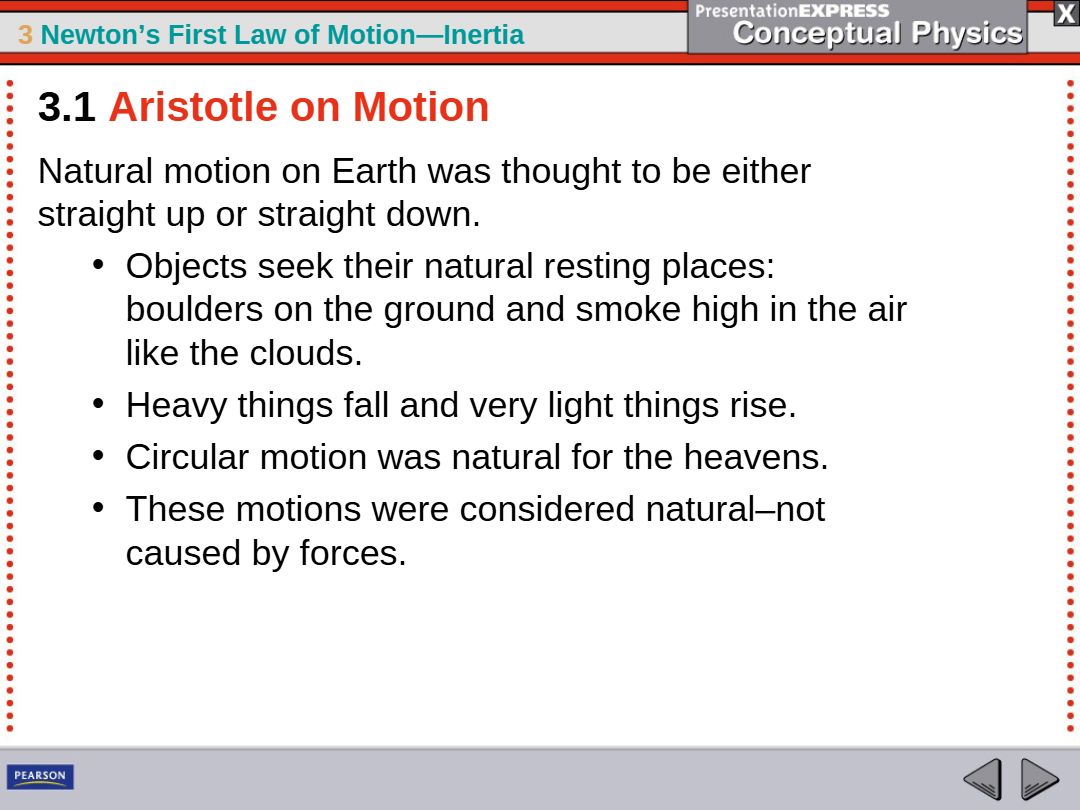
According to Aristotle, which of the following are characteristics of natural motion?
Objects seek their natural resting places
Heavy things fall and light things rise
Circular motion was natural for the heavens
All of the above
9
10
Open Ended
Explain the difference between natural motion and violent motion as described by Aristotle.
11
12
Fill in the Blanks
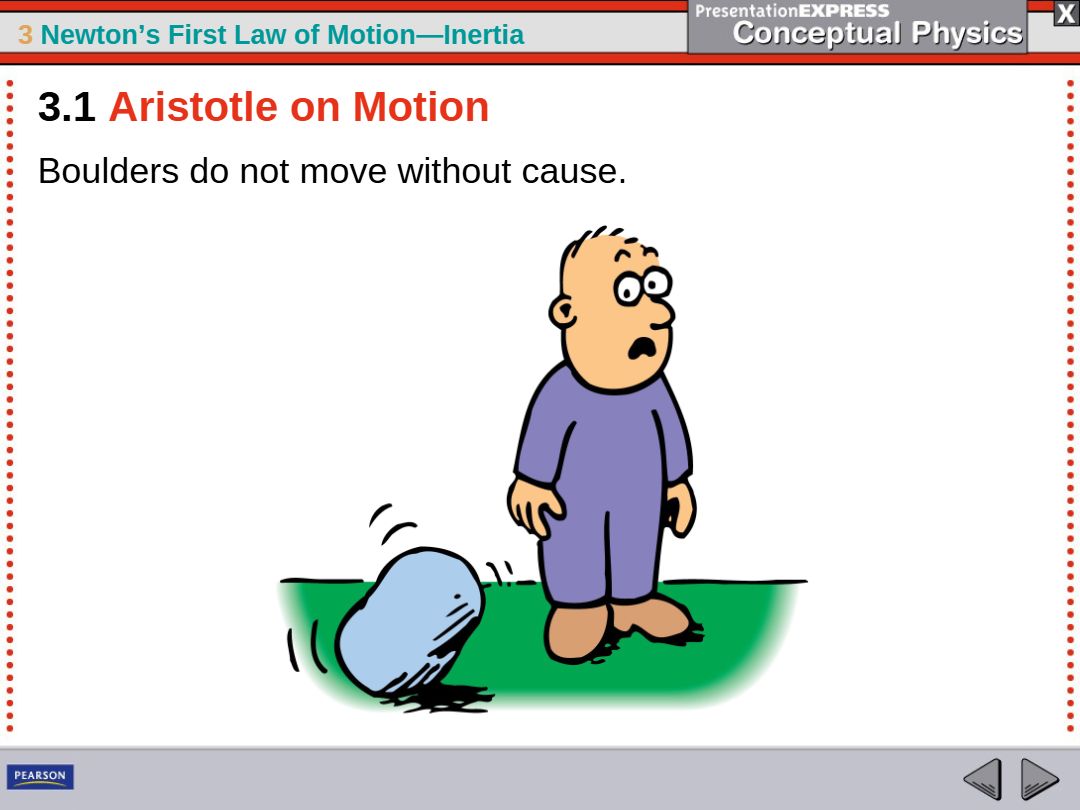
Boulders do not move without
13
14
Multiple Choice
What was the commonly held belief about the movement of the Earth before the 1500s?
Earth was always in motion
Earth was in its natural resting place and did not move
Earth moved due to violent motion
Earth was pushed by a large force
15
16
17
18
Open Ended
Why was Copernicus's idea about the moving Earth considered controversial during his time?
19
20
Multiple Choice
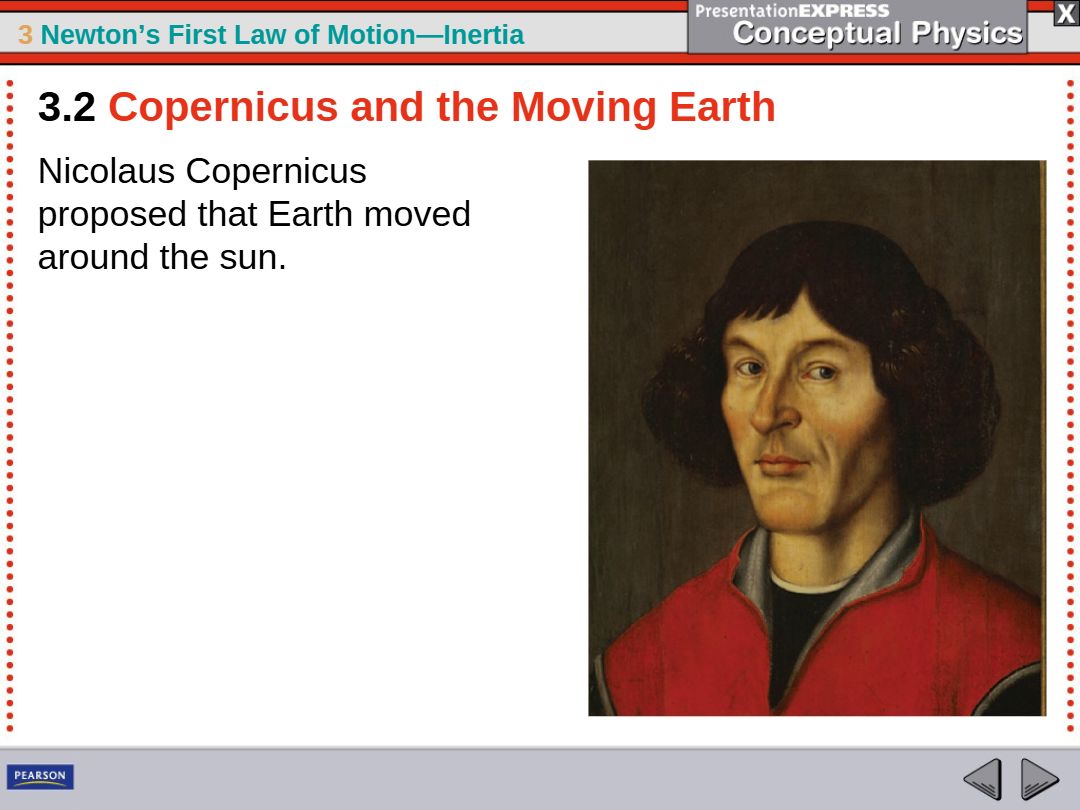
Which astronomer proposed that Earth and the other planets move around the sun?
Galileo Galilei
Isaac Newton
Nicolaus Copernicus
Johannes Kepler
21
22
Fill in the Blanks
What did Copernicus state about Earth’s motion?
23
24
Fill in the Blanks
Galileo argued that only when
25
26
Open Ended
Explain how Galileo's support of Copernicus contributed to the development of physics.
27
Multiple Select
Which of the following statements about Galileo's view on motion are correct?
A force is always needed to keep an object moving.
Friction is required to keep an object moving.
A force is only needed to keep an object moving when friction is present.
No force is needed to keep an object moving if friction is absent.
28
29
Multiple Select
Which of the following statements about friction are correct?
Friction is caused by irregularities in the surfaces of objects that are touching.
Even very smooth surfaces have microscopic irregularities that obstruct motion.
If friction were absent, a moving object would need no force to remain in motion.
Friction only occurs between rough surfaces.
30
Multiple Choice
What is friction?
The force that acts between materials that touch as they move past each other
The force that pulls objects toward the Earth
The resistance of an object to a change in its state of motion
The energy stored in moving objects
31
32
Fill in the Blanks
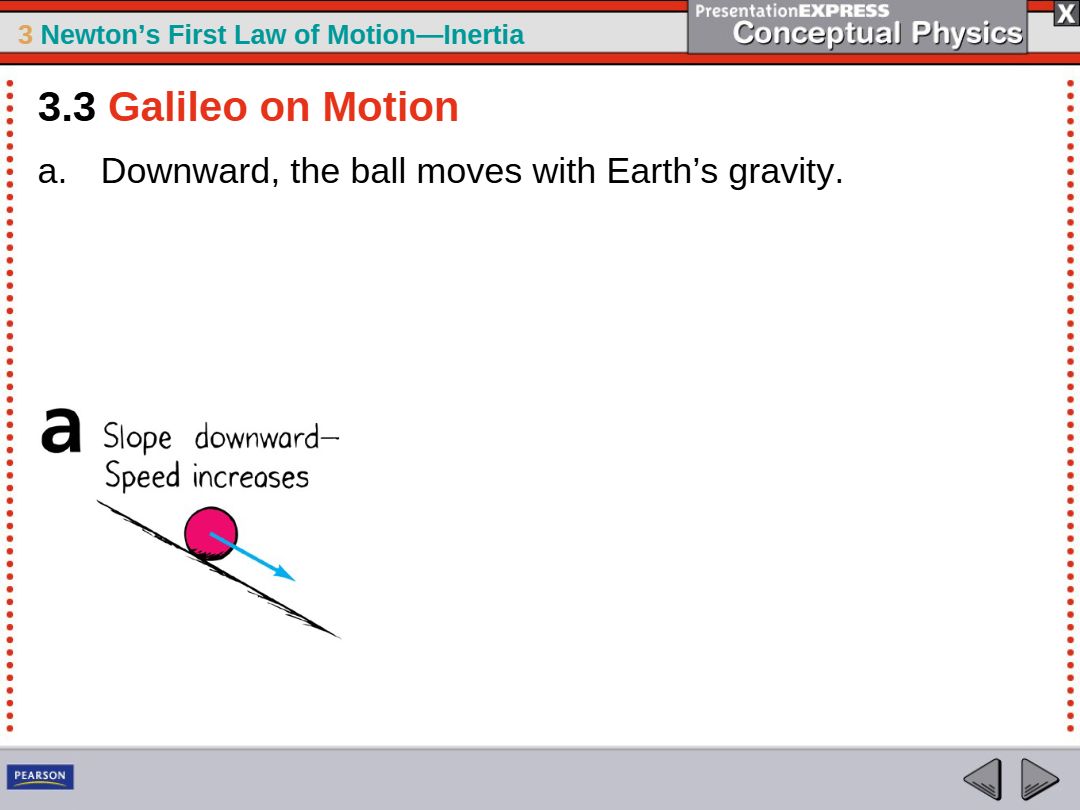
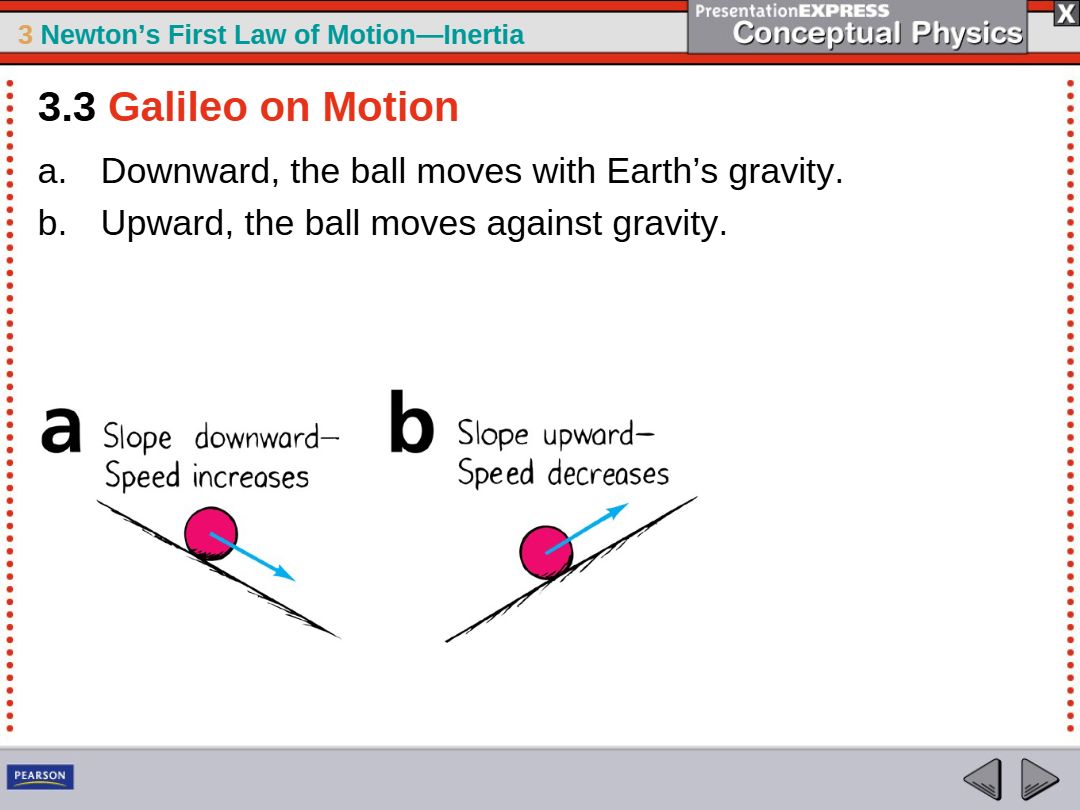
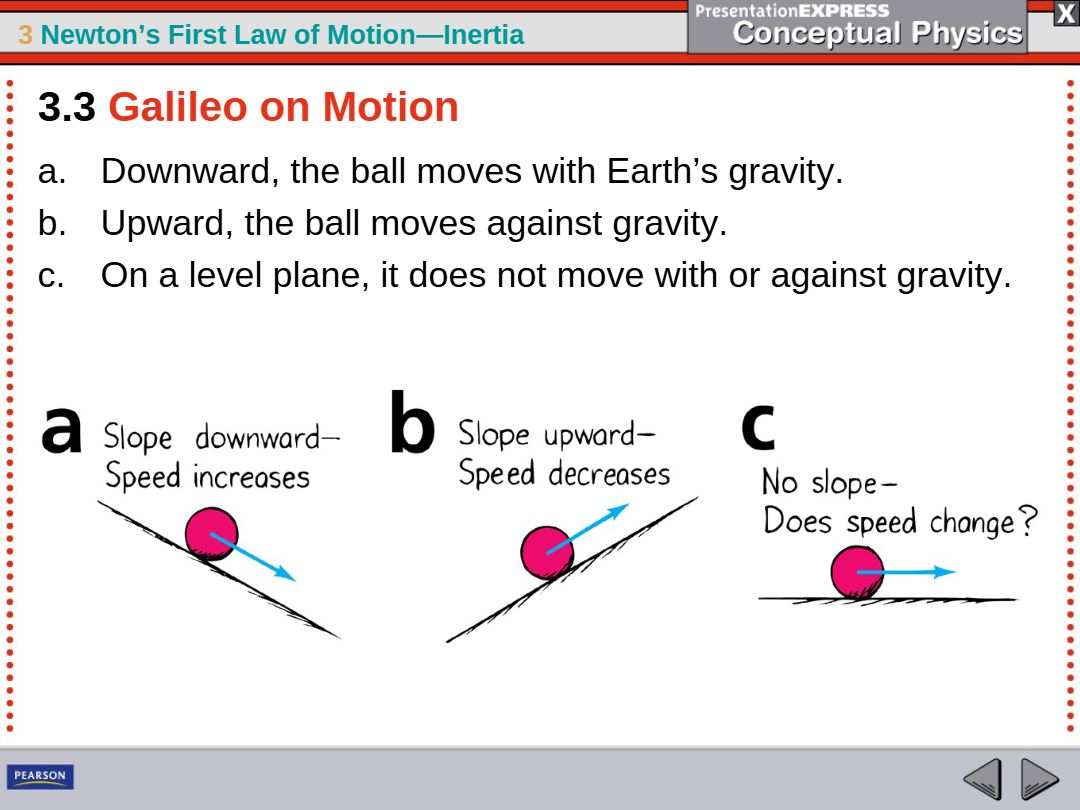
A ball rolling on a smooth horizontal plane has almost constant
33
34
35
36
37
Multiple Choice
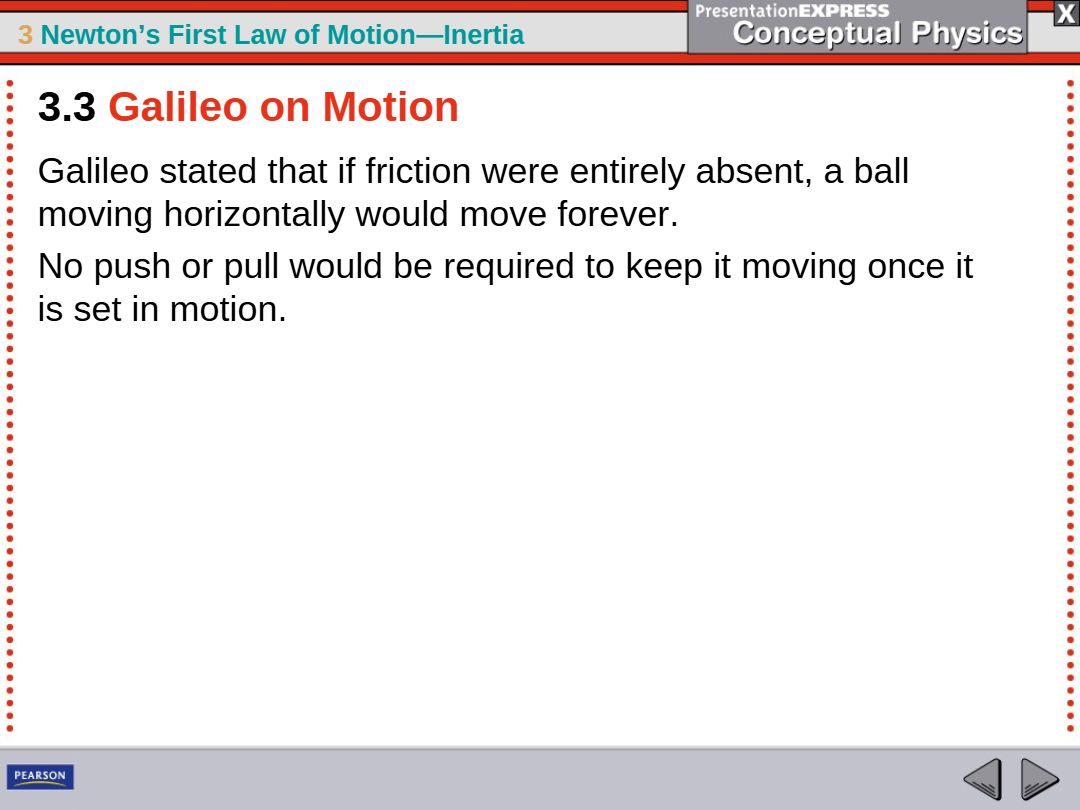
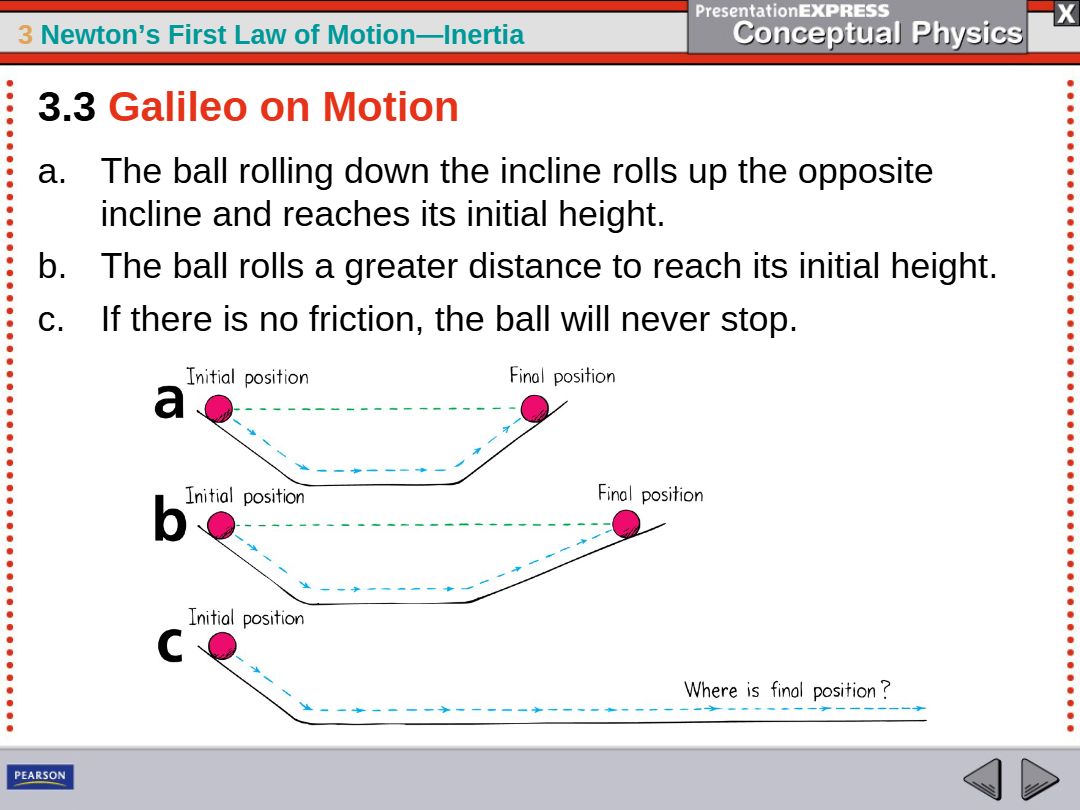
According to Galileo, what would happen to a ball moving horizontally if friction were entirely absent?
It would eventually stop due to air resistance.
It would move forever without stopping.
It would slow down gradually.
It would speed up indefinitely.
38
39
40
Multiple Choice
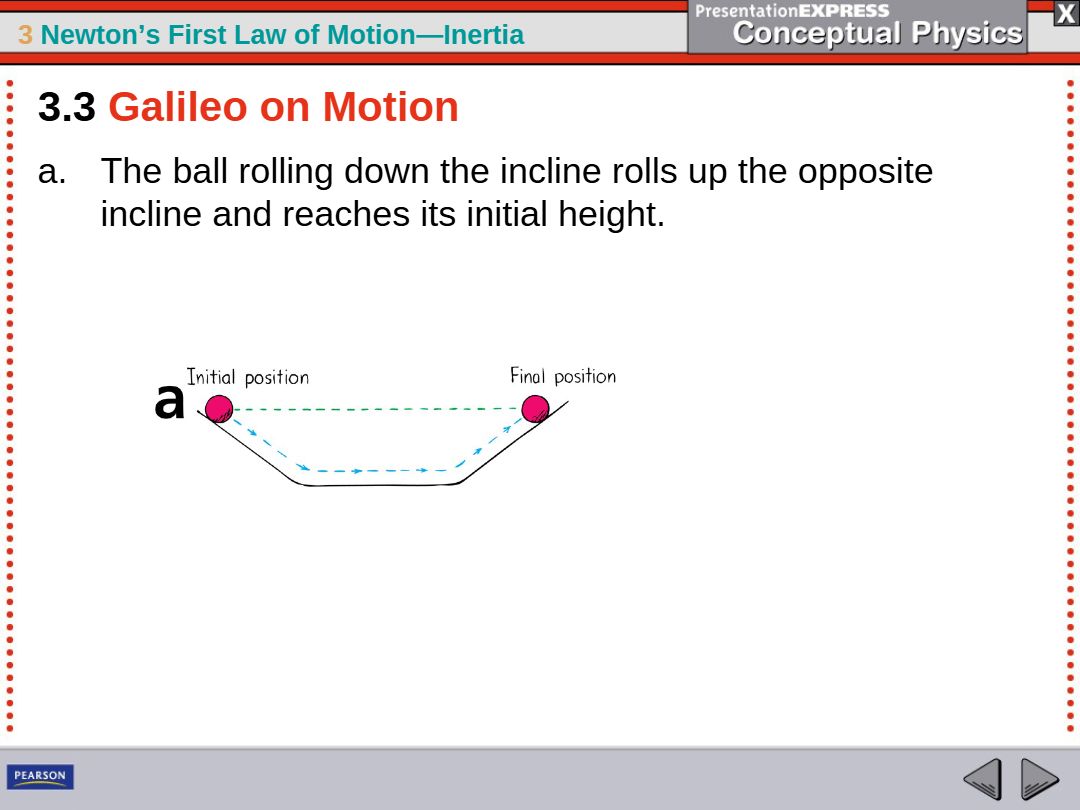
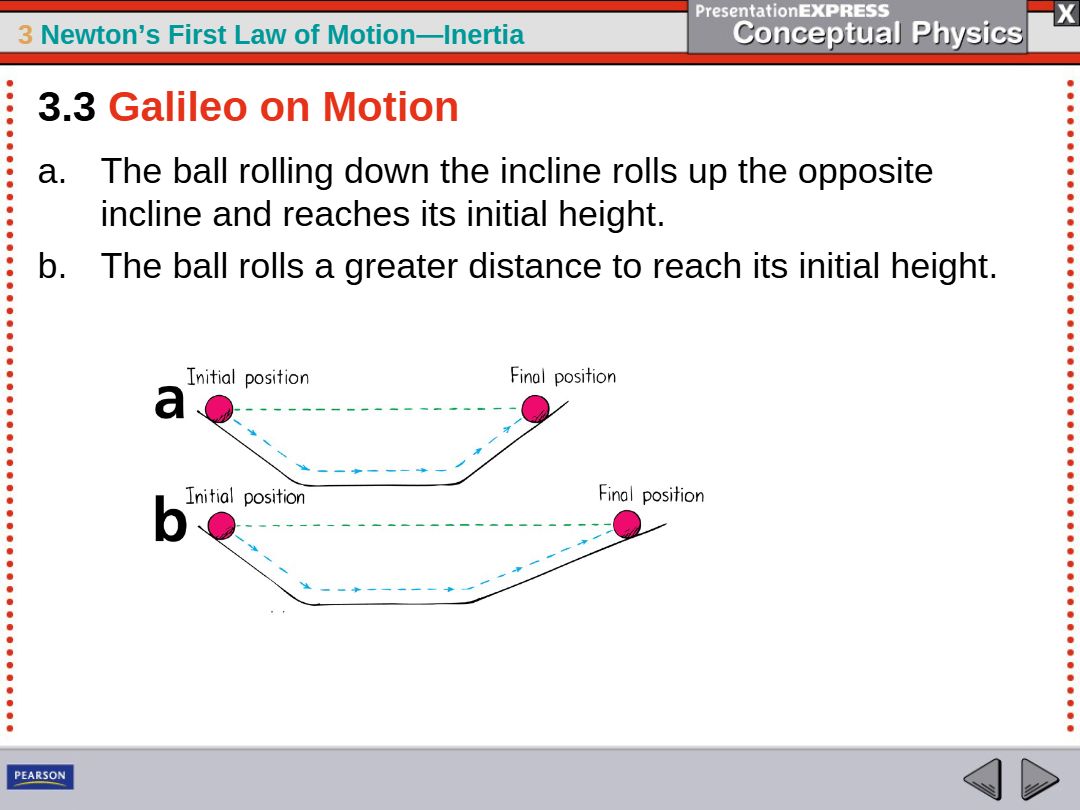
According to Galileo's experiment with inclined planes, what happens to a ball released from one plane when it rolls up the opposite plane?
It comes to rest at the bottom.
It rolls up to nearly the same height from which it was released.
It keeps rolling forever.
It stops halfway up the second plane.
41
42
Multiple Choice
Why does the ball roll a greater distance to reach its initial height when the second plane is inclined at a smaller angle?
Because the ball loses energy.
Because the ball gains speed.
Because the ball must travel farther horizontally to reach the same vertical height.
Because the ball is heavier.
43
44
45
Open Ended
Explain how Galileo's observations with inclined planes challenged Aristotle's view about the nature of moving objects.
46
Multiple Choice
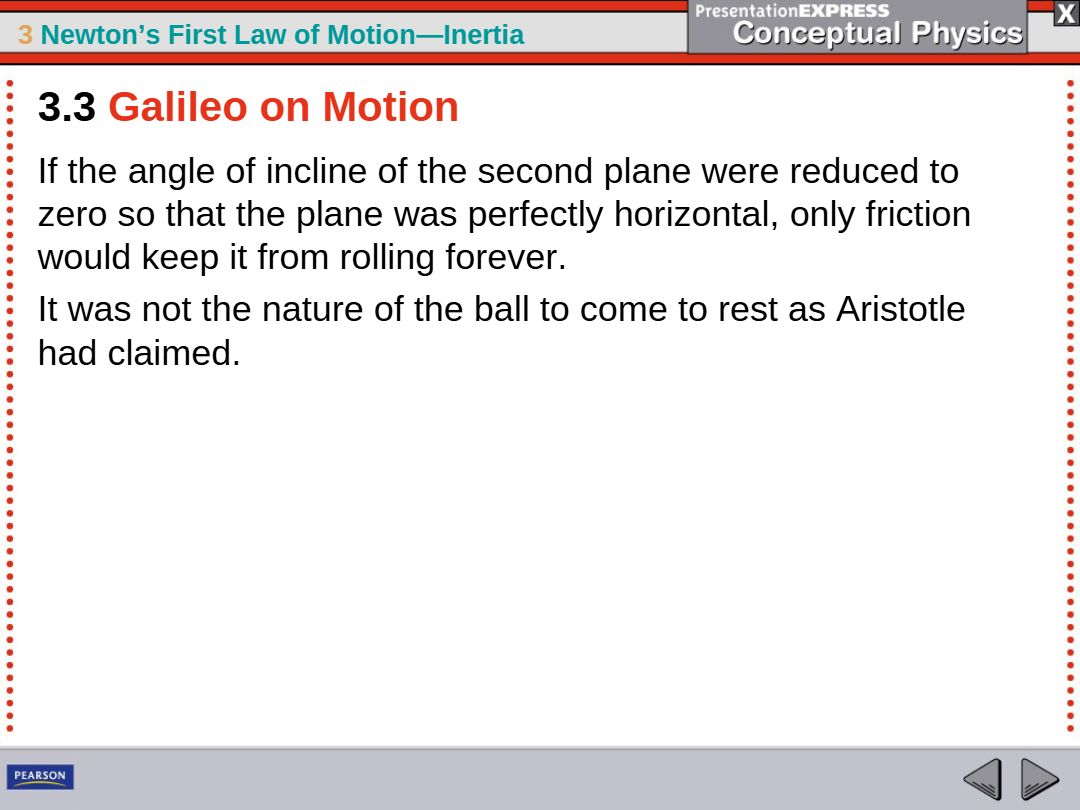
If there is no friction, what will happen to the ball on a perfectly horizontal plane according to Galileo?
It will eventually stop due to its weight.
It will keep moving forever.
It will bounce back to its initial position.
It will slow down gradually.
47
48
Multiple Select
Which of the following statements are correct about Galileo's findings on motion?
A ball will always come to rest due to its nature.
Friction is necessary to stop a moving object on a horizontal plane.
A moving object will keep moving unless acted upon by an external force.
The tendency to resist changes in motion is called inertia.
49
Fill in the Blanks
The property of a body to resist changes to its state of motion is called
50
51
52
53
Multiple Choice
According to Newton's First Law of Motion, what must happen for an object at rest to begin moving?
A force must act on the object.
The object must be heavy.
The object must be round.
The object must be on a slope.
54
Open Ended
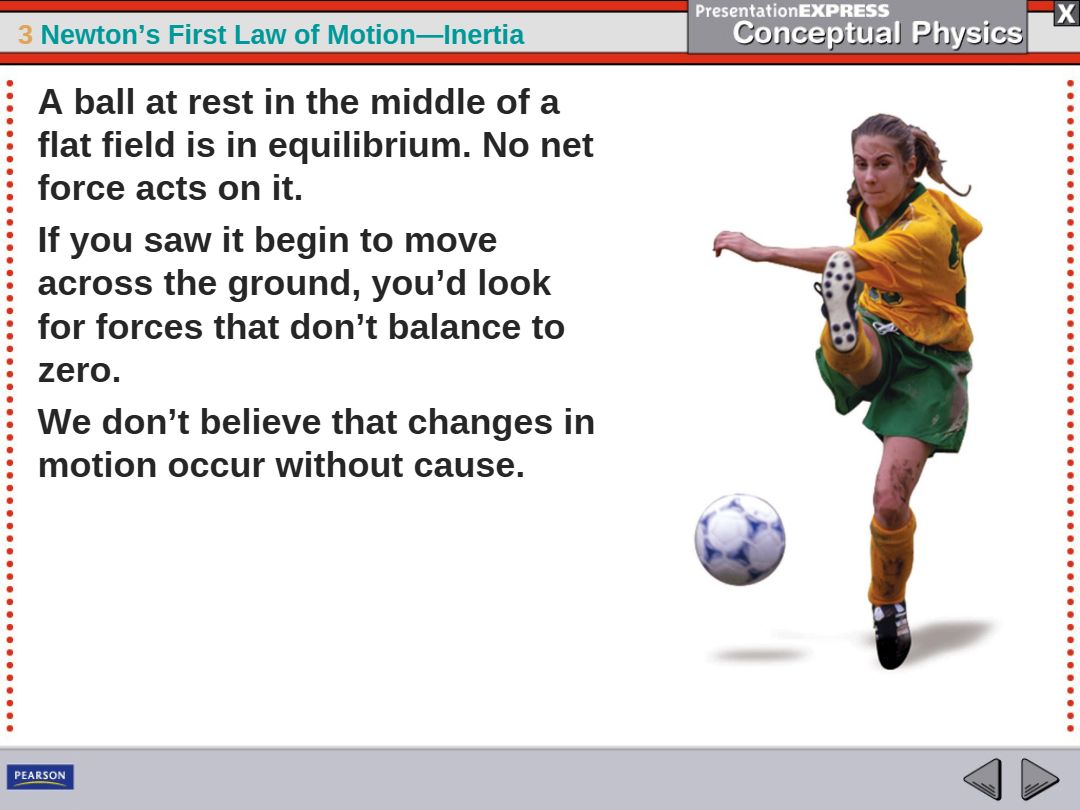
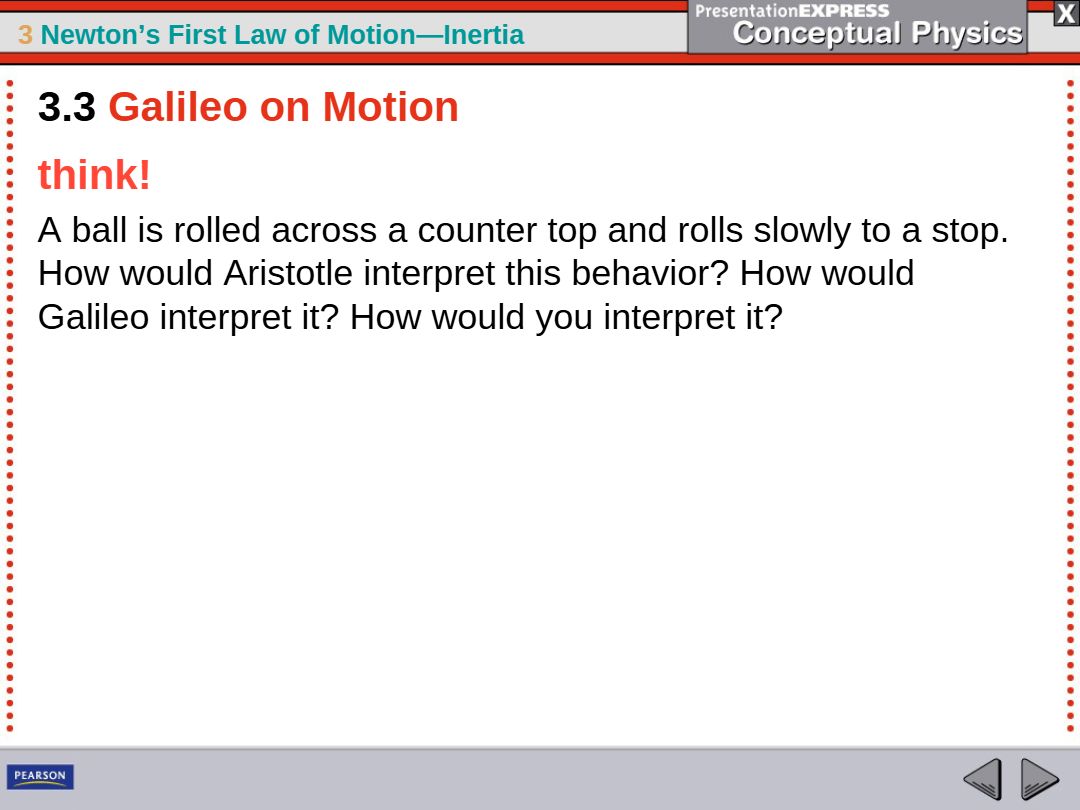
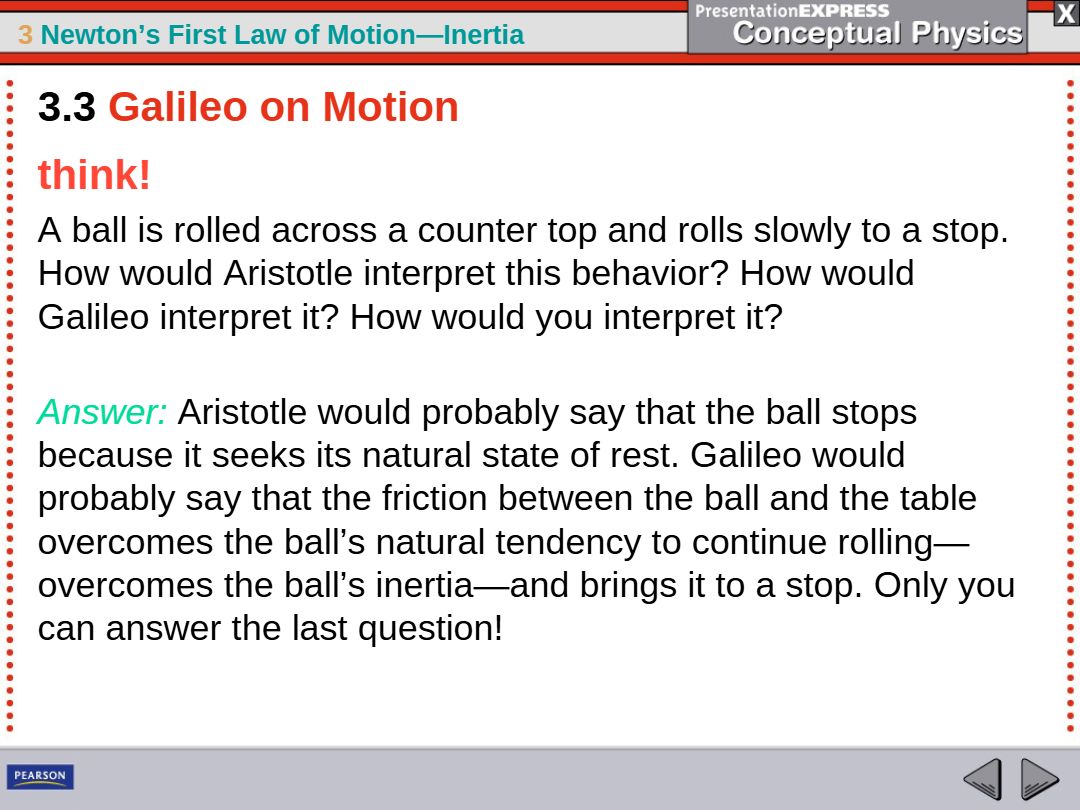
Explain why a ball at rest in the middle of a flat field does not move until a force acts upon it. How does this relate to Newton's First Law of Motion?
Show answer
Auto Play
Slide 1 / 54
SLIDE
Similar Resources on Wayground

49 questions
Summary of the Subjunctive
Presentation
•
9th - 12th Grade
48 questions
Biogeochemical Cycles: Nutrient Cycles
Presentation
•
9th - 12th Grade
53 questions
Kinetic and Potential Energy
Presentation
•
9th - 12th Grade
46 questions
Biomolecule terms - photosynthesis and respiration
Presentation
•
9th - 12th Grade
46 questions
Simple Harmonic Motion & Spring Pendulum Notes
Presentation
•
9th - 11th Grade
49 questions
Pedigrees
Presentation
•
9th - 12th Grade
46 questions
Newton's Three Laws of Motion Class Lesson
Presentation
•
9th - 12th Grade
47 questions
LAB SAFETY - SPRING 2022
Presentation
•
9th - 12th Grade
Popular Resources on Wayground
10 questions
How much do you know about our Portrait of an Eagle?

Quiz
•
10th Grade
10 questions
Fast Food Slogans
Quiz
•
6th - 8th Grade
21 questions
Continents and Oceans
Quiz
•
6th Grade
20 questions
Parts of Speech
Quiz
•
5th Grade
16 questions
Subject & Predicate
Quiz
•
5th Grade
25 questions
Multiplication Facts
Quiz
•
5th Grade
12 questions
Map Skills
Quiz
•
3rd Grade
22 questions
Continents and Oceans
Quiz
•
5th Grade
Discover more resources for Physics
20 questions
Position vs. Time Graphs
Quiz
•
9th Grade
20 questions
Calculating Net Force
Quiz
•
6th - 9th Grade
18 questions
Interpreting Motion Graphs
Presentation
•
9th - 12th Grade
10 questions
Exit Check 4.1 - Destructive Processes
Quiz
•
9th Grade
21 questions
Distance/Time Graphs
Quiz
•
9th Grade
20 questions
Unit 2 - Waves Test - 2026
Quiz
•
9th - 12th Grade
10 questions
Exit Check 4.2 - Constructive Forces
Quiz
•
9th Grade
10 questions
Exit Check 4.3 - Conservation of Momentum
Quiz
•
9th Grade