

Chapter 15 Substance Use & Addiction Google Slides

Presentation
•
Health Sciences
•
Vocational training
•
Practice Problem
•
Medium

Marilyn Goodman
Used 1+ times
FREE Resource
30 Slides • 28 Questions
1

2

3
Open Ended
Why do you think understanding the difference between substance use, intoxication, and addiction is important for healthcare professionals?
4
Multiple Choice
Which of the following best describes the concept of 'tolerance' in the context of substance use?
The brain adapts to repeated dosing, causing decreased effects and requiring greater amounts of substance to achieve the same effect.
A maladaptive pattern of substance use despite negative effects.
A state where an individual's physical or mental status is affected by substance consumption.
Physiologic and psychological dependence on a substance.
5

6
Multiple Choice
Which of the following is NOT a potential consequence of substance use as described in the slide?
Significant costs to health care system
Improved job performance
Increase in child abuse/neglect
Premature deaths
7

8
Open Ended
Explain the concepts of codependence and enabling in the context of substance use disorder. How might these behaviors impact recovery?
9

10
Multiple Choice
Arrange the following phases of substance dependency in the correct order: dependent lifestyle begins, first use, demonstrates dependency/addiction, experiences hangover effects.
first use, experiences hangover effects, dependent lifestyle begins, demonstrates dependency/addiction
experiences hangover effects, first use, dependent lifestyle begins, demonstrates dependency/addiction
first use, dependent lifestyle begins, experiences hangover effects, demonstrates dependency/addiction
demonstrates dependency/addiction, first use, experiences hangover effects, dependent lifestyle begins
11

12
Multiple Select
Which of the following are classified as substances that can lead to misuse or addiction?
Alcohol
Opioids
Antibiotics
Stimulants
13

14
Fill in the Blanks
Type answer...
15

16
Open Ended
Describe the signs and symptoms of substance intoxication and explain how these symptoms can affect daily functioning.
17

18
Multiple Choice
Which of the following is a characteristic of substance withdrawal?
Symptom-specific maladaptive changes in behavior
Improved functioning
Immediate symptom onset after drug cessation
Absence of physiologic symptoms
19

20
Fill in the Blanks
Type answer...
21

22
Multiple Select
Which of the following are signs and symptoms of alcohol-use disorder?
Progressive memory loss
Anxiety and tremors
High dosage results in psychoactive effects
Delusions and hallucinations
23

24

25
Multiple Choice
Which of the following physical symptoms is associated with heavy caffeine usage?
Restlessness
Seizures
Social withdrawal
Flashbacks
26
Open Ended
Compare and contrast the signs and symptoms of cannabis-related disorder and caffeine-related disorder.
27

28
Multiple Choice
What is the most common substance associated with hallucinogen-use disorder?
PCP
LSD
Cannabis
Caffeine
29

30
Multiple Choice
Which of the following is a possible sign or symptom of inhalant-related disorders?
Euphoria
Weight gain
Increased appetite
Insomnia
31

32

33
Open Ended
Compare the signs and symptoms of nicotine-related disorders and opioid-related disorders. What are some key differences?
34

35
Multiple Choice
Which of the following substances is associated with accidental overdoses and acute respiratory arrest?
Opioids
Sedative-hypnotics
Nicotine
Stimulants
36
37
Multiple Select
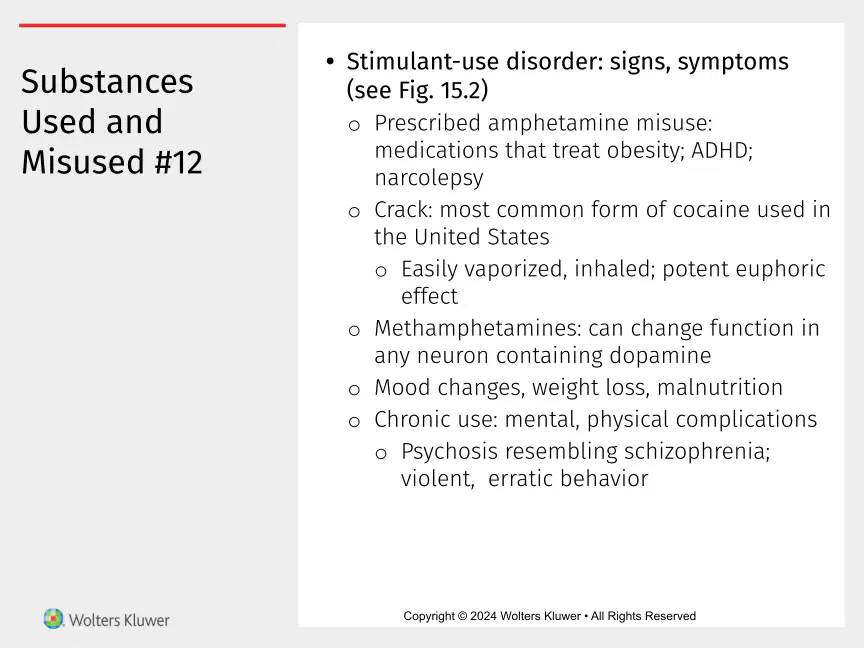
Select all the risks associated with chronic stimulant use.
Psychosis resembling schizophrenia
Weight gain
Violent, erratic behavior
Improved sleep
38

39
Open Ended
Discuss the ethical and legal responsibilities of health care professionals when they suspect a colleague is impaired by substance use.
40
Fill in the Blanks
Type answer...
41

42
Multiple Select
Which of the following are considered short-term goals in the treatment of substance use disorders?
Decreasing negative medical and social effects
Meaningful employment
Contingency plan for relapse
Complete abstinence
43
Multiple Choice
Which of the following is a long-term goal in the treatment of substance use disorders?
Complete abstinence
Immediate withdrawal from drug
Meaningful employment
Contingency plan for relapse
44

45
Multiple Choice
What is the first phase of dependency treatment for substance-related disorders?
Detoxification
Behavioral therapy
12-step recovery program
Evaluation
46

47
Open Ended
Explain the importance of assessment in the nursing process for patients with substance use disorders.
48

49
Fill in the Blanks
Type answer...
50

51

52
Multiple Choice
Which of the following best describes the rationale for diagnosing substance use disorder?
It involves craving, tolerance, and withdrawal symptoms.
It is based solely on withdrawal symptoms.
It is diagnosed only when physical dependence is present.
It is diagnosed only after detoxification.
53

54

55

56

57
Open Ended
How might understanding the concepts of intoxication, addiction, and tolerance help you or someone you know make healthier choices regarding substance use?
58
Multiple Choice
What is the difference between substance use disorder and addiction?
Substance use disorder is only about physical dependence, while addiction includes psychological dependence.
Substance use disorder refers to a maladaptive pattern of use, while addiction involves both physiologic and psychological dependence.
Addiction is only about withdrawal symptoms, while substance use disorder is about tolerance.
There is no difference between substance use disorder and addiction.
Show answer
Auto Play
Slide 1 / 58
SLIDE
Similar Resources on Wayground

50 questions
Quantifiers
Presentation
•
KG
52 questions
DISTANCE LEARNING MODALITY
Presentation
•
Professional Development
54 questions
D4.2. SparkEd 2023
Presentation
•
Professional Development
53 questions
Academic Monitoring-School-based ILT Redelivery
Presentation
•
Professional Development
52 questions
Sharing Session
Presentation
•
Professional Development
52 questions
DJH Behavior Review (Holiday Reset)
Presentation
•
Professional Development
55 questions
Meeting With Vendors
Presentation
•
Professional Development
52 questions
Future
Presentation
•
KG
Popular Resources on Wayground
6 questions
Secondary Safety Quiz
Presentation
•
9th - 12th Grade
10 questions
MyPath Diagnostic Overview
Presentation
•
6th - 8th Grade
20 questions
Lab Safety Quiz

Quiz
•
6th Grade
21 questions
Continents and Oceans
Quiz
•
6th Grade
20 questions
Adding and Subtracting Decimals
Quiz
•
5th Grade
20 questions
Parts of Speech
Quiz
•
5th Grade
16 questions
Subject & Predicate
Quiz
•
5th Grade
21 questions
Lab Safety
Quiz
•
10th Grade