

Earth’s Spheres

Presentation
•
Science
•
6th Grade
•
Practice Problem
•
Medium
+3
Standards-aligned

Barbara White
Used 74+ times
FREE Resource
10 Slides • 10 Questions
1
Middle School

2
Define the geosphere, hydrosphere, biosphere, atmosphere, and cryosphere.
Describe the composition and function of each of Earth's spheres.
Explain how Earth's different spheres interact and affect one another.


3
Key Vocabulary
Geosphere
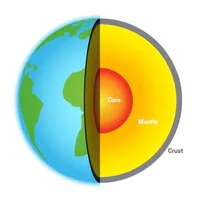
Earth’s mostly solid and rocky part, including all land, rocks, and minerals from crust to core.
Hydrosphere
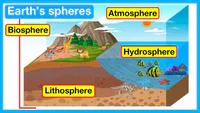
This includes all liquid water on and below the Earth's surface, like rivers, lakes, and oceans.
Biosphere
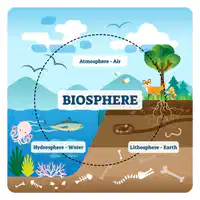
This is the zone on planet Earth where life exists, including all the living plants and animals.
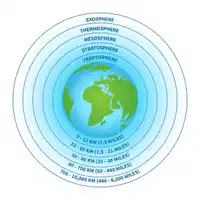
Atmosphere
A blanket of protective gases that surrounds our planet, made of several distinct atmospheric layers.
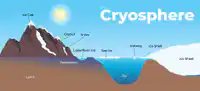
Cryosphere
This sphere has all of Earth's frozen water, including ice sheets, glaciers, icebergs, and sea ice.
4
The Geosphere
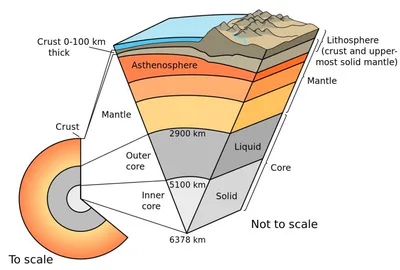
The geosphere is the mostly solid, rocky part of the Earth.
Its name comes from the Greek word 'geo,' meaning 'ground' or 'Earth.'
It includes features like mountains, sand, non-living soil, rocks, and minerals.
It has three main layers: the crust, the mantle, and the core.
5
Multiple Choice
Which of the following correctly lists the layers of the Geosphere, from the outermost to the innermost?
Crust, Mantle, Core
Land, Soil, Mountains
Rock, Minerals, Sand
Troposphere, Stratosphere, Mesosphere
6
The Hydrosphere
The hydrosphere, from the Greek word 'hydro' for water, encompasses all the water on our planet.
This includes all liquid forms like rivers, lakes, oceans, and even the water found underground.
Oceans are the largest part, holding approximately 97% of all the water on Earth.
The Cryosphere
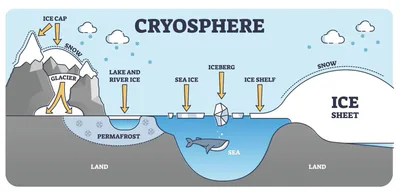
The cryosphere, from the Greek word 'kryo' for cold, is made up of all the frozen water on Earth.
Its largest components are the vast ice sheets that can be found in Antarctica and Greenland.
It also includes other forms of frozen water such as glaciers, icebergs, and large areas of sea ice.
7
Multiple Choice
The Hydrosphere contains most of Earth's water. Which component holds the largest amount, at approximately 97%?
Groundwater
Rivers and Lakes
Glaciers and ice caps
Oceans
8
The Biosphere: Earth's Living Sphere
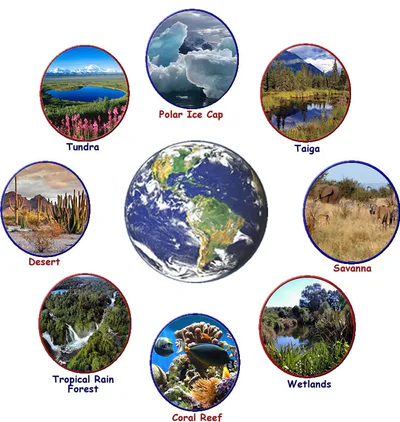
The Biosphere is the global ecosystem encompassing all life on Earth.
Its name comes from the Greek word 'bio,' which means 'life.'
It includes all living things, like single-celled organisms and human beings.
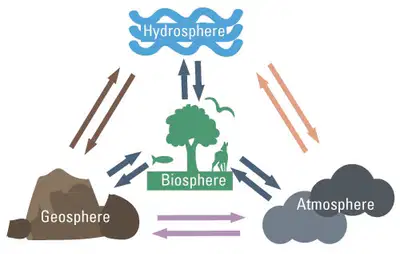
This sphere depends on other spheres for water, gases, and nutrients.
9
Multiple Choice
Based on the description, what does the Biosphere encompass?
All non-living things on Earth
All life, from microorganisms to humans
Only the plants and animals on Earth
Only human beings and their impact
10
What Is the Atmosphere?
The atmosphere is a protective blanket of gases surrounding our planet Earth.
It protects Earth from meteorites and harmful ultraviolet (UV) solar radiation.
It also helps regulate the Earth's temperatures, keeping our planet habitable.
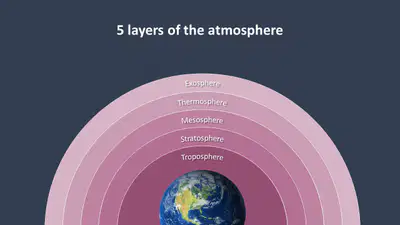
It has five main layers: Troposphere, Stratosphere, Mesosphere, Thermosphere, and Exosphere.
11
Multiple Choice
What is a primary protective function of the Atmosphere?
Housing all living organisms on the planet
Creating solid landmasses for continents
Shielding the planet from harmful UV radiation
Containing all of Earth's water resources
12
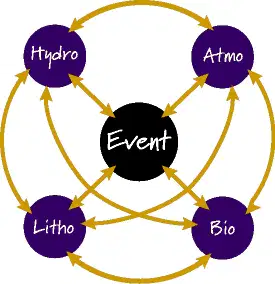
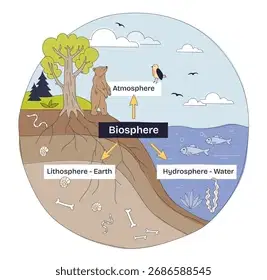
How Earth's Spheres Interact
Earth’s spheres are interconnected and constantly interact with one another.
A volcano (geosphere) can erupt ash into the air (atmosphere).
A river (hydrosphere) can carve a canyon through rock (geosphere).
Decomposing plants (biosphere) enrich the soil (geosphere) with nutrients.
13
Multiple Choice
A river carving a canyon through rock is a clear example of an interaction between which two spheres?
Atmosphere and Biosphere
Geosphere and Biosphere
Cryosphere and Atmosphere
Hydrosphere and Geosphere
14
Misconception | Correction |
|---|---|
The spheres are separate systems that do not interact. | The spheres are interconnected, and a change in one can impact all others. |
The Geosphere is just the ground that we walk on. | The Geosphere includes all rocky parts of the Earth, from crust to core. |
The Hydrosphere is only made up of the Earth's oceans. | It includes all liquid water, such as rivers, lakes, and groundwater. |
The Biosphere only consists of all the animals on Earth. | The Biosphere is made up of all life, including plants and microorganisms. |
15
Multiple Choice
Which of the following scenarios best illustrates an interaction initiated by the Atmosphere that affects the Biosphere?
A river carves a canyon through solid rock.
A dangerous windstorm uproots trees across the land.
A volcano erupts, adding carbon dioxide to the air.
Decomposing plants return nutrients to the soil.
16
Multiple Choice
If a significant portion of the Cryosphere were to melt, what is the most direct consequence for the Hydrosphere?
Groundwater levels would immediately drop worldwide.
The number of rivers and lakes would decrease.
The atmosphere would lose most of its water vapor.
Sea levels would rise due to increased water volume in the oceans.
17
Multiple Choice
A prolonged drought (Hydrosphere) leads to widespread death of plants (Biosphere). Analyze the most likely subsequent impact on the Geosphere.
The formation of new mountains from shifting tectonic plates.
Increased soil erosion due to the loss of plant roots to hold soil in place.
A decrease in volcanic activity worldwide.
The creation of new groundwater sources.
18
Multiple Choice
Considering the Atmosphere's role in protecting life, predict the most likely primary consequence for the Biosphere if the ozone layer, which blocks UV radiation, was significantly depleted.
A sudden rise in sea levels from rapidly melting glaciers.
Widespread harm to living organisms, including DNA damage.
An increase in the number of meteorites reaching Earth's surface.
A sharp and immediate decrease in global temperatures.
19
Earth has five interconnected spheres: the Geosphere, Hydrosphere, Biosphere, Atmosphere, and Cryosphere.
The Geosphere is rocky land, the Hydrosphere is liquid water, and the Cryosphere is frozen water.
The Atmosphere is the protective gas layer, and the Biosphere includes all life.
A change in one sphere can cause changes in the others because they all interact.
20
Poll
On a scale of 1-4, how confident are you about the concepts covered in today's review?
1
2
3
4
Middle School
Show answer
Auto Play
Slide 1 / 20
SLIDE
Similar Resources on Wayground

18 questions
Plate Tectonics Review
Presentation
•
6th Grade
15 questions
Using a Microscope
Presentation
•
6th Grade
16 questions
Matter and Its Interactions LC1 Review
Presentation
•
6th Grade
16 questions
Electricity
Presentation
•
6th Grade
14 questions
States of Matter
Presentation
•
6th Grade
16 questions
Change of state of matter
Presentation
•
6th Grade
14 questions
Earth's Water Distribution
Presentation
•
6th Grade
15 questions
Mrs. Johnson's Layers of Earth Review
Presentation
•
6th Grade
Popular Resources on Wayground
10 questions
Safety Day 2026 – Student Review

Quiz
•
9th Grade
21 questions
Continents and Oceans
Quiz
•
6th Grade
20 questions
Parts of Speech
Quiz
•
5th Grade
16 questions
Subject & Predicate
Quiz
•
5th Grade
25 questions
Multiplication Facts
Quiz
•
5th Grade
12 questions
Map Skills
Quiz
•
3rd Grade
22 questions
Continents and Oceans
Quiz
•
5th Grade
15 questions
Rounding Decimals
Quiz
•
5th Grade
Discover more resources for Science
20 questions
Elements, compounds, and mixtures
Quiz
•
6th Grade
10 questions
6.6D - Relative Density Review
Quiz
•
6th Grade
10 questions
Exploring Chemical and Physical Changes

Interactive video
•
6th - 10th Grade
20 questions
CONDUCTION,CONVECTION AND RADIATION
Quiz
•
6th Grade
20 questions
Rocks and The Rock Cycle
Quiz
•
6th Grade
19 questions
Describing and Classifying Matter
Presentation
•
6th Grade
21 questions
Waves and Wave Properties
Quiz
•
6th - 8th Grade
20 questions
Phases of the Moon
Quiz
•
6th Grade