

Photosynthesis and Respiration Review

Presentation
•
Science
•
6th Grade
•
Practice Problem
•
Medium
+4
Standards-aligned

Barbara White
Used 58+ times
FREE Resource
9 Slides • 9 Questions
1

Photosynthesis and Respiration Review
Middle School

2
Learning Objectives
Identify the reactants and products of photosynthesis and cellular respiration.
Explain how these processes are connected for the flow of energy and matter.
Trace the path of energy from the sun, to glucose, to ATP.
Relate photosynthesis and cellular respiration to their roles in the carbon cycle.


3
Key Vocabulary
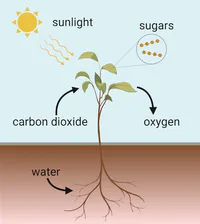
Photosynthesis
The process plants use to convert light, water, and CO2 into their own food.

Cellular Respiration
The process of breaking down glucose with oxygen to produce usable energy, called ATP, for cells.

Chloroplast
The organelle inside plant cells where the entire process of photosynthesis takes place.

Mitochondria
The organelle where cellular respiration occurs, breaking down glucose to release energy for the cell.

ATP (Energy Molecule)
An energy-rich molecule that powers all chemical activities and essential functions within a living cell.

Glucose (Simple Sugar)
A simple sugar with the formula C6H12O6 that is a major energy source for organisms.
4
The Process of Photosynthesis

Plants use sunlight, water, and carbon dioxide to create their food.
Light energy is converted into chemical energy inside the chloroplasts.
This process produces glucose (C6H12O6) for energy and releases oxygen.
5
Multiple Choice
A student is conducting an experiment to demonstrate that carbon dioxide is essential for photosynthesis. The student places a healthy potted plant in a bell jar setup for several hours with access to sunlight. Which chemical should the student include inside the bell jar to remove carbon dioxide and effectively test the hypothesis?
Sodium chloride solution
Dilute sulfuric acid
Potassium hydroxide pellets
Calcium chloride granules
6
The Process of Cellular Respiration
Cells get energy from food through a process called cellular respiration.
It happens in the mitochondria and works best when oxygen is present.
Glucose (C6H12O6) and oxygen (6O2) are the reactants.
The products are carbon dioxide (6CO2), water (6H2O), and energy (ATP).


7
Multiple Choice
What are the primary products of cellular respiration that occur in the mitochondria?
Glucose, oxygen, and energy.
Carbon dioxide, water, and ATP.
Water, light energy, and oxygen.
Carbon dioxide, glucose, and water.
8
The Connection: A Balanced Cycle

The products of one process are the reactants of the other.
Photosynthesis uses CO2, water, and light to make food and oxygen.
Cellular respiration uses food and oxygen to release energy, CO2, and water.
9
Multiple Choice
What is the relationship between the substances involved in photosynthesis and cellular respiration?
The reactants of photosynthesis are also the reactants of cellular respiration.
The products of both processes are identical.
The products of photosynthesis are the reactants for cellular respiration.
There is no relationship between the two processes.
10
Energy and Matter in Ecosystems
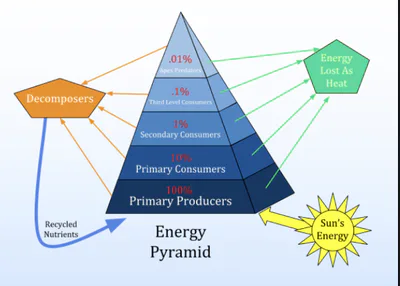
Energy Flow
Producers, like plants, make their own food and capture energy from the sun through photosynthesis.
Consumers get energy by eating other organisms, passing that stored energy through the food web.
This energy flows in one direction and is used by cells to perform life functions like respiration.
Cycling of Matter
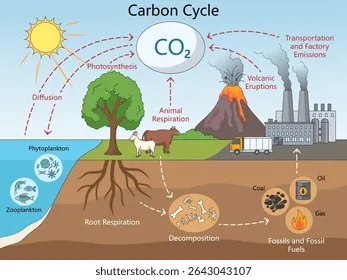
Food provides the matter (atoms) organisms need to build and repair their bodies, like skin and bone.
Matter is not created or destroyed; the atoms from food are just rearranged into new molecules.
Elements like carbon and oxygen are constantly recycled between living things and the nonliving environment.
11
Multiple Choice
How do producers and consumers fit into the flow of energy and matter?
Producers and consumers both create their own food using light energy.
Producers consume other organisms, and consumers use light energy to grow.
Producers release energy as ATP, which is then consumed by other organisms.
Producers capture light energy to make food, and consumers release the energy from that food through respiration.
12
Common Misconceptions
Misconception | Correction |
|---|---|
Plants only perform photosynthesis. | Plants perform both photosynthesis and cellular respiration. |
Cellular respiration is the same as breathing. | Breathing is gas exchange; cellular respiration is a chemical process. |
Plants create energy from sunlight. | Plants convert light energy into stored chemical energy. |
The light reactions and Calvin cycle happen at different times. | Both happen when light is available. |
13
Multiple Choice
Why are photosynthesis and cellular respiration essential for the carbon cycle?
Photosynthesis releases CO2, and respiration removes it from the atmosphere.
Both processes remove CO2 from the atmosphere, decreasing carbon levels.
Both processes release CO2 into the atmosphere, increasing carbon levels.
Photosynthesis removes CO2 from the atmosphere, and respiration releases it back.
14
Multiple Choice
What is the primary difference in how producers and consumers obtain the matter they need for growth?
Producers convert inorganic matter (CO2, H2O) into organic food, while consumers eat other organisms.
Producers absorb matter from the air, while consumers absorb it from water.
Producers eat other organisms for matter, while consumers convert sunlight into matter.
Producers and consumers both obtain matter by breaking down rocks and soil.
15
Multiple Choice
A plant is placed in a sealed container with plenty of light, water, and soil. Predict what would happen to the levels of oxygen and carbon dioxide inside the container over time.
Carbon dioxide will increase and oxygen will decrease, as respiration outpaces photosynthesis.
Both gases will remain at a constant, stable level indefinitely.
Oxygen will increase and carbon dioxide will decrease, as photosynthesis outpaces respiration.
Both gases will be completely used up by the plant.
16
Multiple Choice
Analyze the consequences for an ecosystem if a disease eliminated most of the decomposers (like bacteria and fungi) that perform cellular respiration. How would this impact producers?
Producers would not be affected, as they get carbon dioxide directly from the atmosphere.
Producers would thrive due to having less competition for sunlight and water.
Producers would suffer from a lack of available carbon dioxide, as it would not be recycled from dead organic matter.
Producers would switch from photosynthesis to cellular respiration to survive.
17
Summary
18
Poll
On a scale of 1-4, how confident are you about the concepts covered in today's review?
1 - Very Unconfident
2 - Somewhat Unconfident
3 - Somewhat Confident
4 - Very Confident
Photosynthesis and Respiration Review
Middle School
Show answer
Auto Play
Slide 1 / 18
SLIDE
Similar Resources on Wayground

13 questions
Formation of a New Substance Notes
Presentation
•
6th Grade
13 questions
Climate Change
Presentation
•
6th Grade
12 questions
Non renewable Resources
Presentation
•
6th Grade
15 questions
Science Variables Lesson
Presentation
•
6th Grade
16 questions
Electromagnetism
Presentation
•
6th Grade
16 questions
The Theory of Evolution
Presentation
•
8th Grade
10 questions
Force and type of forces
Presentation
•
6th Grade
14 questions
Plate Tectonics: Lesson 1
Presentation
•
6th Grade
Popular Resources on Wayground
6 questions
PRIDE Always and Everywhere
Presentation
•
12th Grade
20 questions
Lab Safety Quiz

Quiz
•
6th Grade
26 questions
KOR Review Kahoot Questions
Quiz
•
8th Grade
21 questions
Continents and Oceans
Quiz
•
6th Grade
12 questions
Unit Zero lesson 2 cafeteria
Presentation
•
9th - 12th Grade
20 questions
Parts of Speech
Quiz
•
5th Grade
10 questions
Riddles Riddles fun Riddles
Quiz
•
6th - 12th Grade
16 questions
Subject & Predicate
Quiz
•
5th Grade
Discover more resources for Science
20 questions
Lab Safety Quiz
Quiz
•
6th Grade
20 questions
Lab Safety
Quiz
•
5th - 8th Grade
10 questions
6.6D - Relative Density Review
Quiz
•
6th Grade
10 questions
Scientific Method and Variables
Quiz
•
6th Grade
20 questions
Elements, compounds, and mixtures
Quiz
•
6th Grade
10 questions
Exploring Chemical and Physical Changes

Interactive video
•
6th - 10th Grade
20 questions
Distance, Displacement, Speed, Velocity
Quiz
•
6th Grade
10 questions
Exploring the States of Matter
Interactive video
•
6th - 10th Grade