

Atomic Theory

Presentation
•
Chemistry
•
9th - 12th Grade
•
Practice Problem
•
Easy
+2
Standards-aligned

Hector Guzman
Used 5+ times
FREE Resource
36 Slides • 26 Questions
1

2

3
Multiple Choice
Who was the first to suggest the existence of fundamental particles called atoms?
Democritus
Dalton
Bohr
Rutherford
4

5
Fill in the Blanks
Dalton’s theory states that all elements are composed of indivisible atoms, which he described as a solid or hard
Type answer...
6
Multiple Choice
Which scientist is credited with formulating the first atomic theory based on the study of chemical reaction ratios?
John Dalton
JJ Thomson
Ernest Rutherford
Niels Bohr
7

8
Multiple Select
According to Dalton’s Atomic Theory, which of the following statements are correct?
All matter is composed of atoms.
Atoms of different elements have identical properties.
Atoms can combine in simple whole-number ratios to form compounds.
Atoms of a given element are identical in mass and properties.
9

10
Multiple Choice
What major discovery did JJ Thomson make using the cathode ray tube experiment?
The existence of protons
The existence of electrons
The atomic nucleus
The neutron
11

12
Multiple Choice
Which atomic model proposed that electrons and positive charges were dispersed throughout the atom like 'plums in a pudding'?
Dalton’s Model
Rutherford’s Model
Bohr’s Model
Thomson’s Model
13

14
15
Open Ended
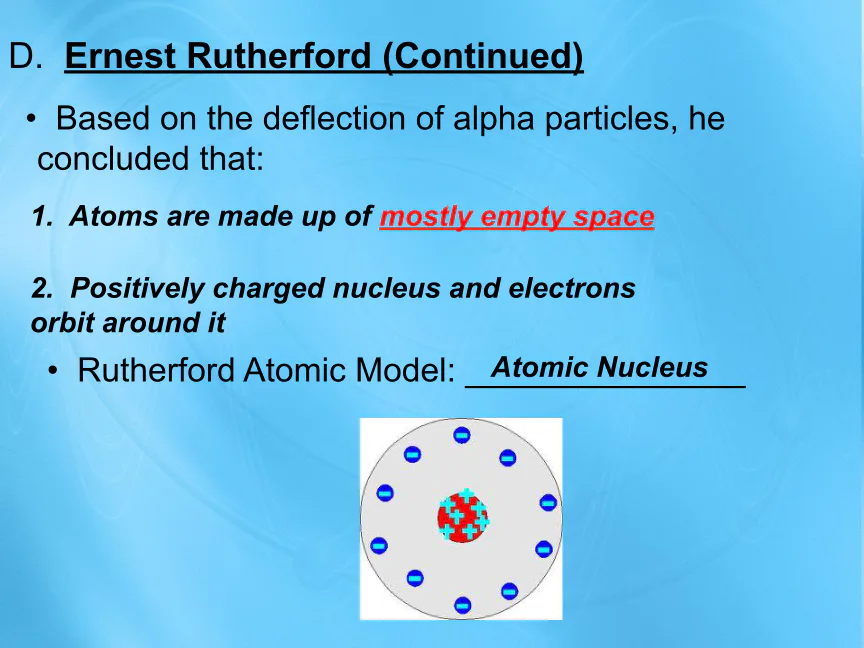
Explain how Rutherford’s gold foil experiment led to a new understanding of atomic structure.
16
17
Multiple Choice
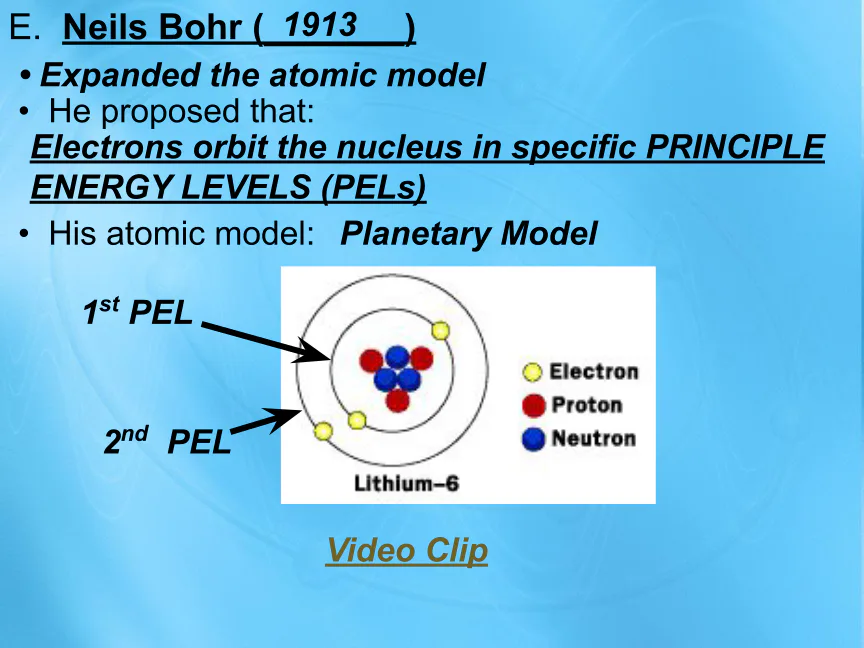
According to Bohr's atomic model, where are electrons found in an atom?
In specific energy levels orbiting the nucleus
Randomly scattered throughout the atom
Only in the nucleus
In fixed positions outside the atom
18

19
Open Ended
Explain what happens to an electron when it absorbs energy according to Bohr's model.
20

21

22
Fill in the Blanks
When an electron returns to its ground state, it releases energy in the form of a
Type answer...
23

24
Multiple Choice
What is the maximum number of electrons that can be held in the third principal energy level (n=3)?
2
8
18
32
25
Multiple Select
Which of the following statements about Principle Energy Levels (PELs) are correct?
Each PEL can hold a specific maximum number of electrons.
Electrons in higher PELs have more energy.
All PELs can hold the same number of electrons.
The formula 2n^2 determines the maximum electrons in a PEL.
26

27
Multiple Choice
How did Schrodinger's model of the atom differ from Bohr's model?
Electrons move in fixed orbits in Schrodinger's model.
Electrons are found in regions called orbitals in Schrodinger's model.
Schrodinger's model places electrons only in the nucleus.
Schrodinger's model does not include a nucleus.
28

29

30
Multiple Choice
Which subatomic particle is found in the nucleus and has no electrical charge?
Proton
Neutron
Electron
Positron
31

32
Fill in the Blanks
The total charge of an atom is always
Type answer...
33
Multiple Select
Which of the following statements about protons are correct?
They are positively charged.
They are found in the nucleus.
They have a mass of 1 amu.
They are the lightest subatomic particle.
34

35

36
Fill in the Blanks
The sum of the number of protons and neutrons in an atom is called the
Type answer...
37

38
Multiple Choice
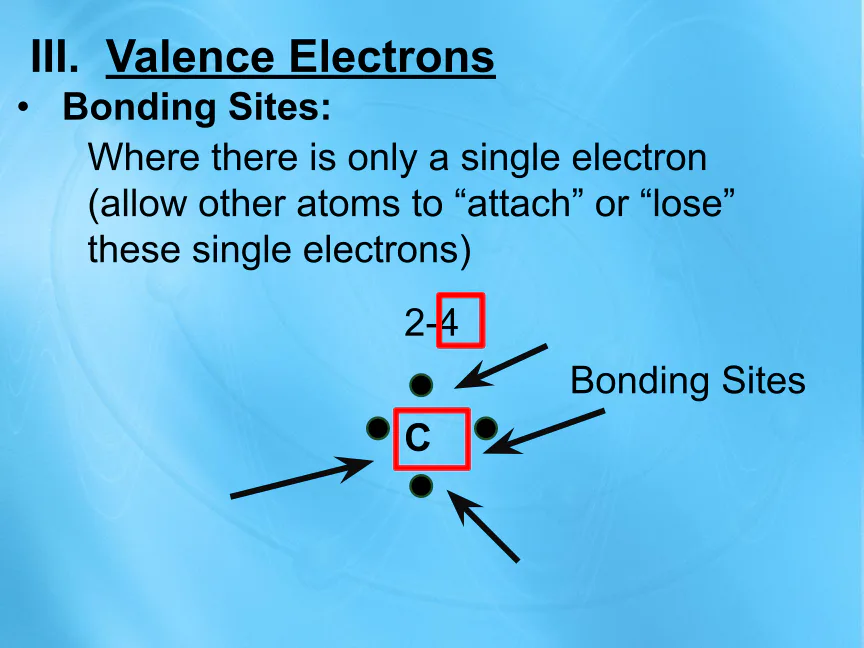
What is the significance of valence electrons in an atom?
They determine the atom's mass.
They are responsible for chemical bonding.
They are found in the nucleus.
They have no effect on the atom's properties.
39

40
Multiple Choice
Based on the table of hydrogen isotopes, which isotope has the greatest number of neutrons?
H-1 (Protium)
H-2 (Deuterium)
H-3 (Tritium)
All have the same number of neutrons
41
Multiple Choice
Which of the following statements best describes isotopes?
Atoms of the same element with different numbers of neutrons and different mass.
Atoms of different elements with the same number of protons.
Atoms of the same element with the same number of neutrons.
Atoms of different elements with different numbers of electrons.
42

43

44
Fill in the Blanks
Fill in the blank: The number of neutrons in an atom is calculated by subtracting the atomic number from the
Type answer...
45
Open Ended
Explain how to determine the number of neutrons in an atom if you know its atomic number and mass number. Use examples from the slides to support your answer.
46

47
Multiple Choice
Which factors are used to calculate the atomic mass of an element as found on the periodic table?
The average of the isotopes' mass numbers and their abundance
The number of protons and electrons
The mass of the most common isotope only
The sum of atomic numbers of all isotopes
48

49

50
Open Ended
Describe the steps involved in calculating the atomic mass of an element when given the percent abundance and mass numbers of its isotopes.
51

52

53

54

55

56
57

58

59

60

61
Multiple Choice
Which of the following statements best summarizes Democritus' view of atoms?
Atoms are indivisible and indestructible particles.
Atoms are made up of smaller particles.
Atoms can be created and destroyed easily.
Atoms are visible to the naked eye.
62
Open Ended
How did Democritus contribute to the development of atomic theory?
Show answer
Auto Play
Slide 1 / 62
SLIDE
Similar Resources on Wayground

57 questions
Circles 1- Arc, Radians & Nomenclature
Presentation
•
9th - 12th Grade
59 questions
Matter vs Energy
Presentation
•
9th - 11th Grade
57 questions
Cells: The Basic Units of Life Lesson
Presentation
•
9th - 12th Grade
56 questions
Lesson 5- Constitutional Convention & Compromises
Presentation
•
9th - 12th Grade
56 questions
Periodic Table
Presentation
•
9th - 12th Grade
55 questions
Mole Conversion and Dimensional Analysis
Presentation
•
9th - 12th Grade
55 questions
Periodic Trends
Presentation
•
9th - 12th Grade
56 questions
REPORTED SPEECH REVIEW
Presentation
•
KG
Popular Resources on Wayground
10 questions
How much do you know about our Portrait of an Eagle?

Quiz
•
10th Grade
10 questions
Fast Food Slogans
Quiz
•
6th - 8th Grade
21 questions
Continents and Oceans
Quiz
•
6th Grade
20 questions
Parts of Speech
Quiz
•
5th Grade
16 questions
Subject & Predicate
Quiz
•
5th Grade
25 questions
Multiplication Facts
Quiz
•
5th Grade
12 questions
Map Skills
Quiz
•
3rd Grade
22 questions
Continents and Oceans
Quiz
•
5th Grade
Discover more resources for Chemistry
20 questions
Metric Conversions
Quiz
•
11th Grade
20 questions
electron configurations and orbital notation
Quiz
•
9th - 12th Grade
26 questions
Atomic Structure, Isotopes and Ions
Quiz
•
10th Grade
20 questions
Periodic Trends
Quiz
•
10th Grade
5 questions
Atomic Theory Intro Video

Interactive video
•
10th Grade
20 questions
COUNTING ATOMS
Quiz
•
10th Grade
20 questions
Practice: E-Con, Orbital Notation, Noble Gas Notation
Quiz
•
10th Grade
11 questions
Balancing Chemical Equations
Presentation
•
9th Grade