Search Header Logo
Colligative Properties

Colligative Properties

Assessment

Presentation

Chemistry

University

Easy

NGSS
MS-PS1-4, HS-PS1-5, HS-PS3-1

+2

Standards-aligned

Created by

Genia Harris

Used 2+ times

FREE Resource

14 Slides • 26 Questions

1

media

2

media

3

Multiple Choice

Which of the following is NOT a colligative property of a solution?

1

Freezing point

2

Boiling point

3

Osmotic pressure

4

Density

4

Open Ended

Why do you think understanding colligative properties is important in real-life situations?

5

media

6

Multiple Choice

Which of the following is NOT a colligative property of solutions?

1

Vapor-pressure lowering

2

Boiling-point elevation

3

Freezing-point lowering

4

Density increase

7

media

8

Open Ended

Explain how the presence of a solute affects the evaporation of a solvent in a solution.

9

media

10

Multiple Select

Which of the following statements about freezing point depression and boiling point elevation are correct?

1

The freezing point of a solution is higher than that of the pure solvent.

2

The boiling point of a solution is higher than that of the pure solvent.

3

The freezing point of a solution is lower than that of the pure solvent.

4

The boiling point of a solution is lower than that of the pure solvent.

11

media

12

Fill in the Blank

Osmotic pressure (π) is equal to the pressure that, when applied, just stops ___.

13

media

14

Open Ended

Describe the process of osmosis and the role of osmotic pressure in this process.

15

media

16

Multiple Choice

What is the function of the semipermeable membrane in the process of osmosis as shown in the diagram?

1

It allows solute particles to pass through but not solvent molecules.

2

It allows solvent molecules to pass through but not solute particles.

3

It prevents both solvent and solute particles from passing through.

4

It allows both solvent and solute particles to pass through freely.

17

media

18

Multiple Choice

Which of the following is a reason why salt is spread on icy roads?

1

To increase the boiling point of water

2

To melt the ice by lowering the freezing point

3

To make the roads rougher

4

To prevent rust on vehicles

19

media

20

Open Ended

How do colligative properties help us understand the behavior of solutions in everyday life?

21

Multiple Choice

Which of the following is a characteristic of colligative properties?

1

They depend on the number of dissolved solute particles.

2

They depend on the type of solute particle.

3

They are the same as the properties of the solvent.

4

They do not affect freezing or boiling points.

22

Open Ended

Explain how the addition of solutes to water is applied in real-life situations, such as those mentioned in the slides.

23

media

24

media

25

media

26

media

27

Multiple Choice

Question image

The table below gives information about four aqueous solutions at standard pressure.

Which list of solutions is arranged in order from highest boiling point to lowest boiling point?

1
  1. A, B, D, C

2
  1. A, C, B, D

3
  1. C, D, B, A

4
  1. D, B, C, A

28

Multiple Choice

Question image

What is the vapor pressure of propanone at 50C?

1

37 kPa

2

50 kPa

3

83 kPa

4

101 kPa

29

Multiple Choice

Question image

Definition of normal boiling point:

1

The boiling point of a substance at an elevation of 8,000

2

The boiling point of a substance of 0.61 atm

3

The boiling point of a substance at standard pressure

4

The boiling point at the most highest elevation available

30

Multiple Choice

What is the boiling point of a solution that contains 7.6 moles of CH4 in 0.850kg of water? Kbp= 0.512 degrees C/m

1

4.58 degrees C

2

100 degrees C

3

104.58 degrees C

31

Multiple Choice

Which law specifically governs the relative lowering of vapor pressures in solutions?

1

a) van’t Hoff law

2

b) Boyle’s law

3

c) Raoult’s law

4

d) Amagat’s law

32

Multiple Choice

The freezing point of a solution is ____ the freezing point of the pure solvent.
1
the same as
2
lower than
3
higher than
4
no relation to

33

Multiple Choice

Find the boiling point of a solution containing 15.0 g sucrose (molar mass = 342.3g/mol), in 100g of water. (Kb = 0.512 oC/m)

1

100.2

2

99.8

3

0.2

4

-0.2

34

Multiple Choice

Question image
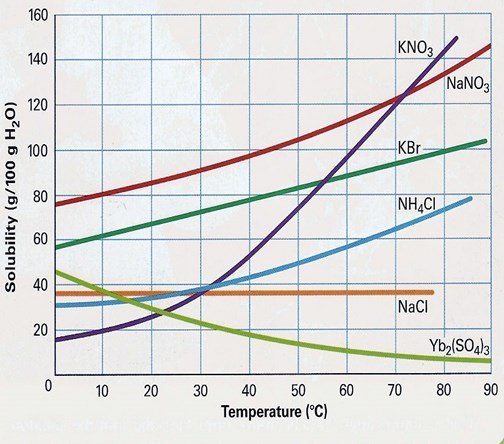
When 20 grams of KNO3 is dissolved in 100 grams of water at 80 ºC, the solution can be correctly described as:
1
supersaturated
2
saturated
3
unsaturated

35

Multiple Choice

Question image

At which temperature do KBr and KNO3 have the same solubility?

1

60

2

55

3

50

4

Never

36

Multiple Choice

Question image
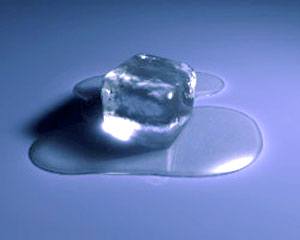
Change of state from a solid to a liquid.
1
sublimation
2
deposition
3
freezing
4
melting

37

Multiple Choice

Question image
What kind of change is a phase change?
1
Physical - it's still the same substance
2
chemical - it's made of chemicals 

38

Multiple Choice

Question image
The steam coming off the pot of boiling water is an example of....
1
a solid becoming a liquid
2
a liquid becoming a solid
3
a liquid becoming a gas
4
a gas becoming a liquid

39

Multiple Choice

Question image
When you heat water it turns into a ____
1
liquid
2
water
3
gas
4
solid

40

Multiple Choice

Question image
When water vapor gets cold, it turns to a...
1
liquid
2
solid
3
raindrop
4
ice
media

Show answer

Auto Play

Slide 1 / 40

SLIDE