Voting Rights
Presentation
•
Social Studies
•
12th Grade
•
Practice Problem
•
Hard
LISA JARRETT
FREE Resource
43 Slides • 24 Questions
1
2
Multiple Choice
What are the key components of voting rights that are important for citizens to understand?
Eligibility requirements
Voting methods
Political parties
Election dates
3
4
Multiple Choice
Why did more people vote in the election of 1828 compared to the election of 1824?
Because many states eliminated property requirement
Because former slaves were allowed to vote
Because women were now allowed to vote
Because people had to pay to vote
5
6
Multiple Select
What were the voting qualifications in 18th century England?
No women could vote
No one under the age of 21 could vote
Men had to own a certain amount of land to vote
Less than 5% of the population was allowed to vote
7
8
Multiple Choice
What did those in power believe about landowners' role in political decisions?
They were responsible and independent
They should not be involved
They were uneducated
They were only interested in profit
9
10
Open Ended
Can you think of reasons to support that non-landowners could also be responsible, independent voters?
11
Open Ended
What reasons might support that landowners would be responsible, independent voters?
12
13
Multiple Choice
Who were the groups of people that were often excluded from voting according to the image?
Anyone under 21
Poor white men
Women
All of the above
14
15
Multiple Choice
What was Paul Cuffee's argument for allowing Black people and American Indians to vote?
They were tax-paying citizens
They were landowners
They were educated
They were part of the government
16
17
Open Ended
If you and kids across the country could vote, how do you think laws about schools might change?
18
19
Open Ended
How do you think the representatives in our early government worked to protect those who couldn’t vote?
20
21
Multiple Choice
What were the implications of not having representation in early America according to the text?
Human enslavement continued
Women had equal rights
American Indians were protected
The government worked for all
22
23
Multiple Select
How did voting rights change according to the text?
By changing state laws
By amending the U.S. Constitution
By increasing voter turnout
By reducing voting age
24
25
Multiple Choice
What are the key factors that led to the expansion and contraction of voting rights over time?
Political movements
Economic factors
Social changes
Legal reforms
26
27
Multiple Choice
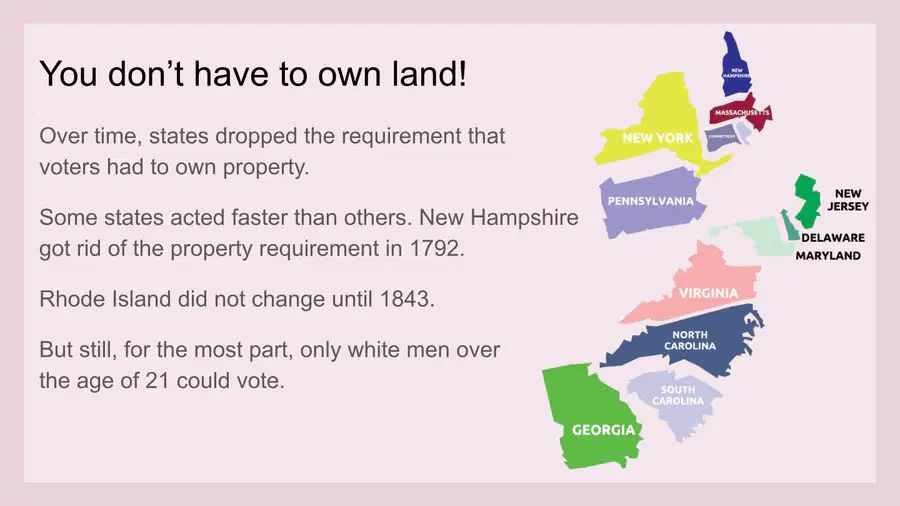
Which state dropped the property requirement for voting first?
New Hampshire
Rhode Island
Virginia
Georgia
28
29
Multiple Choice
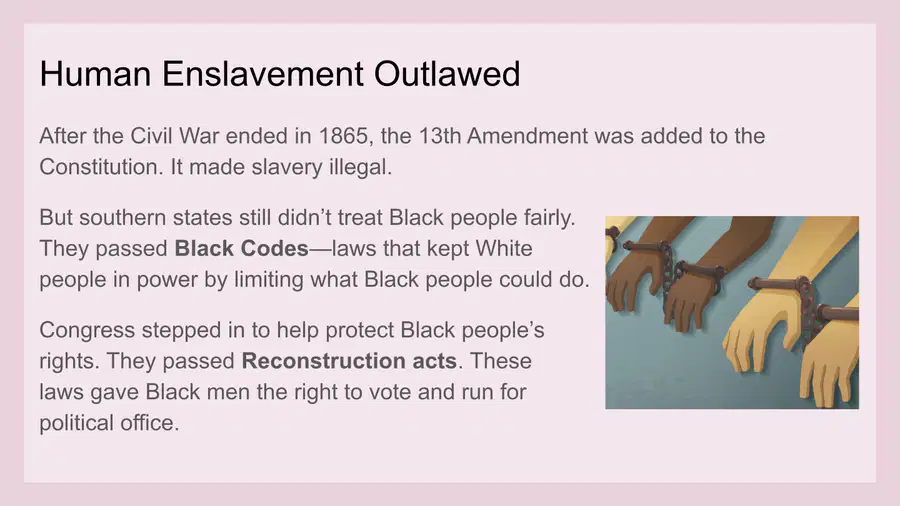
What were the Black Codes and how did they affect Black people's rights after the Civil War?
Laws that protected Black people's rights
Laws that limited Black people's rights
Laws that abolished slavery
Laws that promoted equality
30
31
Multiple Choice
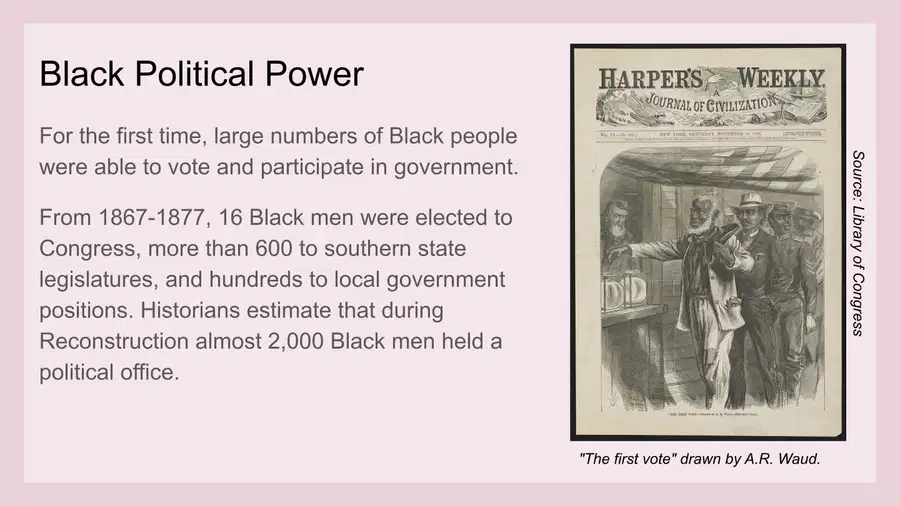
What significant political changes occurred for Black people between 1867 and 1877?
They were able to vote and participate in government
They were denied the right to vote
They were elected to Congress only
They held no political office
32
33
Multiple Choice
What were Union Leagues and what issues did they address for Black communities?
Civic organizations for education
Political organizations for land rights
Groups serving on juries
All of the above
34
35
Open Ended
Read the following passage, and answer the question.
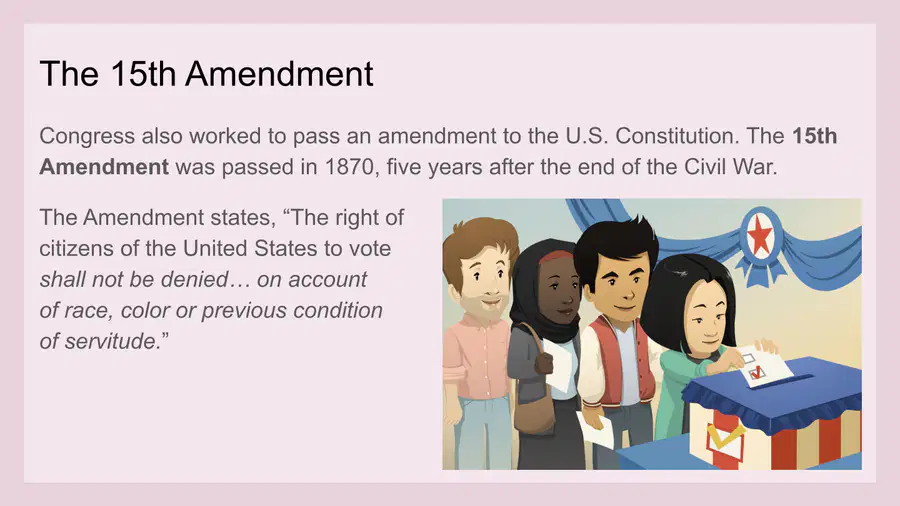
“The right of citizens of the United States to vote shall not be denied or abridged by the United States or by any State on account of race, color, or previous condition of servitude.” -15th Amendment
Why did Congress ratify this amendment?
36
37
38
Multiple Choice
Which event led to the action shown in this illustration?
The revival of nativist policies
The ratification of the Fifteenth Amendment
The Supreme Court ruling in Plessy v. Ferguson
The rise of Social Darwinism
39
40
Multiple Choice
What is the meaning behind this political cartoon?
That whites required blacks to take a literacy test, when they themselves were barely literate
That whites did not require blacks to take a literacy test, because they themselves were barely literate
That the police was at the voting poll to ensure that blacks took their literacy test before they voted
That the police was at the voting poll to ensure that blacks and whites took their literacy test before they voted
41
42
Multiple Choice
What were some barriers that prevented African Americans from voting?
Limited opportunities to register to vote
Unfair tests at the polls
Threats of violence toward voters' families
All of the above
43
44
45
Multiple Choice
What is the purpose of the literacy test shown in the image?
To assess reading skills
To register voters
To evaluate writing skills
To determine age
46
47
Open Ended
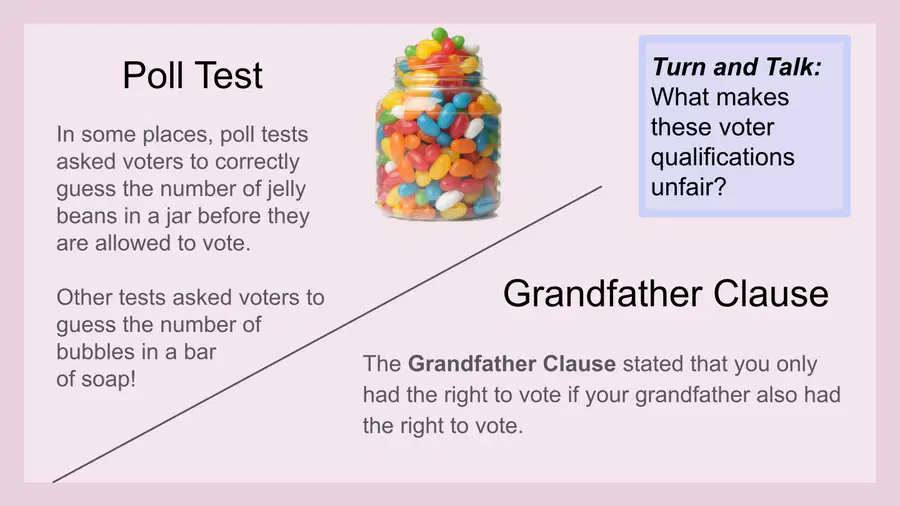
What makes these voter qualifications unfair?
48
49
50
51
52
53
54
55
56
57
58
59
60
61
62
63
64
65
66
67
Poll
How confident do you feel about this topic now?
Show answer
Auto Play
Slide 1 / 67
SLIDE

Similar Resources on Wayground
62 questions
Brandon in Japan
Presentation
•
KG
61 questions
Skin Case Study and Articles
Presentation
•
12th Grade
61 questions
QR Semester 1 MidTerm Review
Presentation
•
12th Grade
62 questions
Robots on the payroll
Presentation
•
12th Grade
67 questions
1980s AP Version
Presentation
•
12th Grade
61 questions
Styles and Techniques in Contemporary Arts
Presentation
•
12th Grade
64 questions
Federalism Part II
Presentation
•
12th Grade
59 questions
ÔN TẬP GIỮA KỲ 1 2024 - 2025 TIN HỌC 12
Presentation
•
12th Grade
Popular Resources on Wayground
19 questions
Naming Polygons
Quiz
•
3rd Grade
10 questions
Prime Factorization
Quiz
•
6th Grade
20 questions
Math Review
Quiz
•
3rd Grade
15 questions
Fast food
Quiz
•
7th Grade
20 questions
Main Idea and Details
Quiz
•
5th Grade
20 questions
Context Clues
Quiz
•
6th Grade
20 questions
Inferences
Quiz
•
4th Grade
19 questions
Classifying Quadrilaterals
Quiz
•
3rd Grade
Discover more resources for Social Studies
30 questions
AP Psychology Unit 4: Social Psychology and Personality
Quiz
•
12th Grade
48 questions
Civics EOC Practice Questions
Quiz
•
12th Grade
43 questions
U.S. History EOC Practice Questions
Quiz
•
12th Grade
50 questions
Economics Final Exam Review
Quiz
•
12th Grade
28 questions
Semester Review Part 1
Quiz
•
9th - 12th Grade
24 questions
Spring Semester Exam Part 2 Review
Quiz
•
9th - 12th Grade
10 questions
Exploring Financial Literacy and Personal Growth
Interactive video
•
9th - 12th Grade