

Interest Groups

Presentation
•
History
•
2nd Grade
•
Practice Problem
•
Medium

Kelly Krause
Used 6+ times
FREE Resource
23 Slides • 23 Questions
1

2
3
Multiple Choice
What are interest groups and how do they organize for influence?
They are organizations that seek to influence public policy
They are groups that only focus on political parties
They are only concerned with local issues
They do not engage in lobbying
4
5
Open Ended
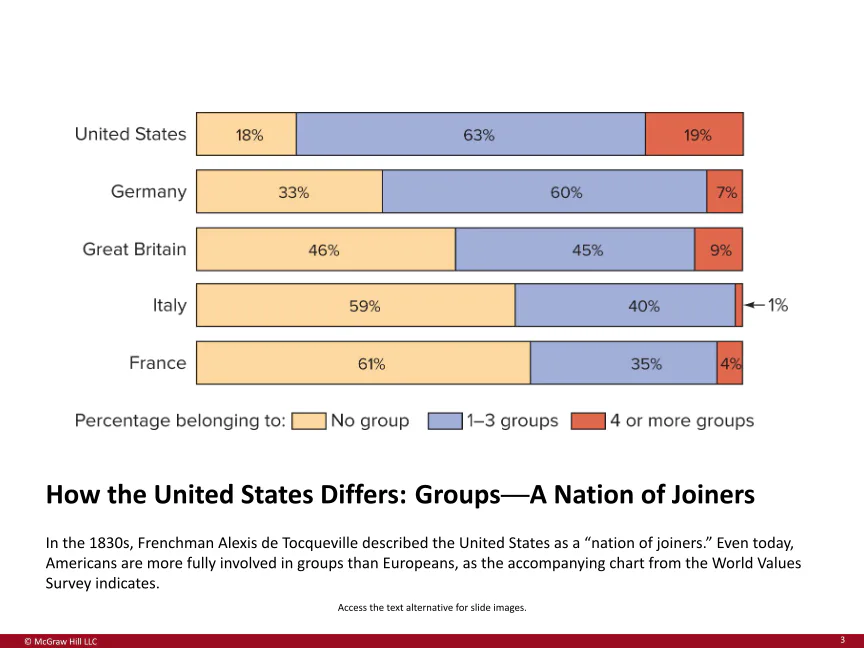
What does the chart suggest about group involvement in the United States compared to European countries?
6

7
Multiple Choice
What is the name of a group of individuals with broad common interests who organize to nominate candidates for office, to win elections, to conduct government, and to determine public policy? The Democrats and Republicans are examples of these.
Corporation
Interest group
Political Party
Government Agency
8
Multiple Choice
Which of the following is NOT an economic group?
Business groups
Labor groups
Farm groups
Social groups
9

10
Multiple Choice
What percentage of lobbying groups in Washington, D.C. are associated with business firms and trade associations?
35%
50%
65%
75%
11

12
Multiple Choice
What are citizens' groups motivated by?
Economic incentives
Purposive incentives
Material incentives
None of the above
13
14

15
Multiple Select
Which of these statements describe the free rider problem?
Free riders enjoy the benefit of a public good without contributing to its creation
Free riders contribute to the degradation of a public good without paying for it
The free rider problem occurs because some goods are non-rivalrous and non-excludable
16

17
Multiple Choice
What is a grassroots lobbying effort?
A campaign that targets high-level government officials exclusively
A movement that starts at the local or community level to influence policy
A strategy that involves only the top executives of large corporations
A lobbying method that relies solely on social media
18

19
Multiple Choice
What is the primary focus of modern lobbying according to the text?
Supplying officials with information
Understanding the policy process
Targeting government branches
Revolving door between firms and government
20
21
Multiple Choice
What is the main goal of lobbying by a technology company?
To provide unbiased information to the public about technology
To influence government decision-making that favors their business
To raise funds for political campaigns for candidates
To organize political protests against other companies
22

23
Multiple Choice
What are the main differences between iron triangles and issue networks in the policy process?
Iron triangles are temporary, while issue networks are stable.
Iron triangles involve bureaucrats, while issue networks do not.
Iron triangles are stable groups, while issue networks are informal and temporary.
Iron triangles focus on immediate issues, while issue networks focus on common interests.
24

25
Multiple Choice
How does lobbying benefit democracy?
By ensuring that all voices, regardless of wealth or power, are heard equally
By providing lawmakers with expert information on complex issues on behalf of interest groups
By allowing foreign governments to influence domestic policy
By making the legislative process faster
26

27
Multiple Choice
What is outside lobbying and how does it influence policymakers?
A method of internal lobbying
Bringing public pressure to bear on policymakers
A form of grassroots lobbying only
A technique used by lobbyists in private meetings
28

29
Multiple Select
What are the tactics used in Inside and Outside Lobbying efforts?
Developing contacts with legislators
Encouraging group members to contact their representatives
Providing information to key officials
Supporting political candidates through money and endorsements
30

31
Multiple Choice
What are some examples of outside lobbying efforts?
Letter-writing campaigns
Public demonstrations
Both of the above
None of the above
32

33
Multiple Choice
What are Political Action Committees (PACs) and how do they influence campaign contributions?
Organizations that pool and donate campaign contributions
Groups that only support challengers
Entities that can contribute unlimited amounts to candidates
Organizations that do not influence elections
34

35
Multiple Select
Rising campaign costs...
encourage the development of political action committees (PACs) and Super PACs
limit opportunities to run for public office
give a disadvantage to wealthy individuals who run for office
give an advantage to wealthy individuals who run for office
36

37
Multiple Choice
What are Super PACs and how do they operate in the context of electoral action?
They can directly contribute to candidates
They are independent-expenditure-only committees
They require disclosure of donors
They are not subject to any regulations
38

39
Multiple Choice
What does pluralist theory suggest about organized groups?
They are a source of sound governance
They are ineffective in governance
They only represent elite interests
They are unnecessary for governance
40

41
Open Ended
What does it mean to serve the "public interest"?
42

43
Multiple Choice
What are the implications of lobbying groups on public interest?
They represent the majority's views
They can distort public policy
They have no influence
They are always beneficial
44
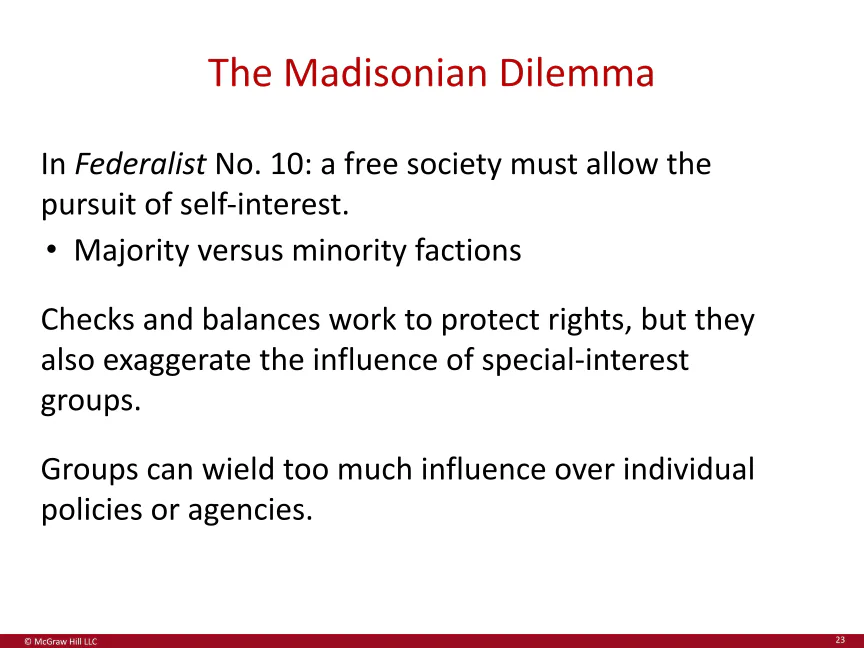
45
Multiple Choice
What is the main conflict described in the Madisonian Dilemma regarding self-interest?
Majority versus minority factions
Checks and balances
Influence of special-interest groups
Pursuit of self-interest
46
Multiple Choice
In Federalist Paper #10, what is a faction?
a majority tyranny
the extended sphere
special interest groups
the new Constitution
Show answer
Auto Play
Slide 1 / 46
SLIDE
Similar Resources on Wayground

43 questions
Africa Facts
Presentation
•
KG
39 questions
French Family Members
Presentation
•
3rd Grade
43 questions
Plants and Animals
Presentation
•
3rd Grade
41 questions
Lesson 5: Gold Mountain
Presentation
•
2nd Grade
40 questions
Promotion
Presentation
•
KG
41 questions
La Fiesta Nacional del Ajo
Presentation
•
2nd Grade
41 questions
2A Ch 5 Reading
Presentation
•
2nd Grade
41 questions
Read This Chart (Class Leader)
Presentation
•
KG
Popular Resources on Wayground
20 questions
"What is the question asking??" Grades 3-5

Quiz
•
1st - 5th Grade
20 questions
“What is the question asking??” Grades 6-8
Quiz
•
6th - 8th Grade
10 questions
Fire Safety Quiz
Quiz
•
12th Grade
20 questions
Equivalent Fractions
Quiz
•
3rd Grade
34 questions
STAAR Review 6th - 8th grade Reading Part 1
Quiz
•
6th - 8th Grade
20 questions
“What is the question asking??” English I-II
Quiz
•
9th - 12th Grade
20 questions
Main Idea and Details
Quiz
•
5th Grade
47 questions
8th Grade Reading STAAR Ultimate Review!
Quiz
•
8th Grade
