Search Header Logo
CER Forces Lesson

CER Forces Lesson

Assessment

Presentation

Physics

9th - 12th Grade

Medium

NGSS
HS-PS2-2, HS-PS2-1, MS-PS2-2

+2

Standards-aligned

Created by

Robert Johnson

Used 11+ times

FREE Resource

21 Slides • 43 Questions

1

​Acceleration vs. Mass

By Robert Johnson

2

Claim

The bigger they are the harder they fall.

What is the evidence?
What is the scientific reasoning?
But, first...

3

Background information

Key terms

  • inversely proportional

  • mass (of system)

  • kilogram (kg)

  • acceleration

  • m/s/s (m/s2)

  • Force

  • ​Newton (N)

  • Net Force

  • Inertia

  • Opposing Forces

  • gravity (g)

  • Weight

  • ​Friction

  • coefficient of friction

  • Tension Force

  • Normal Force

  • Force Diagram

  • momentum

4

Inversely Propotional

As x increases, y decreases.
As x decreases, y increases
Their product is constant

media

5

Multiple Choice

Inversely proportional means...

1
Two quantities are directly proportional if their sum is constant.
2
Two quantities are inversely proportional if their difference is constant.
3
Two quantities are inversely proportional if their ratio is constant.
4
Two quantities are inversely proportional if their product is constant.

6

Multiple Choice

The equation for inversely proportional is y = ?

1
y = k/x
2
y = k+x
3
y = k*x
4
y = k-x

7

Multiple Choice

As x increases, y decreases and vice versa is ...

1
an inverse relationship
2

directly proportional

3

inversely proportional

4
a positive correlation

8

Mass

The quantity of matter or how much stuff something is made up of.

  • Measured in kilograms preferably.

  • Proportional to Net Force, inversely proportional to acceleration.

  • the mass of a system is defined as the total quantity of matter it contains, which is calculated by summing the individual masses of all objects within the system

9

Multiple Choice

The amount of matter in an object is 
1
pressure
2
weight
3
mass
4
force

10

Multiple Choice

The SI unit for mass is...

1
ounce
2
pound
3
gram
4
kilogram

11

Multiple Choice

What is meant by the mass of a system?

1

The total amount of matter in a system defined by the experimenter.

2
The weight of a system in motion.
3
The volume occupied by a system.
4
The energy contained within a system.

12

Multiple Choice

Mass is directly proportional to______ and inversely proportional to ______, according the Newton's 2nd Law

1
force; distance
2
mass; velocity
3
force; acceleration
4
energy; time

13

Inertia

Law of Inertia (Newton's 1st Law of Motion)

  • Inn-ur-sha

  • Increases with mass

  • resistance to a change in motion.

  • An object in motion will remain in motion unless acted on by a net force.

14

Multiple Choice

The Law of Inertia states that

1
An object will remain at rest or in uniform motion unless acted upon by an external force.
2
An object will change its state only when it is in motion.
3
An object will accelerate indefinitely without any force.
4
An object will stop moving if no force is applied to it.

15

Multiple Choice

A resistance to a change in motion is ______

1
inertia
2
acceleration
3
friction
4
momentum

16

Multiple Choice

Inertia increases with ...

1
temperature
2
velocity
3
mass
4
friction

17

Acceleration

Speeding up, Slowing Down, or changing directions

  • Measured in m/s/s or m/s2

  • Directly proportional to force and indirectly proportional to mass

  • Must be > 0 to produce a net force.

18

Multiple Choice

acceleration is

1

speeding up

2

slowing down

3

changing directions

4

all of the above

19

Multiple Choice

The units for acceleration are ...

1
kilometers per hour (km/h)
2
meters per minute (m/min)
3
meters per second squared (m/s²)
4
feet per second squared (ft/s²)

20

Multiple Choice

_____ must be greater than zero to produce a net force.

1

acceleration

2
Gravitational pull
3
Frictional force
4
Inertial mass

21

Force and Net Force

Push or Pull (Force) that causes an acceleration (Net Force)

  • Measured in newtons (N)

  • Fnet =msystem*a (Newton's 2nd Law)

  • Not all pushes or pulls cause a change in motion.

22

Multiple Choice

Forces are measured in _____

1
pascals
2
joules
3
watts
4
newtons

23

Multiple Choice

Compare and contrast force with net force.

1

Force is a push or pull; net force produces a change in motion.

2
Force is a vector quantity; net force is a scalar quantity affecting motion.
3
Force is a total of all interactions; net force is an individual force acting on an object.
4
Force is the sum of all interactions; net force is a single force acting on an object.

24

Multiple Choice

How do you calculate net force?

1
Net force is found by dividing total mass by acceleration.
2

Net force is multiplying mass times acceleration

3
Net force is determined by averaging all forces applied.
4
Net force is the product of mass and velocity of an object.

25

Opposing Forces

Law of Action and Reaction

  • For every action there is an equal and opposite reaction.

  • Newton's 3rd Law

26

Multiple Choice

An opposing force is defined as ...

1
a force that enhances the effect of another force
2
a force that remains stationary and does not interact
3
a force that is always directed upwards regardless of other forces
4
a force that acts in the opposite direction to another force

27

Multiple Choice

Newtons's 3rd Law of Motion is also known as...

1
Push and Pull
2
Action and Reaction
3
Mass and Acceleration
4
Force and Motion

28

Multiple Choice

Newton's Third Law of Motion States...

1
For every force, there is a corresponding force in the same direction.
2
Every action creates a reaction that is twice as strong.
3
For every motion, there is a counter motion that cancels it out.
4
For every action, there is an equal and opposite reaction.

29

Newtonian Gravity

Gravity is a downward acting force.

Gravity = g = 9.8 m/s2
or 9.8 N/kg, because net force/mass = acceleration
Often written as Fg or the force due to gravity.

30

Multiple Choice

Gravity is a________ acting force.

1
medium-range
2

downward

3

upward

4
short-range

31

Multiple Choice

Fg represent

1

The normal force

2

The force due to gravity

3

tension force

4

friction force

32

Weight

Downward acting force due to mass and gravity

Replacing a with g, Newton's 2nd Law can be rewritten as:
Fnet =msystem*g or F =mg

g = 9.8 m/s2

33

Multiple Choice

What is the weight of a 2.00-kilogram object on the surface of Earth?

1

4.91 N

2

2.00 N

3

9.81 N

4

19.6 N

34

Multiple Choice

A 60.-kilogram astronaut weighs 96 Newtons on the surface of the Moon. The acceleration due to gravity on the Moon is

1

0.0 m/s2

2

1.6 m/s2

3

4.9 m/s2

4

9.8 m/s2

35

Multiple Choice

An object has a weight (Fg) of 200 N. If the object is on the surface of the Earth, What is this object's mass?

1

200 kg

2

100 kg

3

20.4 kg

4

20.4 N

36

Multiple Choice

A 50-kilogram student, standing on the Earth, attracts the Earth with a force closest to

1

0 N

2

5 N

3

50 N

4

500 N

37

Friction

Opposes motion, slows things down, and results in waste heat.
μ = coefficient of friction.
Multiplied by the calculated force to determine the net force.

38

Multiple Choice

Friction ...

1

Opposes motion

2

slows objects down

3

creates waste heat

4

all of the above

39

Multiple Choice

A 2.0-N force acts horizontally on a 10-N block that is initially at rest on a horizontal surface. The coefficient of static friction between the block and the surface is 0.50.What is the magnitude of the frictional force that acts on the block?

1

5 N

2

8 N

3

2 N

4

0 N

40

Multiple Choice

There are 25N of friction that keep a 10kg brick moving at a constant rate. What is the coefficient of friction?

1

0.25

2

0.25N

3

4

4

4N

41

Multiple Choice

How does friction affect speed?
1
more friction decreases speed
2
more friction increases speed
3
less friction decreases speed

42

Multiple Choice

 What is the force of friction between a block of ice that weighs 950 N and the ground if μ = .12? 
1
65 N
2
226 N
3
175 N
4
114 N

43

Other types of Forces

Normal Forces, Tension Forces, etc.

  • Normal Force is an upward force that opposes gravity.

  • Tension force is an upward force that opposes gravity.

  • The difference is that a tension force involves hanging, like an elevator. Normal forces occur when objects are resting, like on the floor.

44

Force Diagrams

aka Free-body Diagrams

  • Extremely useful in solving problems in physics.

  • Keeps track of all the forces, which is necessary to determine the net force.

  • uses arrows to show the magnitude and direction of forces.

  • The object can be represented with a dot or a box.

  • You don't have to be artistic to draw one of these.

45

Multiple Choice

Question image

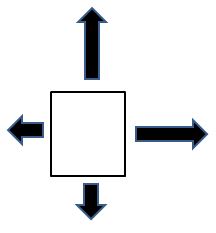
The down-arrow in this diagram is most-likely:

1

gravity

2

normal

3

a push or pull

4

friction

46

Multiple Choice

Question image

If this object were moving right, the left-arrow in this diagram is most-likely:

1

gravity

2

normal

3

a push or pull

4

friction

47

Multiple Choice

Which diagram best shows person pushing a couch (accelerating) across the floor?

1
2
3
4

48

Multiple Choice

Question image
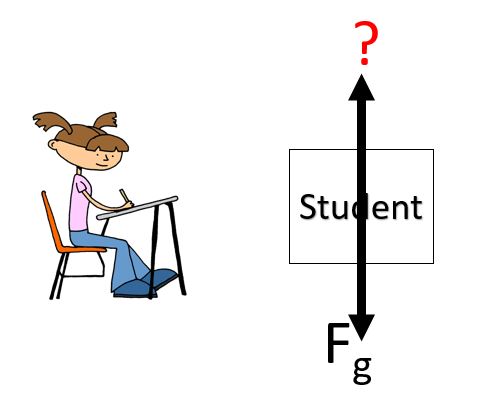
Name the missing force....
1
weight force
2
normal force
3
frictional force
4
tension force

49

Multiple Choice

Question image
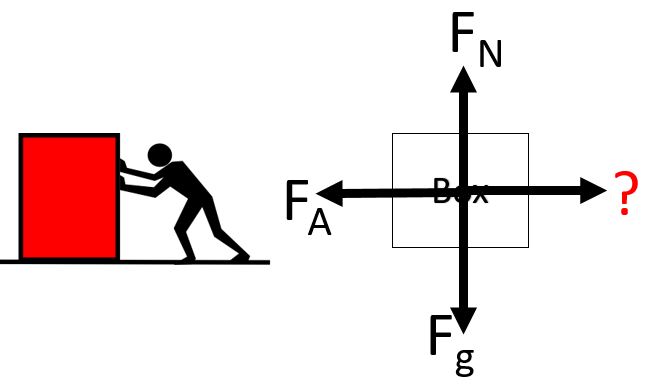
Name the missing force...
1
tension force
2
frictional force
3
normal force
4
spring force

50

Multiple Choice

Question image
Name the missing force...
1
frictional force
2
weight force
3
thrust
4
buoyant force

51

Momentum

ρ = mv

  • Momentum is a way to quantify motion, and is calculated by multiplying mass times velocity.

  • Unlike net force is does not require acceleration.

  • Objects with large momentums are hard to stop and vice versa.

  • Unit is kg m/s

52

Multiple Choice

The momentum of an object depends upon the object's ___________&_____________.  
1
size and shape
2
mass and speed
3
mass and veloctiy
4
mass and energy

53

Multiple Choice

The equation to calculate momentum is
1
p=mv
2
p=1/2mv2
3
p=mgh
4
p=mg

54

Multiple Choice

Determine the momentum of 1000-kg car moving southward at 20 m/s......... 
1
20000 N
2
20000 Joules
3
20000 Kg * m/s south
4
10000 kg * m/s south

55

Multiple Choice

What is the unit for momentum?
1
m/sec
2
kg/sec
3
kg/m
4
kg m/sec

56

Multiple Choice

A 0.250 kg cart moving at 0.400 m/s has how much momentum?
1
0.1 kg-m/s
2
1 kg-m/s
3
10 kg-m/s
4
100 kg-m/s

57

Multiple Choice

Determine the momentum of 1000-kg car moving northward at 20 m/s......... 
1
20000 N
2
20000 Joules
3
20000 Kg * m/s
4
20000 kg * m/s north

58

Multiple Choice

Question image
The definition of momentum is
1
Mass in Motion
2
The size of an object
3
The velocity of an object
4
A comparison between two objects

59

Evidence

media
media

60

Experimental Design

media
media
media

61

Results

media
media

62

Linearization

media

​y=mx+ b or acceleration = m*1/mass

63

Reasoning

Newton's 2nd Law

The results show a y =1/x relationship, so squaring the mass values will linearize the graph. Then we can use y=mx + b
a = Fnet/msystem
acceleration is directly proportional to Net force, and inversely proportional to mass

64

What is the slope of an acceleration vs mass graph?

​y=mx+ b or acceleration = m*1/mass

  • Rise/run with units = m/s2 /(1/kg) rewritten as kg* m/s2 (Reciprocal Rule of fractions)

  • kg* m/s2 = 1 N according to Newton's second law abbreviated F =ma

  • Also expressed as acceleration = Force/mass or a=Fnet/m.

  • So, slope =m = Force on an acceleration vs. mass graph.

​Acceleration vs. Mass

By Robert Johnson

Show answer

Auto Play

Slide 1 / 64

SLIDE