APPC Arith Geo Intro Notice & Wonder
Presentation
•
Mathematics
•
11th Grade
•
Easy
+5
Standards-aligned
Phara Cherdsuriya
Used 2+ times
FREE Resource
5 Slides • 25 Questions
1
Arithmetic & Geometric
Sequence
Objective: Introduce arithmetic & geometric sequences and notice relationships to linear and exponential functions
2
Multiple Choice
What do you notice in the following four patterns? Which one of the following does not belong?
-10, 10, 30, 50, 70, . .
-4, -1, 2, 5, 8, . . .
-2, 4, -8, 16, - 32, . . .
3, 6. 9. 12, 15, . . .
3
4
Multiple Choice
Which of the following is an example of an arithmetic sequence?
4, 8, 16, 32, 64
1, 2, 4, 7, 11
15, 13, 11, 9, 7
3, 6, 12, 24, 48
5
Multiple Choice
Which sequence is NOT an arithmetic sequence?
-7, -13, -19, -25,...
-10, -6, -2, 2,..
6, 8, 10, 12,...
3, 15, 75, 375,...
6
Multiple Choice
The first three terms of an arithmetic sequence are as follows
13, 19, 25
What are the next two terms of the sequence?
31 and 37
31 and 36
30 and 37
30 and 36
7
Graphing
Plot the ordered pairs from the arithmetic sequence 2, 5, 8, on a coordinate plane as (1, 2), (2, 5), (3, 8).
What do you notice about arithmetic sequence?
8
9
Multiple Choice
3, 10, 17, 24, ...
d = -6
d = 6
d = 7
d = -7
10
Multiple Choice
97, 86, 75, 64, ...
d = 8
d = 11
d = -11
d = -8
11
Multiple Choice
3, 7, 11, 15, ...
d = 6
d = 5
d = 4
d = 2
12
Multiple Choice
Each individual number in a sequence of numbers is called what?
13
Multiple Choice
Which table of values represents a linear function?
14
Multiple Choice
True or false: Any arithmetic sequence can be written as a linear function, y = mx + b
True
False
I don't know
I don't care at this point
15
Multiple Choice
Which equation describes this sequence? 1, 3, 5, 7, 9. . .
y = 2(3)^x
y = 2x - 1
y = 2x + 1
y = - 2x + 1
y = -2x - 1
16
Multiple Choice
Two students are solving the same problem: "Find the 100th term of the arithmetic sequence 1, 4, 7, 10, ..." One student uses the explicit formula an = a1+(n−1)d where an is nth term, a1 is first term, and d is common difference, and the other uses the linear function f(x)=3x−2. Critique both approaches. Which is more efficient, and why? When might you prefer one method over the other?
Both methods are correct and equally efficient for finding the 100th term; use whichever you remember.
Both methods are correct, but Student B's linear function is more efficient here because evaluating f(100) is simpler than substituting into an = a1 +(n−1)d.
Both methods are correct, but Student A's explicit formula an=a1+(n−1)d is more direct and clearer for sequences—so it is slightly preferable; however, the linear function is handy if you want to interpret the sequence as a function of position.
Student A is correct and Student B is incorrect because a sequence must use the sequence formula, not a function; only Student A's answer is valid.
17
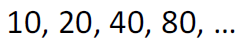
What is Geometric Sequence?
Multiplying a constant # over and over
Example 1) 20, -40, 80, -160, 320, -640, , . . . .
Example 2) 28000, 14000, 7000, 3500, ...
Example 3) Fractals! (Real-life example)
18
19
Multiple Choice
Find the common ratio for the geometric sequence: -192, 48, -12, 3, . . .
r = -4
r = 4
r = 1/4
r = -1/4
20
Multiple Choice
r = 10
r = 1/2
r = 2
r = 4
21
Multiple Choice
22
Multiple Choice
Is the sequence 9, 99, 999, 9999,... geometric? Why?
no, 99/9, 999/99, 9999/999 are not constant and therefore, it is not multiplying by same # pattern which indicates geometric sequence
yes, it a same # multiplying pattern
23
Multiple Choice
What is the equation of the following table?
HINT: Use your STAT Key on your calculator
y = 7(2)x
y = 4x + 7
24
Multiple Choice
What is the equation of the following table?
HINT: Use your STAT Key on your calculator
y = 2x + 4
y = 4(2)x
25
Multiple Choice
Which table represents the following equation?
26
Multiple Choice
True or false: Geometric sequence can be written as exponential function since it is multiplying by a constant
True
False
I don't know
AP Precalculus is too difficult! I don't care at this point : (
27
Multiple Choice
Which equation best describes this sequence? 800, - 400, 200, - 100...
y = 800(-2)x
y = 800(2)x
y = - 800(0.5)x
y = 800(-0.5)x-1
y = 800 - 2x
28
Multiple Choice
29
Multiple Choice
30
Multiple Choice
Identify the type of relationship
Linear
Quadratic
Exponential
Arithmetic & Geometric
Sequence
Objective: Introduce arithmetic & geometric sequences and notice relationships to linear and exponential functions
Show answer
Auto Play
Slide 1 / 30
SLIDE

Similar Resources on Wayground
23 questions
Inverse Functions
Presentation
•
11th Grade
25 questions
Solving quadratics
Presentation
•
10th - 11th Grade
22 questions
Math 8 Midterm Review 2022
Presentation
•
8th Grade
27 questions
Quantitative and Qualitative Research
Presentation
•
11th Grade
23 questions
Persamaan dan Fungsi Kuadrat
Presentation
•
11th Grade
22 questions
Introduction to Right Triangle Trigonometry
Presentation
•
11th Grade
20 questions
Changing Percents to Decimals
Presentation
•
KG
22 questions
CPCTC in Proofs
Presentation
•
10th Grade
Popular Resources on Wayground
20 questions
"What is the question asking??" Grades 3-5
Quiz
•
1st - 5th Grade
20 questions
“What is the question asking??” Grades 6-8
Quiz
•
6th - 8th Grade
10 questions
Fire Safety Quiz
Quiz
•
12th Grade
20 questions
Equivalent Fractions
Quiz
•
3rd Grade
34 questions
STAAR Review 6th - 8th grade Reading Part 1
Quiz
•
6th - 8th Grade
20 questions
“What is the question asking??” English I-II
Quiz
•
9th - 12th Grade
20 questions
Main Idea and Details
Quiz
•
5th Grade
47 questions
8th Grade Reading STAAR Ultimate Review!
Quiz
•
8th Grade
Discover more resources for Mathematics
15 questions
Exponential Growth and Decay Word Problems Practice
Quiz
•
9th - 12th Grade
15 questions
Converting Between Exponential And Logarithmic Form
Quiz
•
9th - 12th Grade
15 questions
Algebra 1 Vocabulary
Quiz
•
9th - 12th Grade
4 questions
Set It Up: Algebra I EOC Review
Quiz
•
9th - 12th Grade
14 questions
Intro solving quads by graphing/factoring
Presentation
•
9th - 12th Grade
17 questions
Intro To Dilations
Quiz
•
8th - 12th Grade
47 questions
CCG Review Day Probability/Counting Procedures
Quiz
•
9th - 12th Grade
19 questions
Circumference and Area of a Circle
Quiz
•
9th - 11th Grade