

Chapter 9 Section 1 Conflict and Change

Presentation
•
History
•
8th Grade
•
Practice Problem
•
Hard

Anna Rogers
Used 1+ times
FREE Resource
17 Slides • 12 Questions
1

2

3
Multiple Choice
Which of the following best describes the immediate effect of the New York Stock Exchange decline in October 1929?
It led to the Panic of 1929 and mass layoffs.
It caused a boom in the agricultural sector.
It resulted in increased government spending.
It had little impact on employment.
4
5

6
Multiple Select
Which of the following costs did Mississippi cotton farmers have to deduct from their earnings in 1923?
Cost of seed
Cost of fertilizer
Cost of ginning
Pay for extra workers
7

8
Multiple Choice
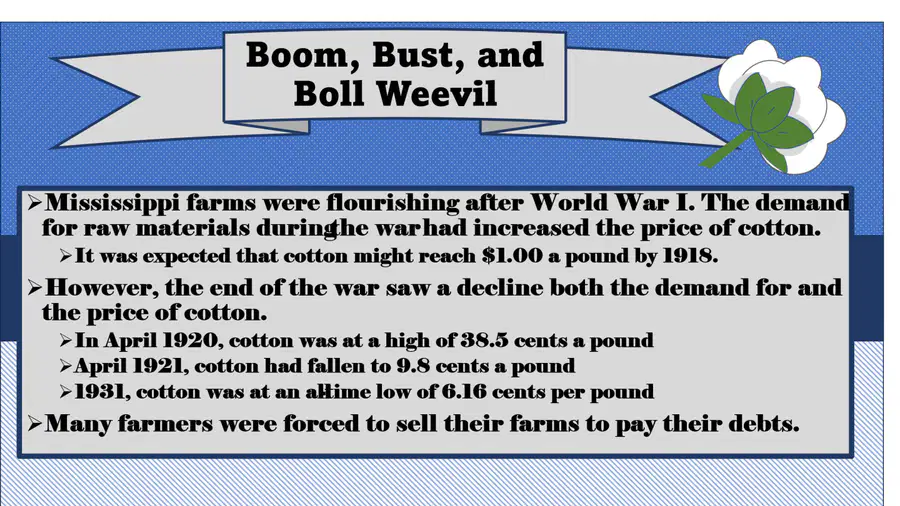
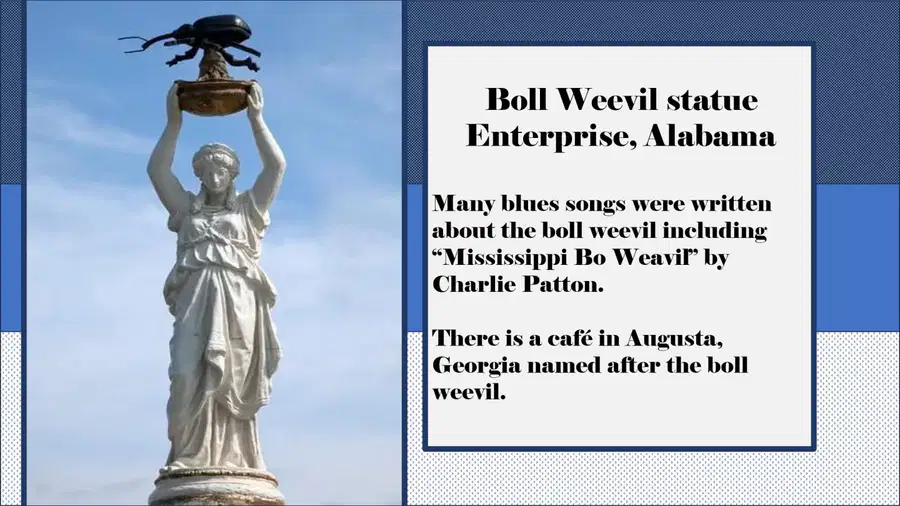
What were the main factors that led to the decline of cotton farming in Mississippi after World War I?
Decreased demand and price for cotton, and boll weevil infestation
Increased demand for cotton and improved farming techniques
Government subsidies and technological advancements
Expansion of cotton farms and favorable weather
9
10

11
Fill in the Blanks
The Great Flood of 1927 was significant because it was the
Type answer...
12

13
Multiple Choice
Which of the following statements about landowners, renters, tenants, and sharecroppers in Mississippi during the 1920s is correct?
Landowners made up about 35% of farmers and were at the top of the system.
Renters made up about 60% of Mississippi farmers.
Tenants provided nothing but labor and received a smaller share than a sharecropper.
Sharecroppers provided their own tools, seeds, animals, and fertilizer.
14
15
Multiple Choice
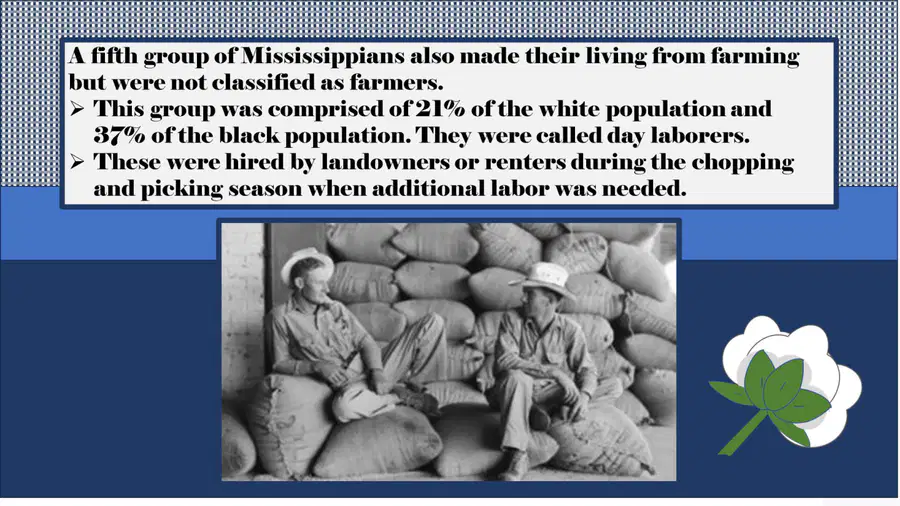
Which group of Mississippians was hired by landowners or renters during the chopping and picking season when additional labor was needed?
Tenant farmers
Sharecroppers
Day laborers
Landowners
16
17
18
Multiple Select
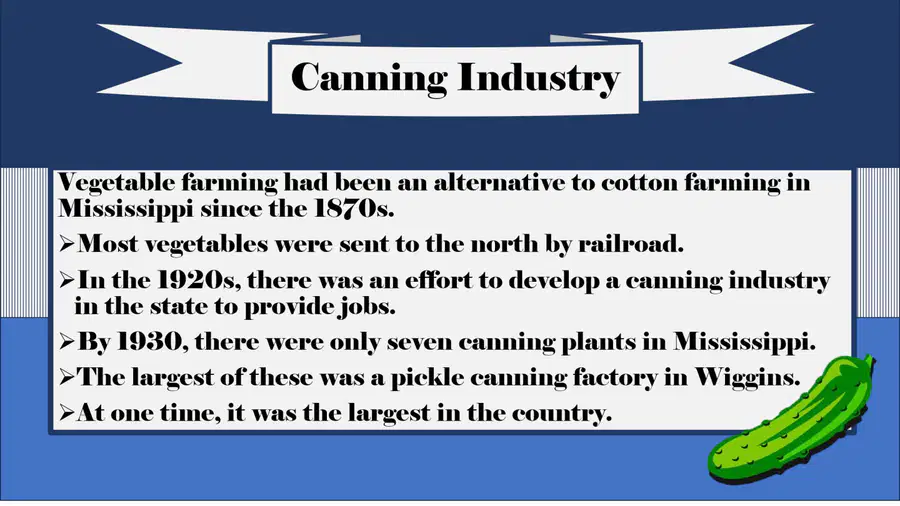
Which of the following statements about the canning industry in Mississippi during the 1920s and 1930s are correct?
Vegetable farming was an alternative to cotton farming since the 1870s.
Most vegetables were sent to the south by railroad.
By 1930, there were only seven canning plants in Mississippi.
The largest canning factory was located in Jackson.
19

20
Fill in the Blanks
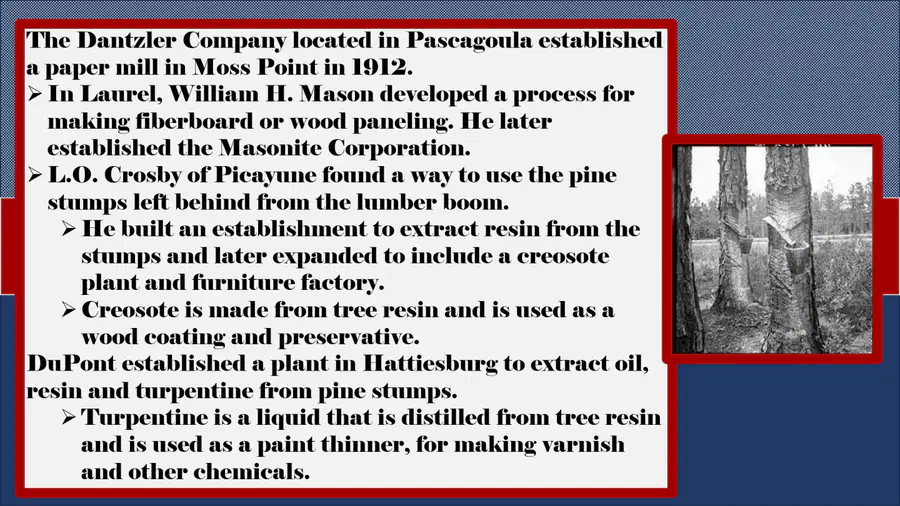
Mississippi's large forest reserves were exhausted by the
Type answer...
21
22
23
Multiple Choice
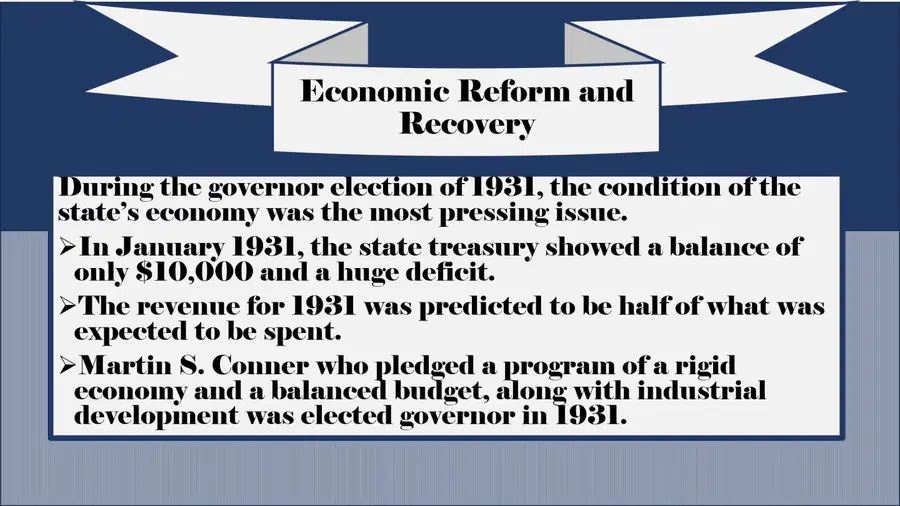
Who was elected governor of Mississippi in 1931, pledging a program of a rigid economy and a balanced budget?
Governor Vardaman
Governor Bilbo
Martin S. Conner
William H. Mason
24

25
Multiple Choice
What major financial challenge did Governor Martin S. Conner inherit when he took office, and what policy did he implement to address it?
A $12 million deficit; he implemented a strict economic policy
A surplus of $3 million; he increased spending
A lack of public employees; he hired more workers
A highway program; he expanded it
26
27
28
Multiple Select
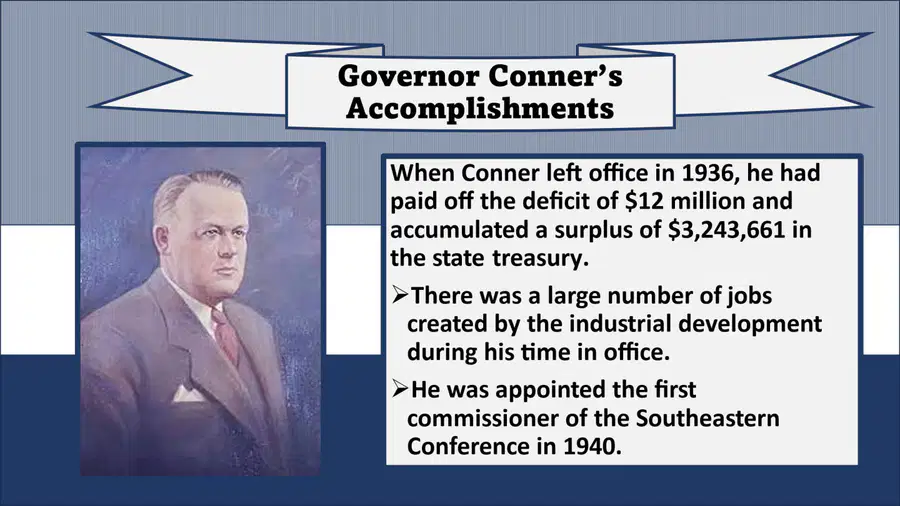
Which of the following were accomplishments of Governor Conner by the time he left office in 1936? Select all that apply.
Paid off a $12 million deficit
Accumulated a surplus in the state treasury
Created a large number of jobs through industrial development
Appointed commissioner of the Southeastern Conference in 1940
29
Fill in the Blanks
The rapid decline of the New York Stock Exchange in October 1929 became known as the Panic of
Type answer...
Show answer
Auto Play
Slide 1 / 29
SLIDE
Similar Resources on Wayground

19 questions
War of 1812- Causes and Effects
Presentation
•
8th Grade
23 questions
Supreme Court Cases
Presentation
•
8th Grade
22 questions
World War One Beginnings
Presentation
•
9th Grade
26 questions
Columbian Exchange Sub Work
Presentation
•
8th Grade
21 questions
Civil War
Presentation
•
8th Grade
22 questions
E. Chapter 21 King John and Magna Carta
Presentation
•
7th - 8th Grade
23 questions
Chapter 16: Lesson 3
Presentation
•
8th Grade
19 questions
Civil War
Presentation
•
8th Grade
Popular Resources on Wayground
10 questions
Safety Day 2026 – Student Review

Quiz
•
9th Grade
21 questions
Continents and Oceans
Quiz
•
6th Grade
20 questions
Parts of Speech
Quiz
•
5th Grade
16 questions
Subject & Predicate
Quiz
•
5th Grade
25 questions
Multiplication Facts
Quiz
•
5th Grade
12 questions
Map Skills
Quiz
•
3rd Grade
22 questions
Continents and Oceans
Quiz
•
5th Grade
15 questions
Rounding Decimals
Quiz
•
5th Grade
Discover more resources for History
15 questions
Unit 3 - Part 1 Road to Revolution
Quiz
•
8th Grade
25 questions
WWII Assessment
Quiz
•
8th Grade
25 questions
The American Revolution
Quiz
•
7th - 10th Grade
15 questions
The Bill of Rights
Quiz
•
8th - 12th Grade
18 questions
American Revolution Review
Quiz
•
8th Grade
14 questions
Weekly Wrap Up #3: CE.1a/e -Fundamental Principles
Quiz
•
8th Grade
15 questions
Ancient Rome
Quiz
•
7th - 10th Grade
16 questions
Students of Civics Unit 2: The Constitution
Quiz
•
7th - 11th Grade