

Global Media Week 12 Class 1

Presentation
•
English
•
University
•
Practice Problem
•
Easy
+39
Standards-aligned

Ashley Smalls
Used 1+ times
FREE Resource
53 Slides • 70 Questions
1
2
Multiple Choice
Zohran Mamdani was elected mayor of New York City this week. What is his political affiliation?
communist
democratic socialist
independent
why does everyone care so much about this mayor?
3
Multiple Choice

Which state elected its first female governor on Tuesday?
California
Delaware
Illinois
New Jersey
Virginia
4
Multiple Choice
Which state approved the redistricting measure called Proposition 50?
Oregon
Maryland
California
Vermont
5
Multiple Choice

Which member of Congress announced she will not seek reelection?
Rep. Nancy Pelosi
Rep. Maxine Waters
Rep. Marjorie Taylor Greene
Sen. Lisa Murkowski
6
Multiple Choice

Former Vice President Dick Cheney died this week at age 84. Under which president did he serve?
Ronald Reagan
George W. Bush
Bill Clinton
Jimmy Carter
7
Multiple Choice

The government shutdown is now the longest in American history, having completed its 35th full day on Wednesday at midnight. During whose presidency was the second-longest shutdown?
Ronald Reagan
George H.W. Bush
Bill Clinton
Barack Obama
Donald Trump
8
Multiple Choice

On Tuesday, a cargo plane for what shipping service crashed, killing at least 12 people?
DHL
FedEx
UPS
USPS
9
Multiple Choice

Canada is about to lose its place among the nations that have eliminated which vaccine-preventable disease?
Malaria
Measles
Mumps
Polio
10
Multiple Choice

Japan has deployed its military to counter a surge in what?
graffiti
protests by the radical left
bear attacks
immigration
11
Multiple Choice

The FAA plans to reduce air traffic at 40 major airports by what percentage if the shutdown continues?
40%
5%
1000%
10%
12

13

14

15

16
Multiple Choice
Which of the following is a key aspect of consumer culture shaped by global advertising?
Personal values and identity
Weather patterns
Geographical borders
Natural resources
17
Multiple Choice
Which of the following is NOT a key aspect of global advertising as described in the lesson?
Consistent branding and messaging
Balancing global appeal with local relevance
Shaping consumer culture and identity
Focusing solely on local markets
18
19
Multiple Choice
What made Coca-Cola’s “Share a Coke” campaign stand out globally?
It introduced a new Coke flavor
It personalized bottles with people’s names
It featured only celebrities
It focused on recycling bottles
20
Multiple Choice
How did “Share a Coke” connect consumer identity to global branding?
By showing the same ad worldwide without changes
By linking personal names to emotions of belonging and friendship
By removing all local languages
By focusing only on U.S. consumers
21
Multiple Choice
Which concept best describes how “Share a Coke” was adapted to local markets using regional names and languages?
Globalization
Cultural imperialism
Glocalization
Homogenization
22
Poll
When you see your name or a friend’s name on a Coke bottle, how do you feel?
More likely to buy it for fun
No different than any other Coke
More connected to the brand
It feels too personal or manipulative
23
Poll
Does “Share a Coke” represent emotional connection or consumer manipulation to you?
Genuine connection across cultures
Smart marketing that plays on emotion
Manipulative consumerism
A mix of both or all
24

25
Multiple Select
Which strategies are essential for effective global advertising according to the lesson?
Establish unified brand identity
Integrate local relevance
Leverage diverse media channels
Ignore local market trends
26

27
Fill in the Blanks

Consumer culture refers to a society where the acquisition and consumption of goods and services becomes central to personal identity, social relationships, and
28
Consumer Culture
We just defined consumer culture as how products become part of who we are — shaping our identity, values, and even our emotions. Let’s look at this short clip about Starbucks’ new limited-edition teddy-bear cup and see how this plays out in real life.
29
30
Follow Up - Discussion
What’s really being sold here — a cup, or the feeling attached to owning it?
31
Multiple Choice
What best explains the frenzy over Starbucks’ bear-shaped cup?
It has a unique taste when used
It’s a symbol of belonging and exclusivity
People need it for practical use
It was given away for free
32
Multiple Choice
Why were some customers willing to pay hundreds of dollars for a $30 cup?
The cup had a built-in feature unavailable elsewhere
It reflected scarcity and status in consumer culture
Starbucks required it for store discounts
It came with a lifetime coffee supply
33
Multiple Choice
Which concept does this video illustrate most clearly?
Cultural imperialism
Glocalization
Emotional marketing
Economic globalization
34
Poll
Would you ever line up or pay extra for a limited-edition product?
Yes — I like being part of the excitement
Maybe, if it felt meaningful
No — it’s just a product
Depends on the brand
35
Poll
What do you think drives this type of consumer behavior the most?
Genuine love of the product
Social media influence and FOMO
Desire for exclusivity and status
Emotional attachment to the brand
36
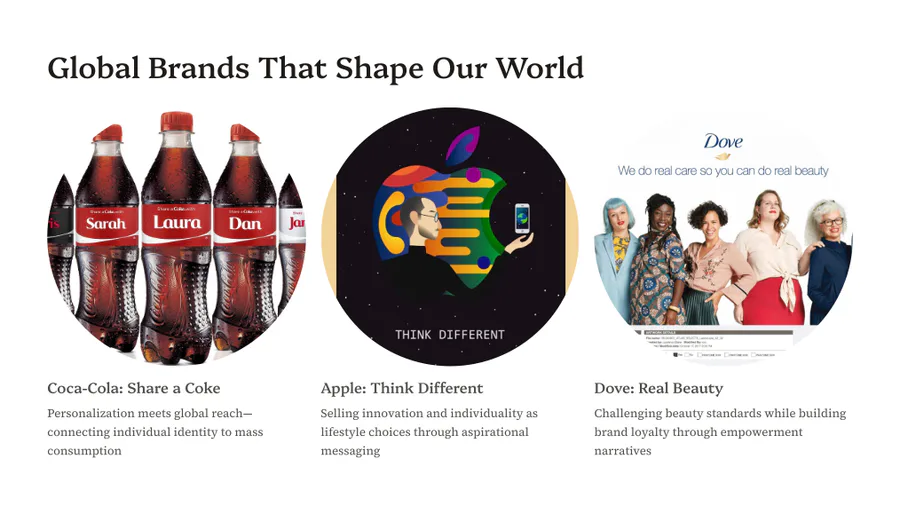
37

38
Multiple Choice
Which of the following emotions is most commonly targeted by global advertising campaigns to create brand connection?
Belonging
Fear
Anger
Confusion
39
We just explored how global ads sell emotions instead of just products. This next campaign takes that idea to another level — Dove isn’t just selling soap. It’s selling self-image. Let’s watch this short video and think about what emotion or identity Dove wants us to connect with the brand.
40
41
Follow-Up Discussion
How does Dove use emotion to connect to consumers — and what are they really asking women to “buy into”?
42
Multiple Choice
What was the key concept behind Dove’s “Choose Beautiful” campaign?
Encouraging women to buy Dove products through discounts
Empowering women to redefine how they see their own beauty
Showing professional models using Dove
Criticizing unrealistic beauty standards in other brands
43
Multiple Choice
How did Dove connect emotion and consumption in this ad?
By linking beauty to self-confidence rather than a physical product
By showcasing all their available skincare products
By focusing on product ingredients and price
By comparing Dove to other beauty brands
44
Multiple Choice
Why did Dove film this campaign in multiple countries like Shanghai, London, and São Paulo?
To show that beauty standards and self-esteem are universal issues
To compare which city had more Dove customers
To advertise regional Dove factories
To highlight cultural differences in buying habits
45
Poll
Do you think Dove’s “Choose Beautiful” campaign was authentic empowerment or emotional marketing?
Authentic empowerment that builds confidence
Clever emotional marketing strategy
A mix of both
Neither — just another ad
46
Poll
Would you say this campaign changed your perception of Dove as a brand?
Yes — it made the brand feel more positive and human
Somewhat — but I know it’s still marketing
No — I see it as just another ad
I’ve never thought about Dove differently
47
Emotional Branding and Shared Values
Emotional branding is when a company connects its product to feelings, values, or beliefs rather than just product features.
Instead of saying ‘Buy this soap, it’s moisturizing,’ Dove says ‘Choose to feel beautiful.’ The product becomes part of an emotional experience.
48
Emotional Branding and Shared Values
Emotional branding works because it appeals to values we already care about — like self-confidence, belonging, or empowerment.
When a brand mirrors our beliefs back to us, we begin to trust it. It feels like the company “gets” us or represents what we stand for.
49
Emotional Branding and Shared Values
Dove uses the shared value of self-acceptance. The campaign doesn’t tell women to buy soap; it tells them they deserve to feel beautiful.
That emotional alignment builds brand loyalty because consumers associate Dove with authenticity and care — even though the message still serves a commercial purpose.
50
Emotional Branding and Shared Values
If emotional branding is about trust and shared values, where’s the line between authentic connection and strategic manipulation? Can a company genuinely care about empowerment and still be selling something?
51

52

53
Multiple Choice
Which of the following best describes the concept of glocalization as presented in the lesson?
Maintaining a strictly global brand identity without local adaptation
Adapting products and messaging to local cultures while maintaining a global brand identity
Focusing only on local markets and ignoring global trends
Changing brand identity completely for each market
54

55
Multiple Choice
Which of the following are examples of glocalization in practice?
McDonald's India offering vegetarian options
Nike featuring local athletes in regional campaigns
KFC celebrating Lunar New Year in China
All of the above
56

57

58

59
60
Multiple Choice
What global message does Nike maintain in The Great Chase ad?
Competition and winning are the only goals
Determination and joy through movement
Traditional sports are more valuable than play
Fashion and status over performance
61
Multiple Choice
What tradition is the ad centered around?
The Dragon Dance competition
Gift exchange at weddings
Red envelope (hongbao) giving for Lunar New Year
Preparing family feasts
62
Multiple Choice
How does this ad represent glocalization?
It replaces all local culture with Western imagery
It uses a Chinese setting but keeps Nike’s global brand message
It ignores Nike’s global slogan
It only advertises traditional Chinese clothing
63
Poll
How did the ad make you feel about Nike as a global brand?
More relatable and culturally aware
Clever marketing, but still just advertising
I didn’t notice much difference
It felt forced or inauthentic
64
Poll
What do you think is the main emotion Nike wanted viewers to feel?
Guilt for not celebrating Lunar New Year
Joy and energy tied to family and play
Nostalgia for old traditions
Pride in owning Nike products
65
Cultural Adaptation
Nike keeps its global Just Do It message — about effort, movement, and drive — but reinterprets it through Chinese cultural traditions.
66
Cultural Adaptation
Local tradition: The ad centers on red envelopes (hongbao), a Chinese New Year custom where elders give money to younger relatives. The playful chase between the aunt and niece transforms this familiar ritual into a humorous game of pursuit.
67
Cultural Adaptation
Global message: Movement, sport, and perseverance — the core of Nike’s global brand — are reframed as part of a festive, family-oriented story.
Cultural design cues: Red color palette (symbolizing luck and prosperity), Lunar New Year decorations, and family gatherings root the ad in Chinese context.
68
Cultural Adaptation
Outcome: Nike shows cultural respect and connection without losing its global identity.
This is glocalization at work: Nike doesn’t just translate an English slogan — it translates values. The brand becomes emotionally relevant to Chinese audiences while still being unmistakably Nike.
69
Cultural Adaptation
Nike’s The Great Chase shows that glocalization isn’t about making every ad identical. It’s about making a global message feel local — so that audiences everywhere see themselves in the brand’s story.
70

71

72

73

74
75
Multiple Choice
What is the main message of Nike’s “You Can’t Stop Us” campaign?
Success only comes to professional athletes
Sports unite people across differences
Winning is more important than teamwork
Only elite players represent true strength
76
Multiple Choice
How does this ad reflect global advertising?
It shows local games in one region
It combines athletes and imagery from around the world
It focuses only on American sports
It uses humor instead of emotion
77
Multiple Choice
Which emotion does Nike primarily use to connect with its audience in this ad?
Fear and competition
Nostalgia and sadness
Inspiration and resilience
Surprise and humor
78
Poll
What do you think the phrase “You Can’t Stop Us” refers to most?
The athletes in the video
The Nike brand itself
The human spirit and collective perseverance
A specific sports team
79
The phrase "You Can't Stop Us" operates on multiple levels:
Athletic level: It speaks to perseverance — athletes refusing to give up despite challenges or setbacks.
Brand level: It reflects Nike’s identity as unstoppable — a brand built on innovation, motion, and momentum.
Human level: It connects to a universal message of resilience, unity, and collective strength, especially powerful in a global context (the ad was released during the pandemic).
80
"You Can't Stop Us"
Nike intentionally blurs these meanings so the viewer feels included in the “us.” Whether you’re an athlete, fan, or everyday person, you’re part of that unstoppable energy.
Key takeaway: The “us” creates an emotional sense of belonging — a hallmark of effective global advertising.
81
Poll
Does Nike’s focus on inclusion and resilience feel authentic or like strategic branding?
Authentic — it matches the brand’s long-term message
Strategic — it uses activism to sell products
A mix of both
Neither — it doesn’t connect emotionally
82
Key Takeaway
Emotional storytelling builds trust and loyalty, but it’s also a calculated brand strategy. Nike succeeds because it blurs the line between genuine inspiration and smart global marketing.
83

84
Multiple Select
What are two key strategies used by Coca-Cola's 'Open Happiness' campaign to adapt its message for different cultural contexts?
Universal theme of joy and connection
Integration of local festivals and traditions
Consistent brand colors
Focus on athletic perseverance
85
86
Multiple Choice
Why did the 1995 “Holidays Are Coming” ad resonate so strongly with global audiences?
It featured a new product launch
It used universal symbols of family, light, and celebration
It focused on Coca-Cola’s ingredients
It relied on celebrity endorsements
87
Poll
When you watch the 1995 ad today, what emotion stands out most?
Joy and Nostalgia
88
Advertising as Tradition
Coca-Cola blurred the line between brand and cultural ritual.
The ad didn’t just reflect holiday joy — it created it for consumers.
Emotional branding transforms consumption into a shared cultural experience.
89
90
Multiple Choice
What might Coca-Cola be trying to achieve by remaking its 1995 holiday ad with AI?
Reconnect with nostalgia while appearing modern and innovative
Completely replace human creativity in advertising
Save money by avoiding traditional filming
Distance itself from its original brand image
91
Poll
What was your immediate reaction to the AI remake?
It felt nostalgic and creative
It felt different — I’m not sure how
It felt off or less emotional
I didn’t feel much of anything
92
93
Multiple Choice
What was one of the main viewer reactions discussed in the segment?
People found the AI version uplifting and emotional
Many thought it was “creepy” or lacked holiday spirit
Audiences didn’t notice it was AI-generated
Fans said it was better than the original
94
Multiple Choice
What business reason did experts give for companies experimenting with AI ads?
To reduce costs and create more content efficiently
To win creative awards
To replace all marketing teams
To test new animation software
95
Multiple Choice
According to the segment, what effect did the AI ad have on Coca-Cola’s brand image?
It boosted trust among long-time fans
It confused viewers about what Coca-Cola stands for
It “fell flat” emotionally with consumers
It made the company appear more family-oriented
96
Multiple Choice
How does this story reflect a larger challenge for global advertisers?
Balancing innovation with the emotional authenticity audiences expect
Re-using classic campaigns without seeming repetitive or forced
Appealing to global nostalgia while using new technology responsibly
Both A and C
97
Poll
What part of the Today Show segment stood out to you the most?
The viewer backlash
The expert commentary on AI efficiency
The comparison to other brands using AI
Something else entirely
98
Poll
Do you think using AI makes a brand seem more modern or less authentic?
More modern
Less authentic
Both
Neither / depends on how it’s used
99
Multiple Choice
What insight about consumer culture does this controversy highlight?
People care more about efficiency than emotion
Consumers value emotional authenticity as part of brand trust
Viewers ignore how ads are made
Nostalgia no longer matters in marketing
100
Poll
After seeing both Coca-Cola ads (1995, AI remake) and the Today Show critique), what lesson stands out most to you?
Emotional branding still depends on humanity
AI will change how we define creativity
Nostalgia is powerful but hard to reproduce
All of the above
101

102
Fill in the Blanks

Apple's 'Shot on iPhone' campaign demonstrates glocalization by showcasing
103
104
Multiple Choice
What product feature is being highlighted in “Saving Simon”?
Camera quality and cinematic storytelling
Battery life for long video shoots
Siri voice commands
New iPhone color options
105
Multiple Choice
How does Apple connect emotion to technology in this ad?
By showing technology as cold and distant
By positioning the iPhone as a tool for capturing human moments
By focusing on product specifications and price
By showing the iPhone being used for work meetings
106
Multiple Choice
Why is the ad’s “Shot on iPhone” message significant?
It authenticates that everyday people can create cinematic stories
It means Apple outsourced filming to another brand
It suggests the ad was animated
It highlights Apple’s affordability
107
Poll
What feeling did the ad leave you with?
Warm and nostalgic
Inspired by creativity
Indifferent — just another ad
Unsure — not what I expected from Apple
108
Multiple Choice
What storytelling technique helps make this ad universal across cultures?
Humor and dialogue
Silence and visual emotion
Celebrity cameos
Text-based narration
109
Multiple Choice
How does “Saving Simon” reflect Apple’s global brand identity?
It emphasizes simplicity, emotion, and creativity
It shifts focus to corporate power and dominance
It rejects emotion in favor of logic
It promotes competition between users
110
Poll
How does Apple’s approach here differ from Coca-Cola’s AI remake?
Apple focuses on human emotion; Coca-Cola focuses on digital replication
Both rely entirely on nostalgia
Apple avoids showing products altogether
Coca-Cola’s feels more authentic
111

112
Multiple Choice
Which of the following is NOT a common assumption made in global advertising about the 'global consumer'?
Economic privilege
Western values
Rural lifestyles
Youth orientation
113

114
A Day in the Life of a Global Consumer
Think about your day from the moment you wake up to when you go to bed. How many of your choices — from what you eat, wear, watch, or post — are shaped by global brands, marketing, or cultural trends?
Let’s reflect on how global advertising influences our routines, values, and sense of identity.
115
Poll
What’s the first global brand you interact with when you wake up?
A tech brand (Apple, Samsung, etc.)
A food or drink brand (Starbucks, Dunkin’, etc.)
A clothing brand (Nike, Adidas, etc.)
Something else
116
A Day in the Life of a Global Consumer
Why do you think that brand became part of your morning routine — convenience, habit, or emotional connection?
117
Poll
How often do you make a purchase (online or offline) influenced by something you saw on social media?
Frequently
Sometimes
Rarely
Never
118
A Day in the Life of a Global Consumer
Think about emotional branding — do you buy because you need something, or because you connect with the story around it?
119
Poll
If you had to remove one global brand from your daily life, which would affect you the most?
My phone brand
My favorite food/drink brand
My favorite clothing or fashion brand
My favorite entertainment/streaming brand
120

121
Multiple Select
According to the key takeaways, which of the following are important considerations for analyzing global advertising?
Consumer culture is global
Glocalization balances global and local
Theory helps us analyze power
You have agency
122
Multiple Choice
What concept best explains why global brands feel familiar even across cultures?
Glocalization
Localization
Product placement
Exclusivity
123
Multiple Choice
How do brands influence consumer culture across different countries?
By shaping values and identities
By controlling government policies
By limiting access to products
By enforcing cultural traditions
Show answer
Auto Play
Slide 1 / 123
SLIDE
Similar Resources on Wayground

116 questions
AE 413 - MODULE 1
Presentation
•
University
117 questions
Carbohydrates
Presentation
•
University
120 questions
Teori Bahasa dan Literasi
Presentation
•
University
116 questions
Race and Ethnicity
Presentation
•
KG - University
114 questions
Science (Group 5)
Presentation
•
University
113 questions
Enterprise Architecture Frameworks and Practices
Presentation
•
University
112 questions
BBoL weeks 1-4
Presentation
•
University
112 questions
Work, Power, and Simple Machines
Presentation
•
12th Grade - University
Popular Resources on Wayground
10 questions
Safety Day 2026 – Student Review

Quiz
•
9th Grade
21 questions
Continents and Oceans
Quiz
•
6th Grade
20 questions
Parts of Speech
Quiz
•
5th Grade
16 questions
Subject & Predicate
Quiz
•
5th Grade
25 questions
Multiplication Facts
Quiz
•
5th Grade
12 questions
Map Skills
Quiz
•
3rd Grade
22 questions
Continents and Oceans
Quiz
•
5th Grade
15 questions
Rounding Decimals
Quiz
•
5th Grade
Discover more resources for English
20 questions
Disney Trivia
Quiz
•
University
10 questions
Spanish Greetings and Goodbyes!
Presentation
•
6th Grade - University
20 questions
Physical or Chemical Change/Phases
Quiz
•
8th Grade - University
39 questions
Unit 7 Key Terms
Quiz
•
11th Grade - University
25 questions
SER and Subject Pronouns
Quiz
•
8th Grade - University
38 questions
Unit 6 Key Terms
Quiz
•
11th Grade - University
19 questions
Key Concepts in Buddhism
Quiz
•
University
0 questions
Cell Domain Basic Review (Biology)
Quiz
•
University