
Study Guide: Transoceanic Connections (1450-1750)

Presentation
•
History
•
6th - 10th Grade
•
Practice Problem
•
Easy

Isiah Jones
Used 5+ times
FREE Resource
5 Slides • 11 Questions
1
World History Unit 3 Study Guide: Transoceanic Connections (1450-1750)
By Isiah Jones
2
Match
Match the following
Conquistador
Syncretism
Mercantilism
Mestizo
Encomienda System
Spanish conqueror motivated by Gold, God
Blending of indigenous and European cultures
Economic theory emphasizing trade and accumulation of wealth
Person of mixed Spanish and Indigenous ancestry
Labor system that granted colonists the right to demand tribute and labor
Spanish conqueror motivated by Gold, God
Blending of indigenous and European cultures
Economic theory emphasizing trade and accumulation of wealth
Person of mixed Spanish and Indigenous ancestry
Labor system that granted colonists the right to demand tribute and labor
3
Match
Match the following
Middle Passage
Joint-Stock Company
Plantation System
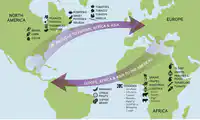
Triangular Trade
Forced transportation of enslaved Africans
A business model for colonial ventures
A system of large-scale agriculture
Trade route connecting Europe, Africa, and the Americas
Forced transportation of enslaved Africans
A business model for colonial ventures
A system of large-scale agriculture
Trade route connecting Europe, Africa, and the Americas
4
Open Ended
Based on your matching, which term do you think had the biggest impact? Turn and talk for 2 minutes.
5
🎯 Today's Objectives
SWBAT: Students Will Be Able To...
Review and organize key content for our Unit 3 test through collaborative study
Analyze primary sources using the HAP-P method
Develop evidence-based arguments for potential essay questions
Create a personalized study guide for efficient test preparation- quote or document providedPlease open a Google Doc and title it:
"Unit 3 Study Notes - [Your Name]"

6
📊 Test Breakdown
Total: 100 points
Time: 80 minutes
Section 1: Multiple Choice (60 pts)
20 questions × 3 points each
25 minutes
Vocabulary, cause/effect, document analysis
Section 2: Short Answer (15 pts)
3 questions × 5 points each
25 minutes
Primary source analysis - quote or document provided
Section 3: Long Essay (25 pts)
1 essay from 3 choices
30 minutes
Thesis + evidence + analysis required
⏰ Recommended Timing
0-25 min: Multiple Choice
25-50 min: Short Answer Questions
50-80 min: Long Essay
7
📖 Study These Readings
Religious Syncretism in Mexico City
Transatlantic Slave Trade
New Economic Systems
Race & Coerced Labor Parts I & II
Primary Source Accounts (slave narratives)
You can use Google and Ai to study
I have posted all of the documents in google classroom
8
Poll

Which part of HAPPY is most important for understanding this document?
Historical Context
Audience
Point of View (POV)
Purpose
9
Collaborative Study Guide (30 minutes)
DIRECTIONS:
Work with classmates or alone
Use your notes from the past month
Complete as much of the study guide as possible
Divide and conquer - split the work!
PRIORITY ORDER:
Vocabulary Matching (Part 1)
8 Test Questions (Yellow Section)
Fill-in-Blanks & Charts
Primary Source Practice
You can use Ai and Google
10
Multiple Choice
Cause/Effect: "What was the MAIN reason Europeans shifted from indigenous forced labor to African slavery?"
A) Indigenous peoples refused to convert to Christianity
B) Disease dramatically reduced indigenous populations
C) African workers were more skilled farmers
D) Spanish laws protected indigenous rights
11
Multiple Choice
Sourcing: "A Spanish merchant's account of profitable silver mines would likely emphasize which aspect?"
A) The wealth generated for Spain
B) The harsh conditions for indigenous workers
C) The harsh conditions for indigenous workers
D) The environmental damage caused
12
Multiple Choice
Comparison: "How did mercantilism DIFFER from capitalism in colonial economics?"
Mercantilism involved private companies, capitalism involved government control
Mercantilism emphasized free trade, capitalism emphasized controlled trade
Mercantilism benefited colonies, capitalism benefited European nations
Mercantilism focused on government wealth, capitalism focused on private profit
13
Open Ended

"Debate this statement: The Columbian Exchange benefited Europe more than it harmed the Americas. Support your position with TWO pieces of evidence."
14
Open Ended

"Which was a more powerful force in shaping colonial societies: religion or economics? Defend your choice with specific examples."
15
Open Ended
Exit Ticket: What is ONE historical connection you understand better after today's review? Explain.
16
Open Ended
Exit Ticket: What is ONE question you still have about transoceanic connections?
World History Unit 3 Study Guide: Transoceanic Connections (1450-1750)
By Isiah Jones
Show answer
Auto Play
Slide 1 / 16
SLIDE
Similar Resources on Wayground

11 questions
Would you rather ...
Presentation
•
6th - 8th Grade
12 questions
Scientific Method
Presentation
•
6th - 8th Grade
12 questions
Independent and Dependent Clauses
Presentation
•
6th - 12th Grade
10 questions
Tables and Graphs
Presentation
•
6th - 8th Grade
14 questions
La Apariencia
Presentation
•
KG
11 questions
Northwest Ordinance of 1787
Presentation
•
6th - 8th Grade
11 questions
3.2 Written Works
Presentation
•
10th Grade
13 questions
Grade 8th-2.pdf
Presentation
•
KG
Popular Resources on Wayground
10 questions
Safety Day 2026 – Student Review

Quiz
•
9th Grade
21 questions
Continents and Oceans
Quiz
•
6th Grade
20 questions
Parts of Speech
Quiz
•
5th Grade
16 questions
Subject & Predicate
Quiz
•
5th Grade
25 questions
Multiplication Facts
Quiz
•
5th Grade
12 questions
Map Skills
Quiz
•
3rd Grade
22 questions
Continents and Oceans
Quiz
•
5th Grade
15 questions
Rounding Decimals
Quiz
•
5th Grade
Discover more resources for History
15 questions
Unit 3 - Part 1 Road to Revolution
Quiz
•
8th Grade
25 questions
WWII Assessment
Quiz
•
8th Grade
25 questions
The American Revolution
Quiz
•
7th - 10th Grade
15 questions
The Bill of Rights
Quiz
•
8th - 12th Grade
18 questions
American Revolution Review
Quiz
•
8th Grade
14 questions
Weekly Wrap Up #3: CE.1a/e -Fundamental Principles
Quiz
•
8th Grade
6 questions
District Assessment Review #1
Quiz
•
6th Grade
30 questions
Foundations of Gov. Test Review
Quiz
•
7th Grade