

The Trearty Of Versailles

Presentation
•
History
•
12th Grade
•
Practice Problem
•
Easy

Sajida Manzoor undefined
Used 5+ times
FREE Resource
11 Slides • 7 Questions
1
Lesson 5:
Topic: The Treaty of Versailles — “A Peace Built on Quicksand”
By Sajida Manzoor
2
Open Ended
Why did you choose your answer?
What do you already know about the Treaty’s terms that supports your view?
Do you think “fair” means the same as “effective” in this case?
3
Poll
“If you were one of the ‘Big Three,’ what would your goal be at Versailles?”
Punish Germany
Rebuild Europe’s economy
Create lasting peace
Protect your own country’s interests
4
I CAN
1. Evaluate: Judge how fair and effective the Treaty of Versailles was.
2. Produce my own conclusion on whether the Treaty built peace or future conflict
5
Poll
“The Treaty of Versailles was a fair punishment for Germany after World War I.”
Strongly Agree
Agree
Disagree
Strongly Disagree
6
Multiple Choice
The Treaty of Versailles officially ended which major war?
WWII
WWI
Cold War
The Napoleonic War
7
Multiple Choice
How did the Treaty of Versailles affect Germany’s military power?
It allowed Germany to rebuild a stronger navy
It limited the German army to 100,000 soldiers
It required Germany to form new alliances
It expanded Germany’s control in Europe
8
Multiple Choice
Which statement best explains why the Treaty of Versailles caused resentment in Germany?
It rewarded Germany for helping rebuild Europe
It made Germany join the League of Nations
It blamed Germany for the war and imposed harsh penalties
It ignored Germany’s colonies and focused only on trade
9
Background • WWI ended Nov 1918; 8.5 million dead, Europe in ruins. • Germany surrendered, expecting a peace based on Wilson’s “14 Points.” Leader Country Main Aims Georges Clemenceau France Revenge, security, weaken Germany permanently. Woodrow Wilson USA Fair peace, League of Nations, self-determination. David Lloyd George Britain Punish but keep Germany strong enough for trade and to stop communism.
10
Key Terms of the Treaty :
1. War Guilt (Article 231): Germany accepted full blame for WWI.
2. Reparations: £6.6 billion to Allies.
3. Territorial Losses: Alsace-Lorraine to France; colonies to League; Polish Corridor created.
4. Military Restrictions: 100,000 men, no air force, 6 ships, no submarines.
5. League of Nations: Created to prevent future wars. Reactions
• Germany: Outrage, humiliation, called it a “Diktat.”
• France: Relief but thought it wasn’t harsh enough.
• USA: Thought it was too severe; Congress refused to join the League. Historians’ Debate
• John Maynard Keynes: “The treaty will ruin Europe.”
• Marshal Foch: “Not peace, but an armistice for twenty years.”
• Modern historians: “A flawed compromise—punishment disguised as peace.”
11

12
Reactions to the Treaty
• Germany: outrage, humiliation ('Diktat').
• France: relief, wanted harsher terms.
• Britain: mixed feelings.
• USA: thought it was too harsh.
13
14
Extract A: 'Germany must accept full responsibility for the war.'
Extract B: German Newspaper (1919): 'The Fatherland is dishonored!'
Extract C: Lloyd George (1919): 'We want a peace which will last.'
15
Group 1 (Outstanding Students): |
Write a mini argument: “The Treaty of Versailles achieved peace through punishment.” Use Extracts A, B, and C to support your points. | |
Group 2 (On-Level Students): | Write a short statement (6–8 sentences) from one of the Big Three’s perspectives using Extracts A & C. End with a 1–5 fairness rating. | |
Group 3 (Struggling Students): |
| |
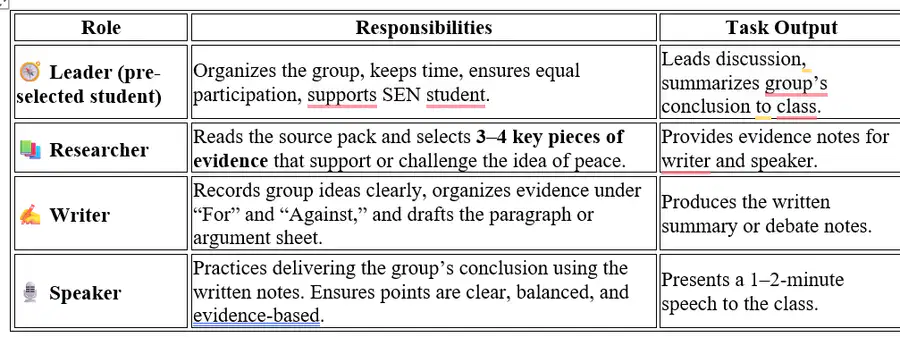
Gifted & Talented Jasim Ebrahim Jasim Boausaibah Al Ali | Lead group discussion, time-keep, and prepare summary of class opinions to report at the end |
16
Task 1: Mini Argument Prompt: “The Treaty of Versailles achieved peace through punishment.” Use Extracts A, B, and C to support your points. Before writing:
While writing: After writing: |
|---|
17
Task 2: Big Three Perspective Statement Prompt:
Write a short statement (6–8 sentences) from one of the Big Three’s perspectives using Extracts A & C. End with a fairness rating (1–5).
Before writing:
Which leader are we choosing — Wilson, Clemenceau, or Lloyd George? What did that leader want from the Treaty?
While writing:
3. Does our writing sound like what that leader would say?
4. Are we using words or ideas from the extracts to support their viewpoint?
After writing:
5. Why did we give that fairness rating?
6. Would the other leaders agree or disagree with our rating — why? 7. What helped us understand that leader’s feelings about fairness the most?
18
Open Ended
“The Treaty of Versailles was fair/unfair because…”
Lesson 5:
Topic: The Treaty of Versailles — “A Peace Built on Quicksand”
By Sajida Manzoor
Show answer
Auto Play
Slide 1 / 18
SLIDE
Similar Resources on Wayground

12 questions
Geometry - Lesson Area of Circle Sector and Length of Arc
Presentation
•
12th Grade
15 questions
APPLICATION LETTER
Presentation
•
12th Grade
11 questions
Reading tips
Presentation
•
12th Grade
13 questions
The Restored Republic
Presentation
•
12th Grade
15 questions
digestive system
Presentation
•
12th Grade
15 questions
The Rise of Dictators Pt. 2: Japan
Presentation
•
12th Grade
16 questions
The Theory of Evolution
Presentation
•
8th Grade
13 questions
Satire
Presentation
•
12th Grade
Popular Resources on Wayground
10 questions
Safety Day 2026 – Student Review

Quiz
•
9th Grade
21 questions
Continents and Oceans
Quiz
•
6th Grade
20 questions
Parts of Speech
Quiz
•
5th Grade
16 questions
Subject & Predicate
Quiz
•
5th Grade
25 questions
Multiplication Facts
Quiz
•
5th Grade
12 questions
Map Skills
Quiz
•
3rd Grade
22 questions
Continents and Oceans
Quiz
•
5th Grade
15 questions
Rounding Decimals
Quiz
•
5th Grade