

Kinetic Molecular Theory

Presentation
•
Science
•
8th Grade
•
Practice Problem
•
Easy
+4
Standards-aligned

Amy Kramer
Used 29+ times
FREE Resource
13 Slides • 17 Questions
1

The Kinetic Theory of Matter
2


3
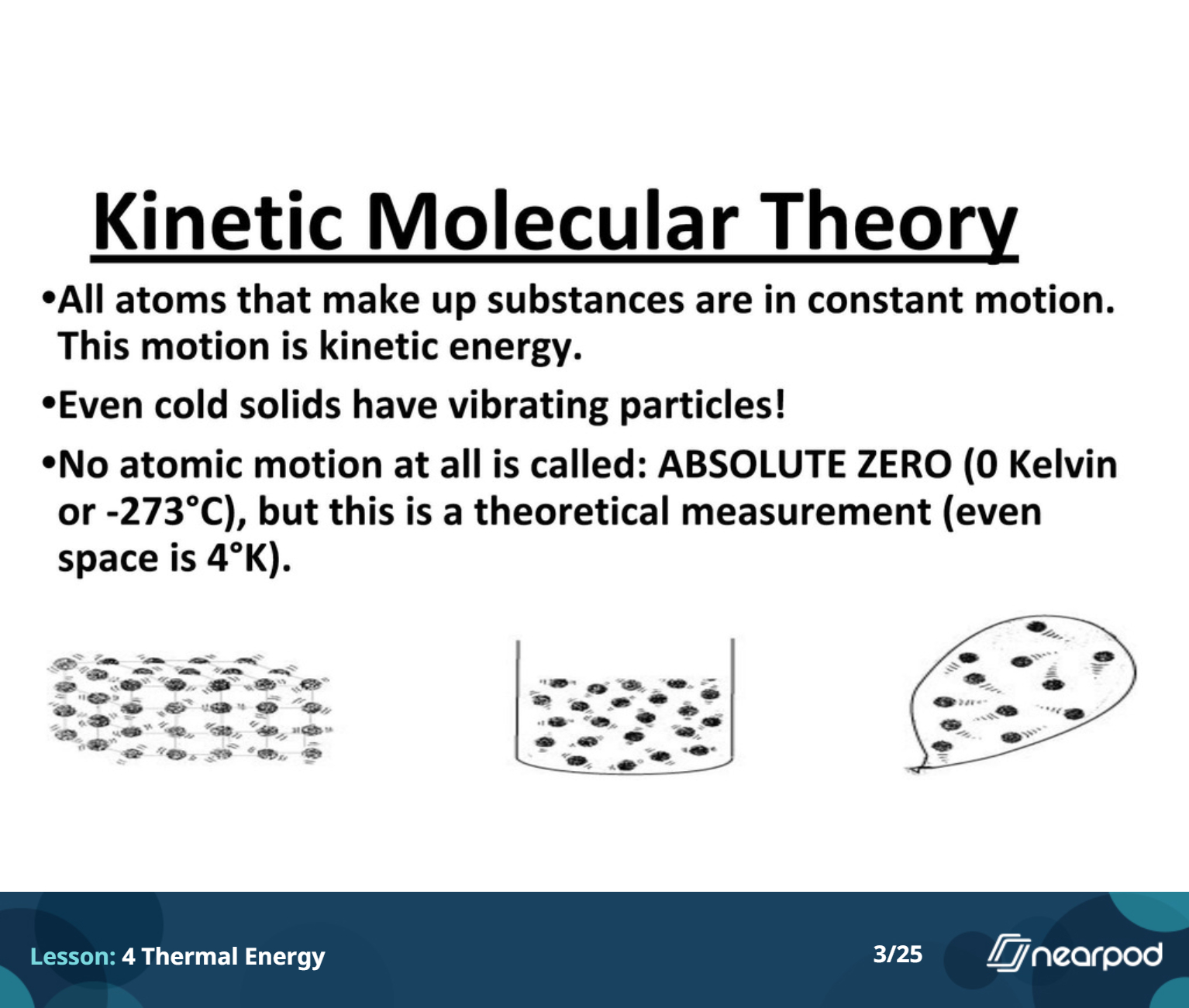

4
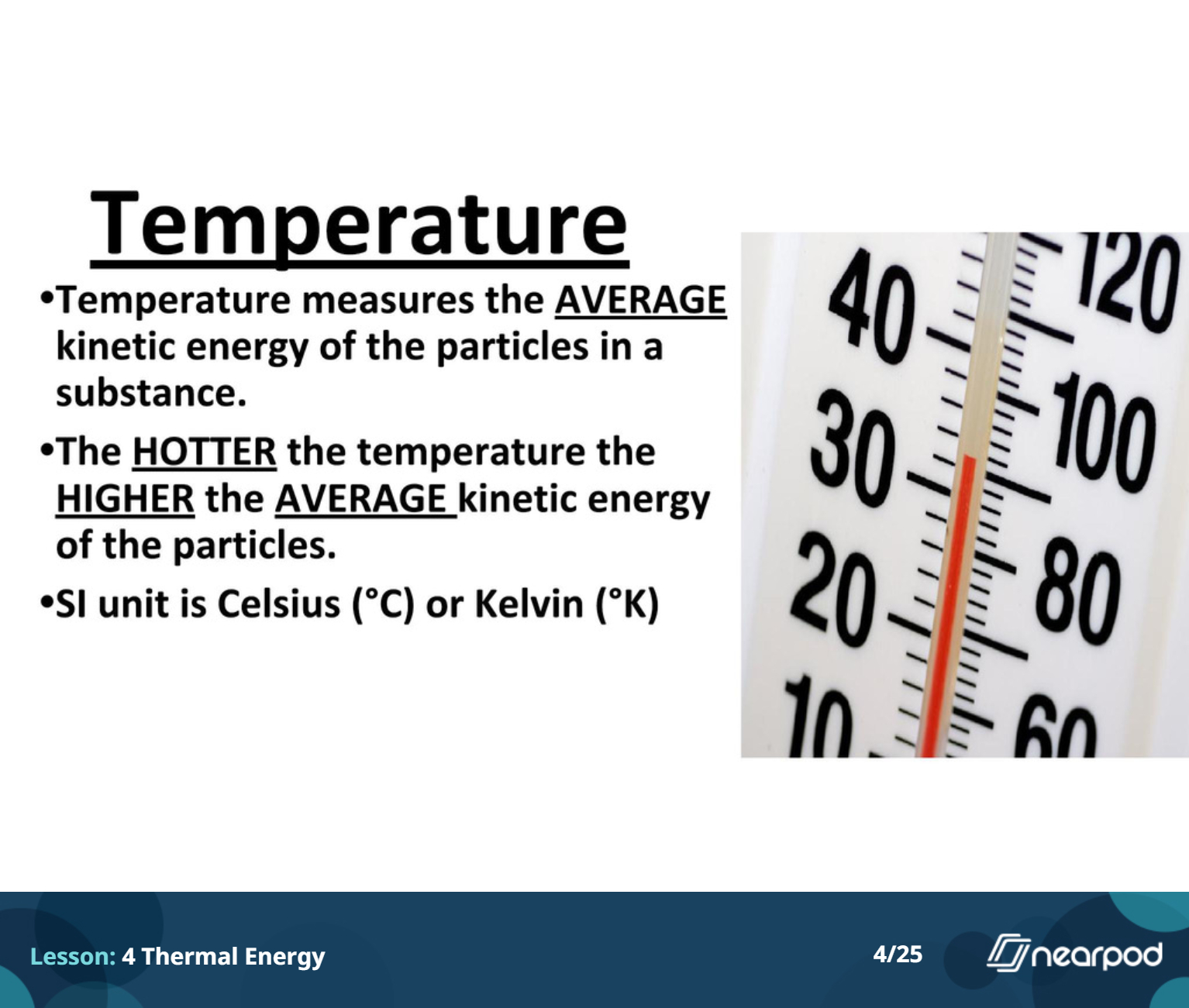

5
Draw
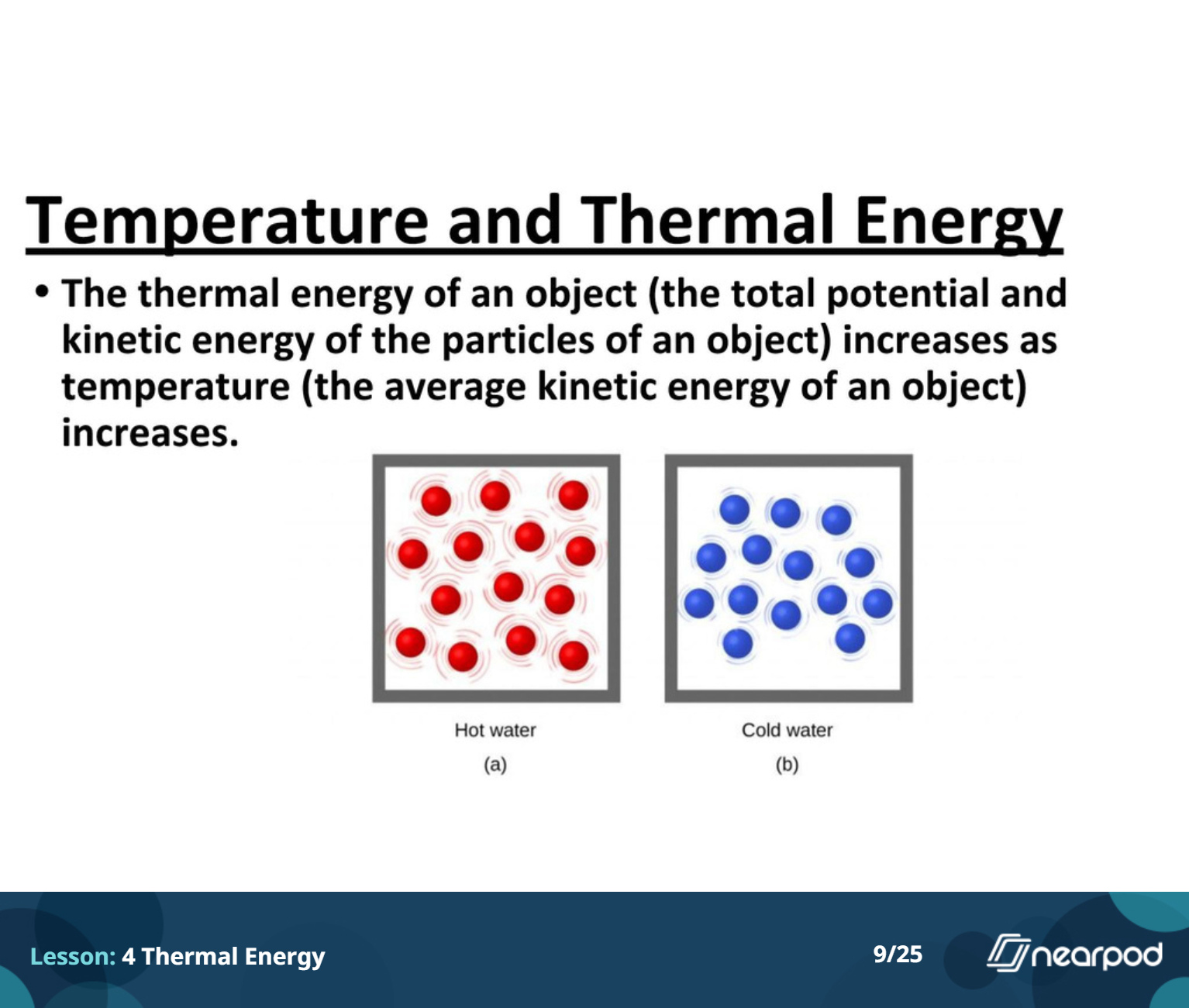
Which of the pictures shows molecules at a hotter temperature?
6
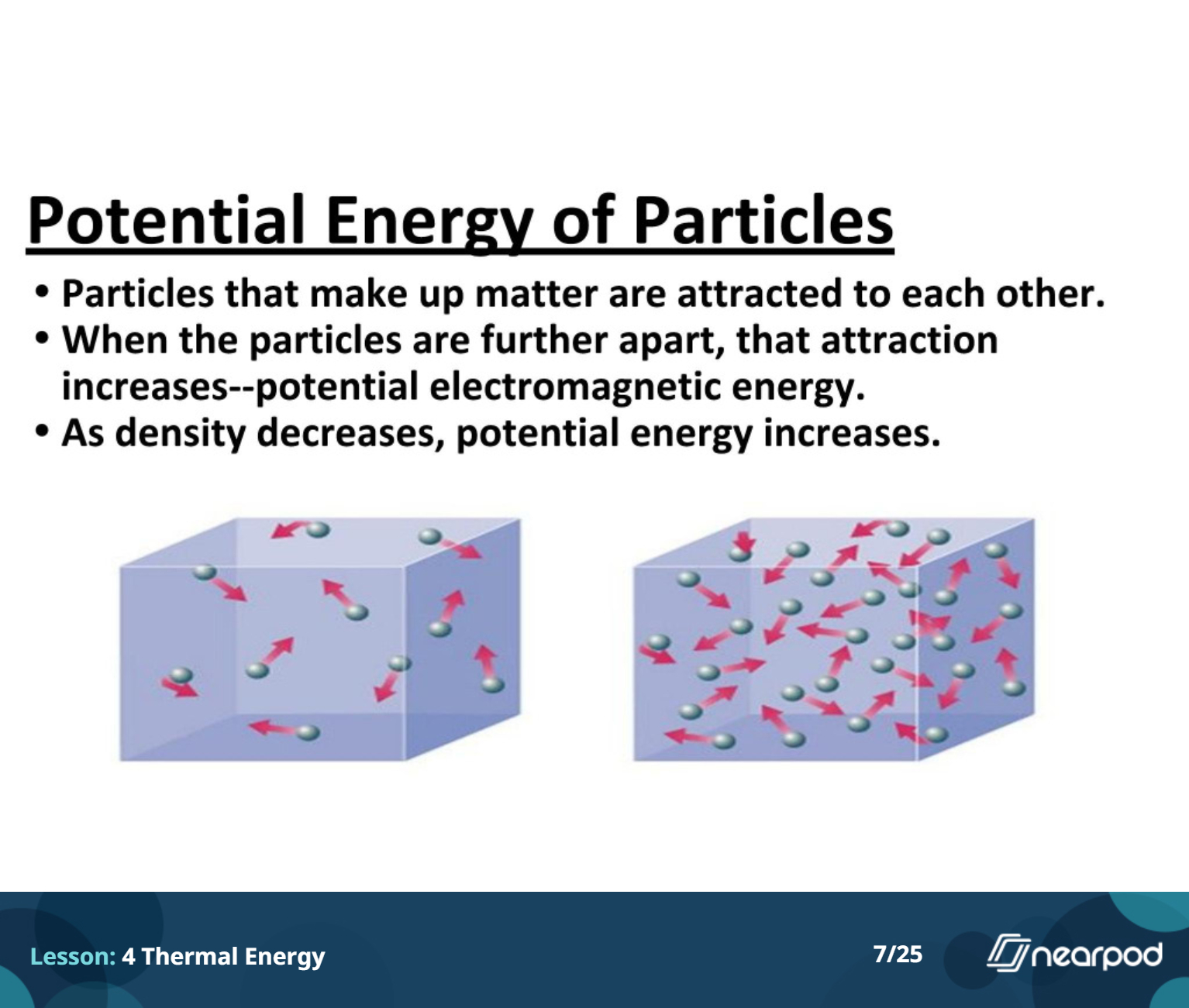

7
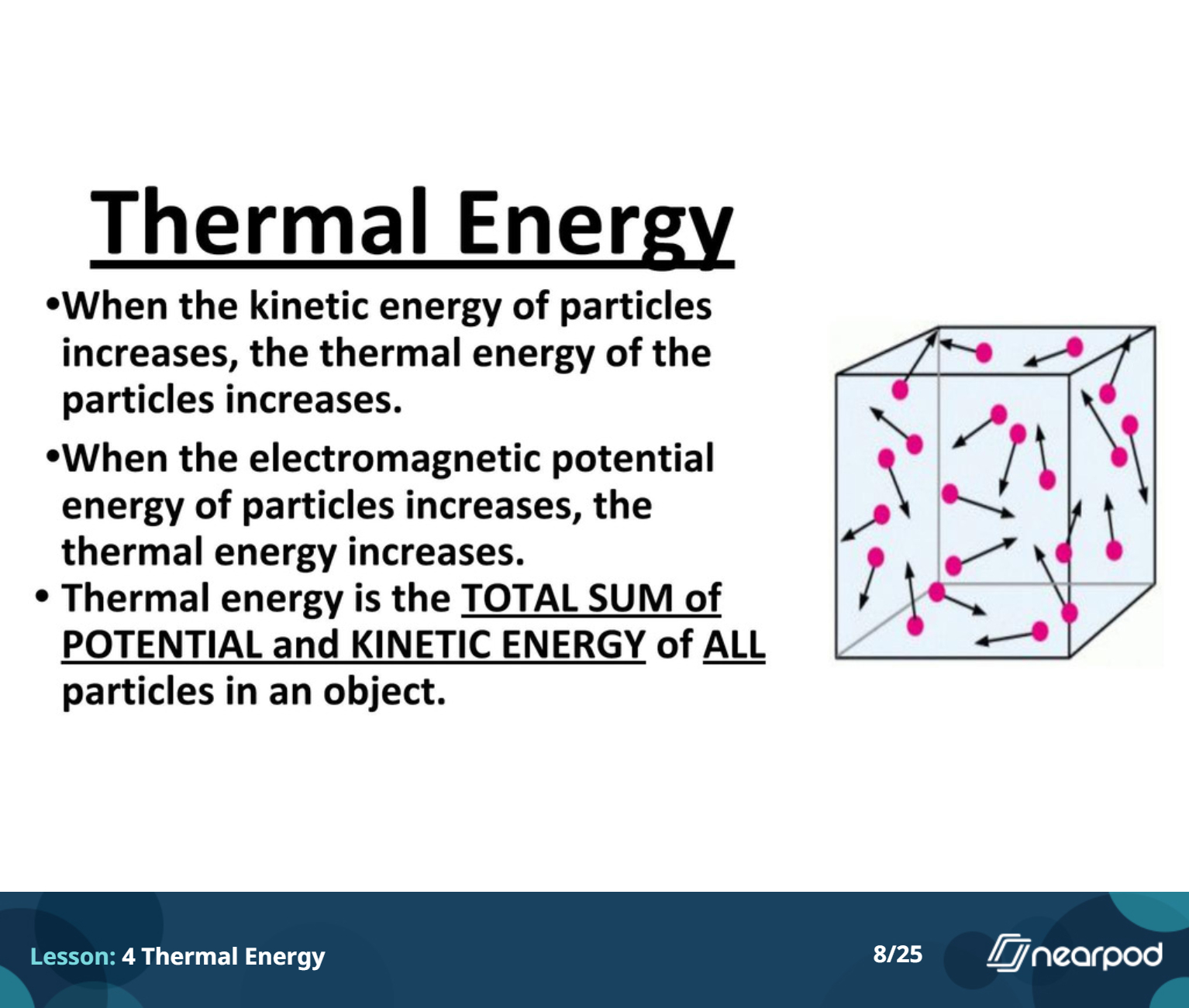
When mutually attracting particles are far apart, their potential energy is higher because work must be done to pull them farther apart against their attractive force. This energy is stored as potential energy in the system.

Why do particles far apart have more potential energy?
8

9

10

11
Multiple Choice
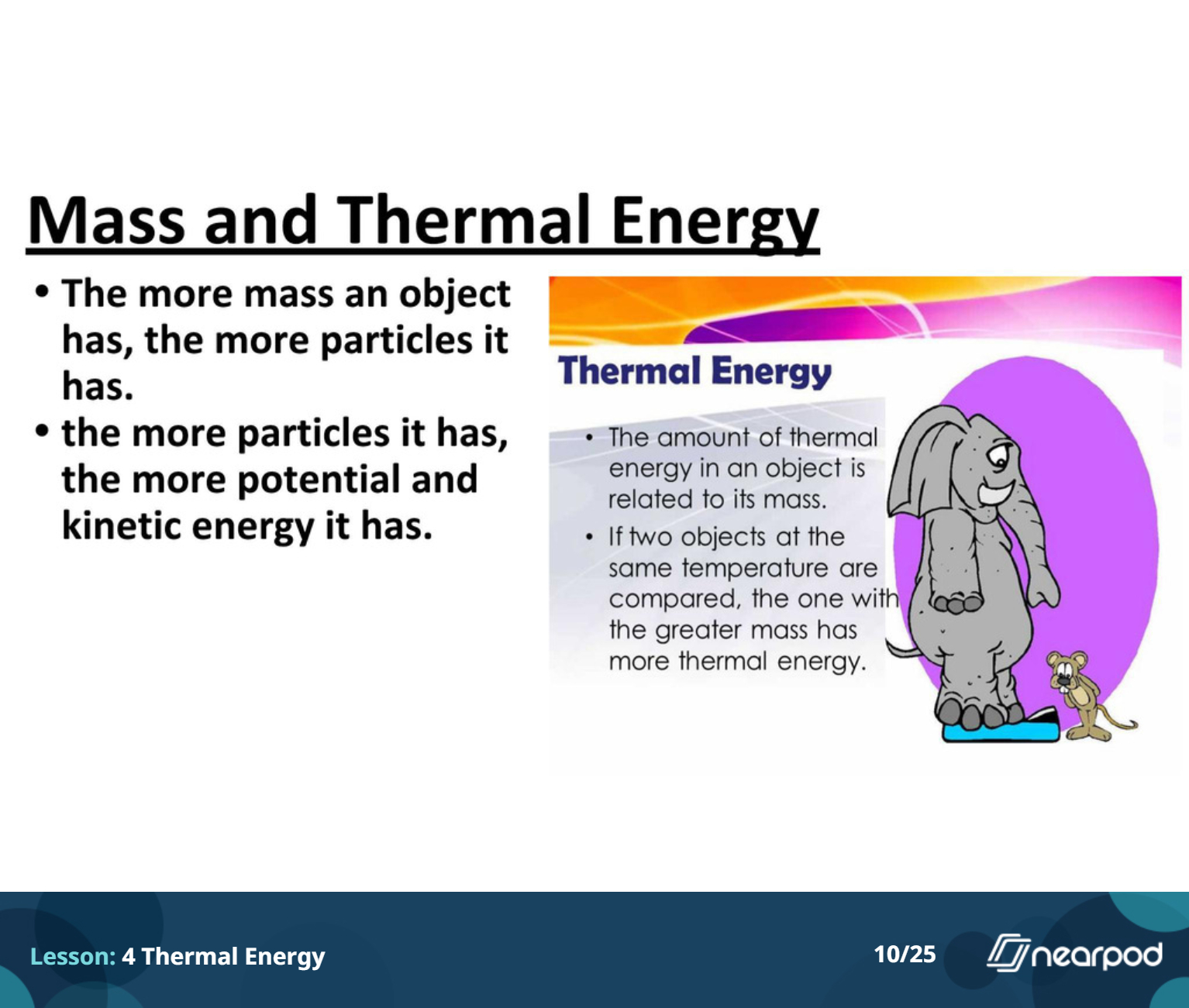
How does the mass of an object affect its thermal energy?
Objects with more mass have more thermal energy if temperature is the same.
Objects with less mass have more thermal energy if temperature is the same.
Mass does not affect thermal energy.
Thermal energy only depends on temperature, not mass.
12

13
Open Ended
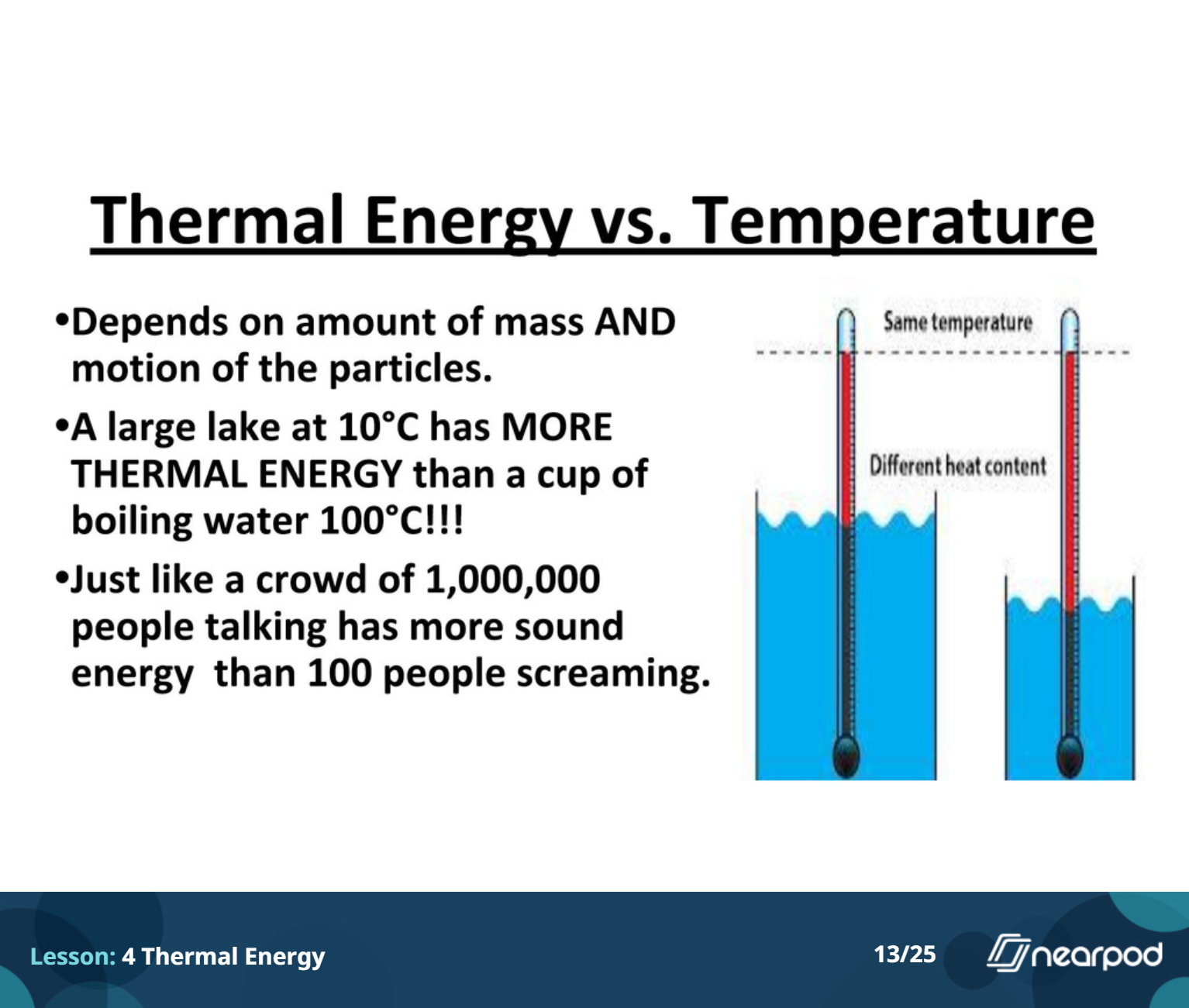
In your own words, differentiate temperature and thermal energy.
14

15
Multiple Choice
Which of the following best explains the significance of the kinetic theory of matter in understanding thermal energy?
It describes how matter changes state due to chemical reactions.
It explains how the movement of particles relates to temperature and energy.
It focuses on the gravitational force between molecules.
It is only relevant for solids and not for liquids or gases.
16

17

18
Match
Match the following terms with their definitions:
Average Kinetic Energy
Total Potential and Kinetic Energy
Energy transferring from hot to cold
Molecules are always in random motion
The amount of heat needed to increase 1 degree Celsius
Temperature
Thermal Energy
Heat
Kinetic Molecular Theory
Specific Heat
Temperature
Thermal Energy
Heat
Kinetic Molecular Theory
Specific Heat
19
Multiple Choice
Which of the following statements best describes the kinetic molecular theory?
All atoms are at rest in a solid state.
Atoms in substances are in constant motion.
Atoms only move when heated above 0°C.
Atoms stop moving at room temperature.
20
Multiple Choice
How does temperature relate to the kinetic energy of particles in a substance?
Temperature measures the total energy of the particles.
Temperature measures the average kinetic energy of the particles.
Temperature measures the potential energy of the particles.
Temperature only measures energy in solids.
21
Fill in the Blanks
22
Multiple Select
Which of the following factors contribute to an increase in the thermal energy of a substance?
Increase in kinetic energy of particles
Increase in electromagnetic potential energy of particles
Decrease in the number of particles
Both increase in kinetic and potential energy of particles
23
Multiple Choice

Which material would need the most heat to raise its temperature? (Use the chart)
solid water
liquid water
Tin
Mercury
Lead
24
Multiple Choice
Which of the following statements best explains the relationship between temperature and thermal energy?
Thermal energy increases as temperature increases because particles move faster.
Thermal energy decreases as temperature increases because particles move slower.
Temperature and thermal energy are not related.
Thermal energy is only affected by the motion of the particles.
25
Multiple Select
Which of the following are true about thermal energy?
It depends on both mass and temperature.
A large object at low temperature can have more thermal energy than a small object at high temperature.
Thermal energy is the same as temperature.
Thermal energy only depends on the speed of particles.
26
Multiple Choice
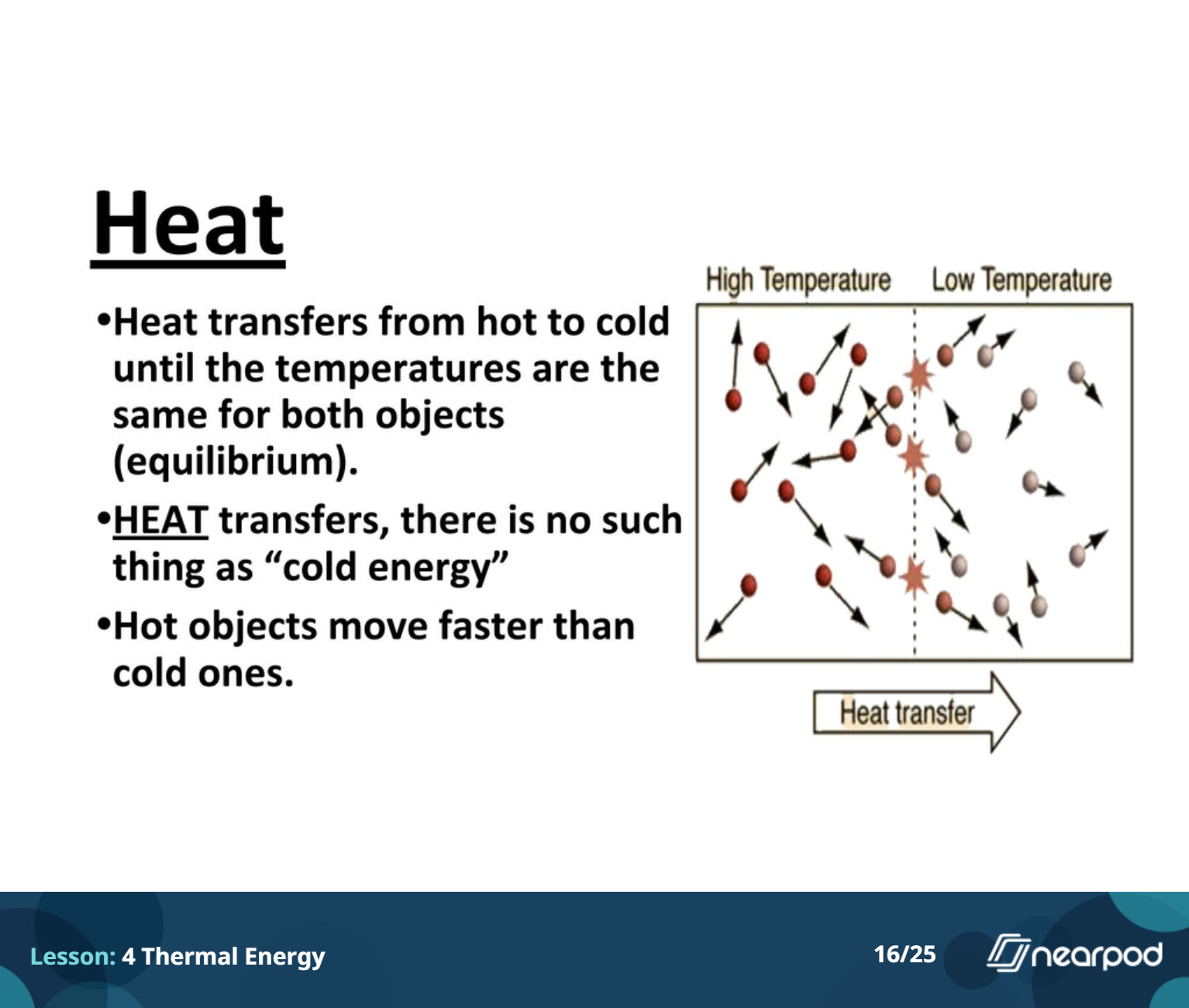
Which statement best describes how heat transfers between objects of different temperatures?
Heat transfers from hot to cold until both objects reach the same temperature.
Heat transfers from cold to hot until both objects reach the same temperature.
Heat transfers only if both objects are made of the same material.
Heat transfers only if both objects are at equilibrium.
27
Multiple Choice
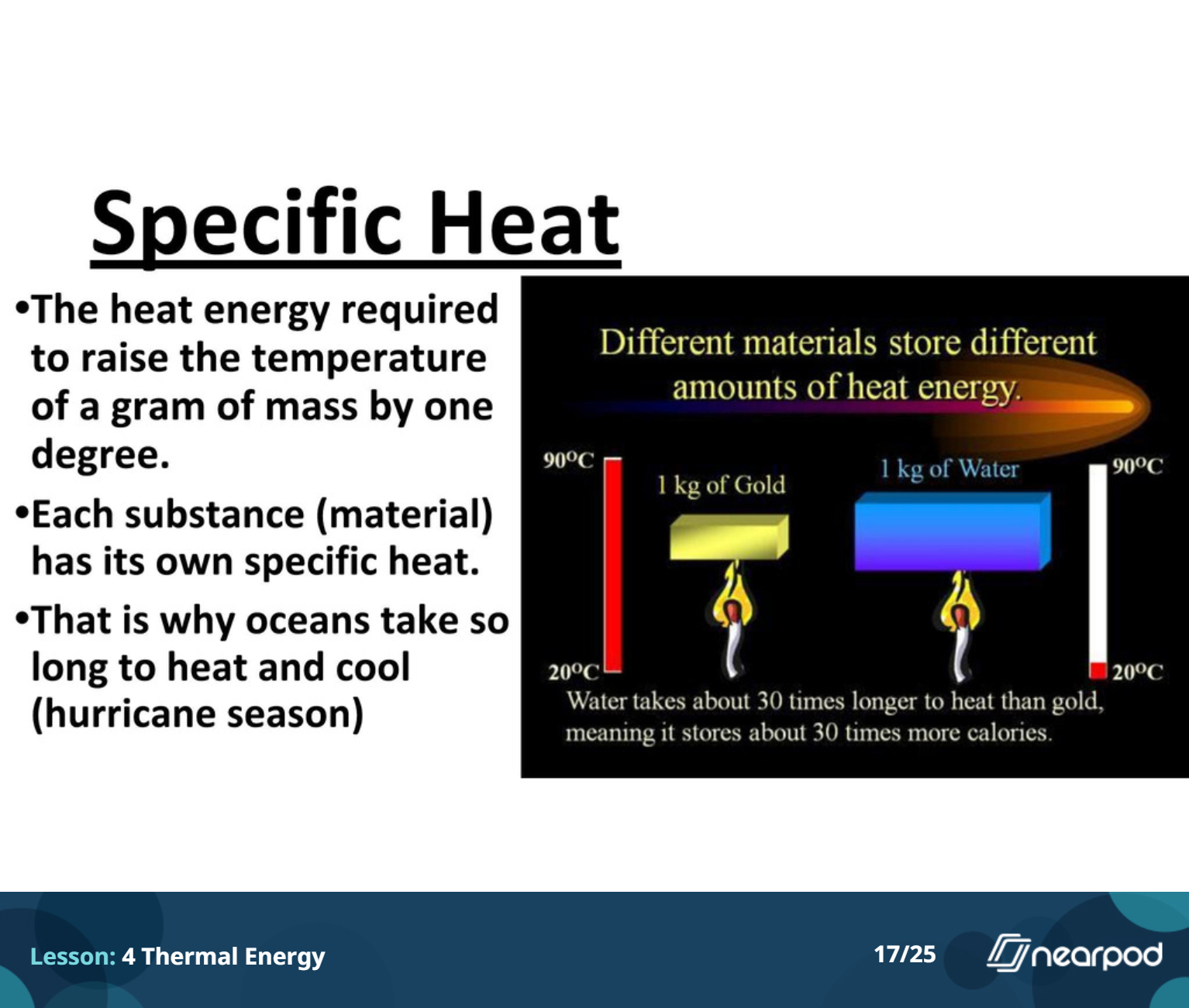
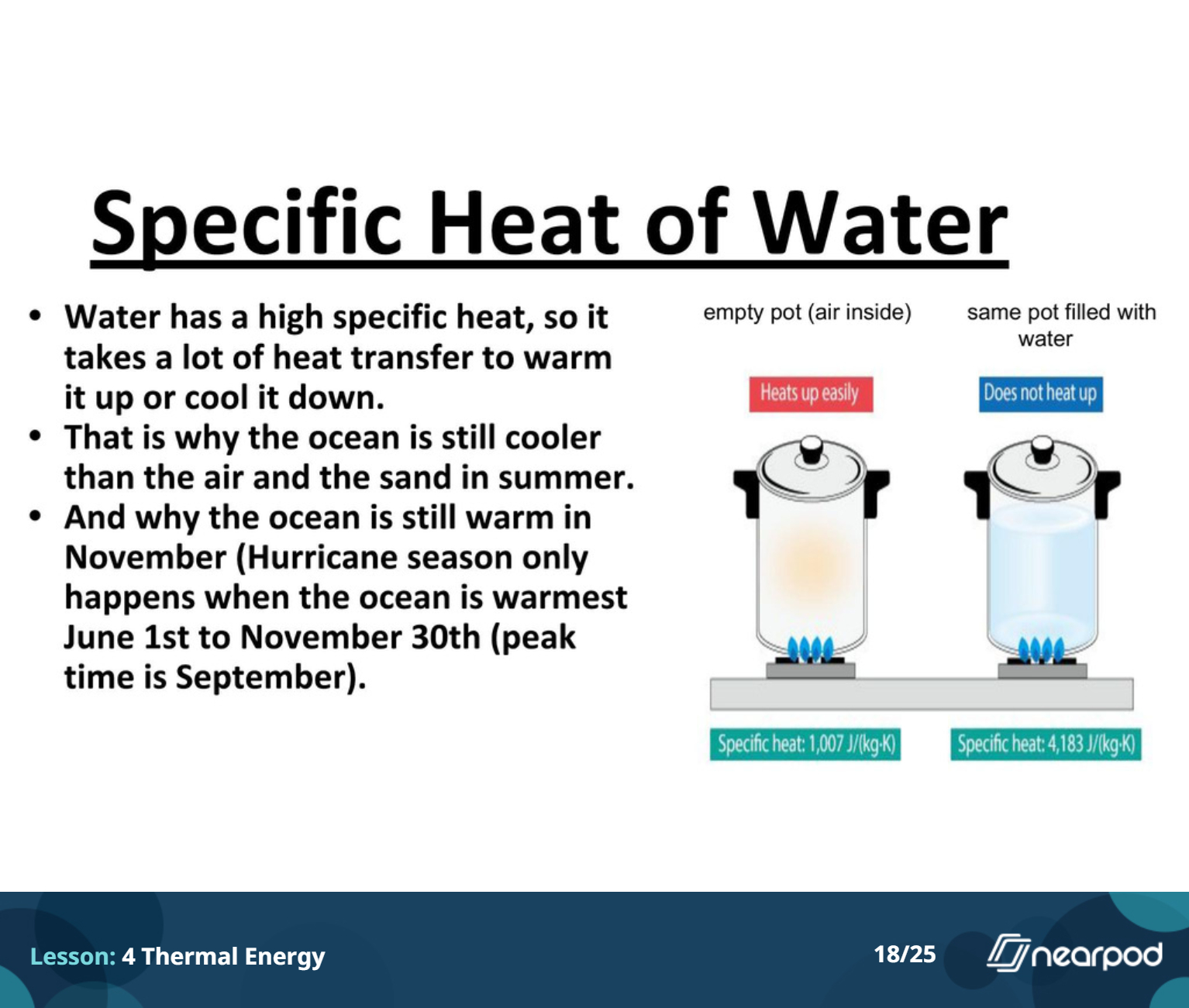
Why does water take longer to heat up compared to gold when the same amount of heat is applied?
Water has a higher specific heat than gold.
Gold has a higher specific heat than water.
Water and gold have the same specific heat.
Water is a better conductor of heat than gold.
28
Multiple Select
Which of the following statements about specific heat is/are correct?
Each material has its own specific heat.
Specific heat is the heat energy required to raise the temperature of a gram of mass by one degree.
Oceans take longer to heat and cool because of their specific heat.
All materials store the same amount of heat energy.
29
Multiple Choice
How is temperature different from thermal energy?
temperature is the kinetic energy, thermal energy is the potential energy
temperature is how hot something is, and thermal energy is the amount of heat something has
temperature is the average kinetic energy of an object, thermal energy is the total energy of an object
temperature and thermal energy are the same thing
30
Multiple Choice
Which of the following has more thermal energy?
a pool at 80 degrees celsius
an ocean at 80 degrees celsius
The Kinetic Theory of Matter
Show answer
Auto Play
Slide 1 / 30
SLIDE
Similar Resources on Wayground

24 questions
Notes: Eclipses and Seasons
Presentation
•
8th Grade
26 questions
Rotation and Revolution
Presentation
•
8th Grade
21 questions
Specific heat Capacity
Presentation
•
8th Grade
24 questions
7.8C Watershed
Presentation
•
7th - 8th Grade
24 questions
Classification of matter
Presentation
•
8th Grade
25 questions
Atomic Structure Lesson
Presentation
•
8th Grade
21 questions
Solar System Vocabulary
Presentation
•
8th Grade
21 questions
Net Force Review
Presentation
•
8th Grade
Popular Resources on Wayground
20 questions
"What is the question asking??" Grades 3-5

Quiz
•
1st - 5th Grade
20 questions
“What is the question asking??” Grades 6-8
Quiz
•
6th - 8th Grade
10 questions
Fire Safety Quiz
Quiz
•
12th Grade
20 questions
Equivalent Fractions
Quiz
•
3rd Grade
34 questions
STAAR Review 6th - 8th grade Reading Part 1
Quiz
•
6th - 8th Grade
20 questions
“What is the question asking??” English I-II
Quiz
•
9th - 12th Grade
20 questions
Main Idea and Details
Quiz
•
5th Grade
47 questions
8th Grade Reading STAAR Ultimate Review!
Quiz
•
8th Grade
Discover more resources for Science
20 questions
8th Grade Science STAAR Review
Quiz
•
8th Grade
8 questions
Amoeba Sister Asexual vs Sexual Reproduction

Interactive video
•
8th Grade
19 questions
Introduction to Properties of Waves
Presentation
•
6th - 8th Grade
16 questions
Interactions within Ecosystems
Presentation
•
6th - 8th Grade
46 questions
8th Science STAAR Review
Quiz
•
8th Grade
15 questions
Symbiotic Relationships
Quiz
•
6th - 8th Grade
10 questions
Food Chain and Food Web
Quiz
•
8th Grade
24 questions
8th grade Science STAAR Review
Quiz
•
8th Grade