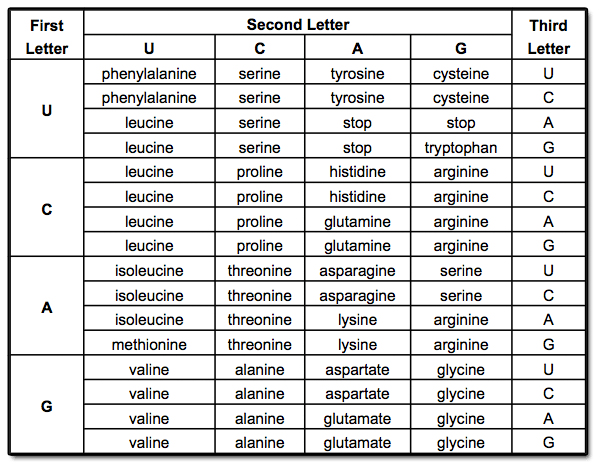
Protein Synthesis and Codon Chart Notes
Presentation
•
Science
•
9th - 12th Grade
•
Medium
+1
Standards-aligned
Rebecca Parchman-Hitch
Used 9+ times
FREE Resource
8 Slides • 41 Questions
1
2
Multiple Choice
mRNA is made from what?
proteins
DNA
mitochondria
Sugar
3
Multiple Choice
Segments of DNA are called _______________________
Genes
Alleles
Traits
Chromosomes
4
Multiple Choice
Why is DNA important?
it is very small and very complicated
it's in everything
it serves as the blueprint for traits of all living things
because we eat it every day for energy
5
Multiple Choice
6
7
Multiple Choice
Transcription goes from:
DNA to DNA
DNA to Protein
DNA to RNA
None of the above
8
Multiple Choice
What is the goal of the central dogma?
To create DNA
To create RNA
To create proteins
9
Multiple Choice
Which term describes the process of taking the genetic information from mRNA and creating an amino acid chain to form proteins?
DNA replication
Transcription
Translation
10
Multiple Choice
11
12
Multiple Choice
13
Multiple Choice
Which of the following enzymes is needed for Transcription?
Helicase
DNA Polymeras
RNA Polymerase
Ligase
Topoisomerase
14
Multiple Choice
15
Multiple Choice
During transcription which of the following does NOT happen?
16
Multiple Choice
17
Multiple Select
During TRANSCRIPTION, as the DNA is being read which nucleotides are being used to build the RNA? (mark all that apply)
Adenine
Thymine
Cytosine
Guanine
Uracil
18
Multiple Choice
Which RNA carries the message from the DNA molecule out of the nucleus?
mRNA
rRNA
tRNA
19
Multiple Choice
20
Multiple Choice
Transcription is a process that in eukaryotic cells takes place in the:
Nucleus
Cytoplasm
Golgi Apparatus
Rough E.R.
21
22
Multiple Choice
What is the purpose of the process of translation and where does it occur?
to synthesize amino acids in the nucleus
to produce a specific sequence of amino acids in the ribosome
to replicate the DNA of an organism in the ribosome
23
Multiple Choice
What is the job of tRNA?
assembles amino acids
transfers the message from the genetic code
transfers the amino acids to the ribosome
24
Multiple Choice
Where does tRNA bring an amino acid to?
nucleus
ribosome
rough endoplasmic reticulum
Golgi apparatus
25
Multiple Choice
26
Multiple Choice
What is the function of ribosomes in protein synthesis?
To replicate DNA
To synthesize lipids
To synthesize proteins
To modify proteins
27
Multiple Choice
What is the job of rRNA?
28
Multiple Choice
What process is going on in this photo?
Transcription
Translation
Replication
All the above
29
Dropdown
1=
2=
4=
7=
30
Multiple Choice
31
Multiple Choice
TGGCAAGTACGT
32
Multiple Choice
If a strand of DNA had bases in the following order - ATCCGTC, what would be the transcribed mRNA sequence?
TAGGCAG
UAGGCAG
TUGGCUG
None of the above are correct
33
Multiple Choice
ATG GGA ACT CCA
34
Multiple Choice
What ensures that the correct amino acid is added to the growing polypeptide chain during translation?
The matching of the tRNA anticodon with the mRNA codon
The sequence of DNA
The size of the ribosome
The type of amino acid
35
Multiple Choice
How many nucleotides equal make up a codon?
1
2
3
4
36
37
By Rebecca Parchman-Hitch
38
39
Multiple Choice
(Practice) CAC Codes for ________
histidine
proline
valine
40
Multiple Choice
(Practice) UCC Codes for ________
histidine
threonine
serine
41
Multiple Choice
What is the role of the start codon in protein synthesis?
It signals the ribosome to stop translation.
It adds the first amino acid in the protein chain.
It signals the ribosome to begin translation.
It marks the site of DNA replication.
42
Multiple Choice
(Practice) ACG Codes for ________
histidine
threonine
valine
43
44
Multiple Choice
Which of the following is a codon?
ATC
A
AUC
AU
45
Multiple Choice
How many codons equals 1 amino acid?
1
2
3
4
46
Multiple Choice
How do know when to STOP translating a strand of mRNA?
you don't
stop at the end of the strand
when Metz tells you to
the codon will read STOP on the codon chart
47
Multiple Choice
48
Multiple Choice
49
Match
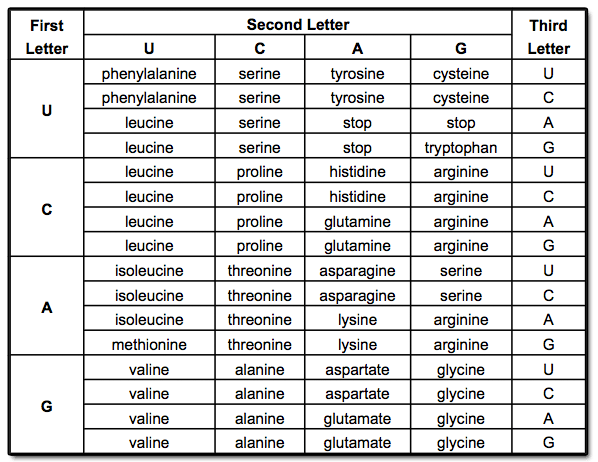
Match the correct process and product with the diagrams below.
Transcription; mRNA
Translation; Protein
Replication; identical DNA strands
Transcription; mRNA
Translation; Protein
Replication; identical DNA strands
Show answer
Auto Play
Slide 1 / 49
SLIDE

Similar Resources on Wayground
44 questions
Unit 2-2 Rocks, Weathering, Erosion, & Soil
Presentation
•
9th - 12th Grade
46 questions
Matrices; 11.2
Presentation
•
9th - 12th Grade
44 questions
4.7 Greenhouse Gases & Global Warming
Presentation
•
9th - 12th Grade
46 questions
ACT Charts & Graphs
Presentation
•
9th - 12th Grade
46 questions
Mr. Bradley' pH Acids and Bases Lesson
Presentation
•
9th - 12th Grade
45 questions
Unit 7 Cell cycle and DNA Replication
Presentation
•
9th - 12th Grade
45 questions
Synthetic Materials Tutorial
Presentation
•
9th - 12th Grade
42 questions
Lab Equipment
Presentation
•
8th - 12th Grade
Popular Resources on Wayground
20 questions
STAAR Review Quiz #3
Quiz
•
8th Grade
20 questions
Equivalent Fractions
Quiz
•
3rd Grade
6 questions
Marshmallow Farm Quiz
Quiz
•
2nd - 5th Grade
20 questions
Main Idea and Details
Quiz
•
5th Grade
20 questions
Context Clues
Quiz
•
6th Grade
20 questions
Inferences
Quiz
•
4th Grade
19 questions
Classifying Quadrilaterals
Quiz
•
3rd Grade
12 questions
What makes Nebraska's government unique?
Quiz
•
4th - 5th Grade
Discover more resources for Science
46 questions
Unit 4 Geosphere Test Review
Quiz
•
9th - 12th Grade
25 questions
Naming Ionic and Covalent Compounds
Quiz
•
9th Grade
20 questions
Human Impact on the Environment Review #2
Quiz
•
9th Grade
16 questions
Ecosystem Stability
Quiz
•
9th Grade
20 questions
Mendelian Genetics Review
Quiz
•
9th Grade
12 questions
Unit 6 Quiz #3 (Life Cycles of Stars)
Quiz
•
9th Grade
34 questions
Human Impact on Ecosystems Quiz
Quiz
•
9th Grade
10 questions
Exploring Alfred Wegener's Continental Drift Theory
Interactive video
•
6th - 10th Grade